A Black Coral Off Hawaii Was Dated at About 4,265 Years Old Page 4

A second clock in the Gulf
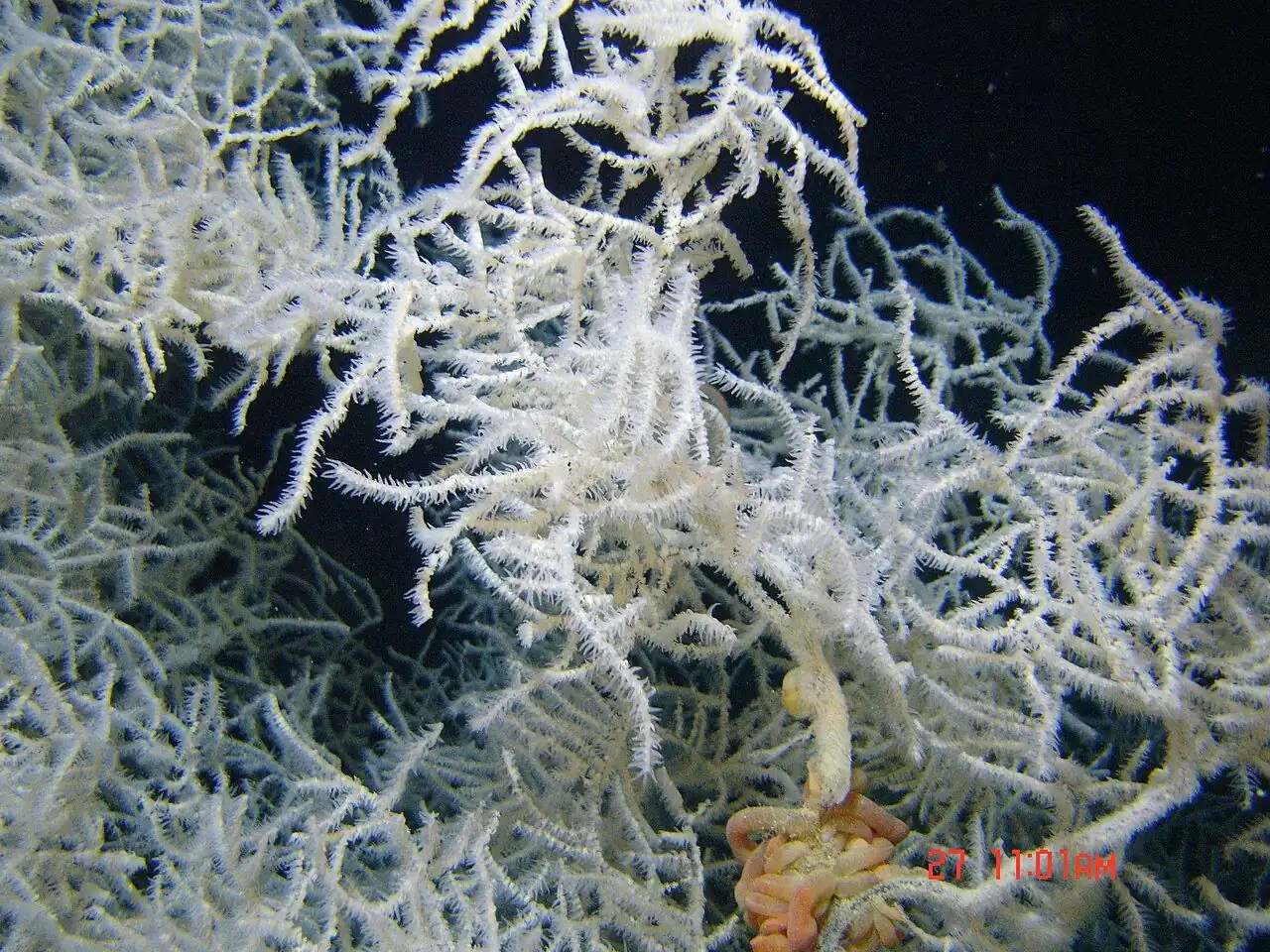
Between 2003 and 2009, scientists collected black corals at two sites on the upper De Soto Slope in the Gulf of Mexico. A team led by Nancy Prouty of the US Geological Survey, with Roark among the co-authors, dated them.
The oldest Leiopathes, from about 300 meters (roughly 1,000 feet) down, had been growing for at least 2,000 years. The Gulf black corals added 8 to 22 micrometers a year, faster than their Hawaiian cousins but still slower than almost anything you could watch.
Under a scanning electron microscope, the team counted fine growth rings in the skeleton. According to their 2011 paper, the ring counts agreed well with the radiocarbon ages, a sign that these black corals lay down one ring a year.
In April 2010, the Deepwater Horizon oil spill reached deep coral communities in the Gulf. Researchers found corals coated in fluffy material, with bare skeleton, heavy mucus and sloughing tissue.
Prouty and colleagues later dated octocorals, a different group from black corals, collected in 2010 and 2011 from the area the spill had hit. At a site about 11 kilometers (7 miles) southwest of the spill, the oldest specimens pointed to life spans of more than 600 years for Paramuricea biscaya, the most common coral in the region.
Sources
- Roark et al. (2009), Extreme longevity in proteinaceous deep-sea corals, PNAS
- Roark et al. (2006), Radiocarbon-based ages and growth rates of Hawaiian deep-sea corals, Marine Ecology Progress Series
- Prouty et al. (2011), Growth rate and age distribution of deep-sea black corals in the Gulf of Mexico, Marine Ecology Progress Series
- Prouty et al. (2016), Growth rates and ages of deep-sea corals impacted by the Deepwater Horizon oil spill, Deep-Sea Research Part II
Spotted an error? Tell us and we will fix it and note the change.
3 strange things from the deep
One short email a week with the strangest true ocean stories we found. Free. Unsubscribe any time.
See our privacy policy.