Twilight Zone · 200–1,000 m
A Black Coral Off Hawaii Was Dated at About 4,265 Years Old
Radiocarbon dating of deep corals collected by submersible off Oahu found black coral and gold coral colonies thousands of years old.
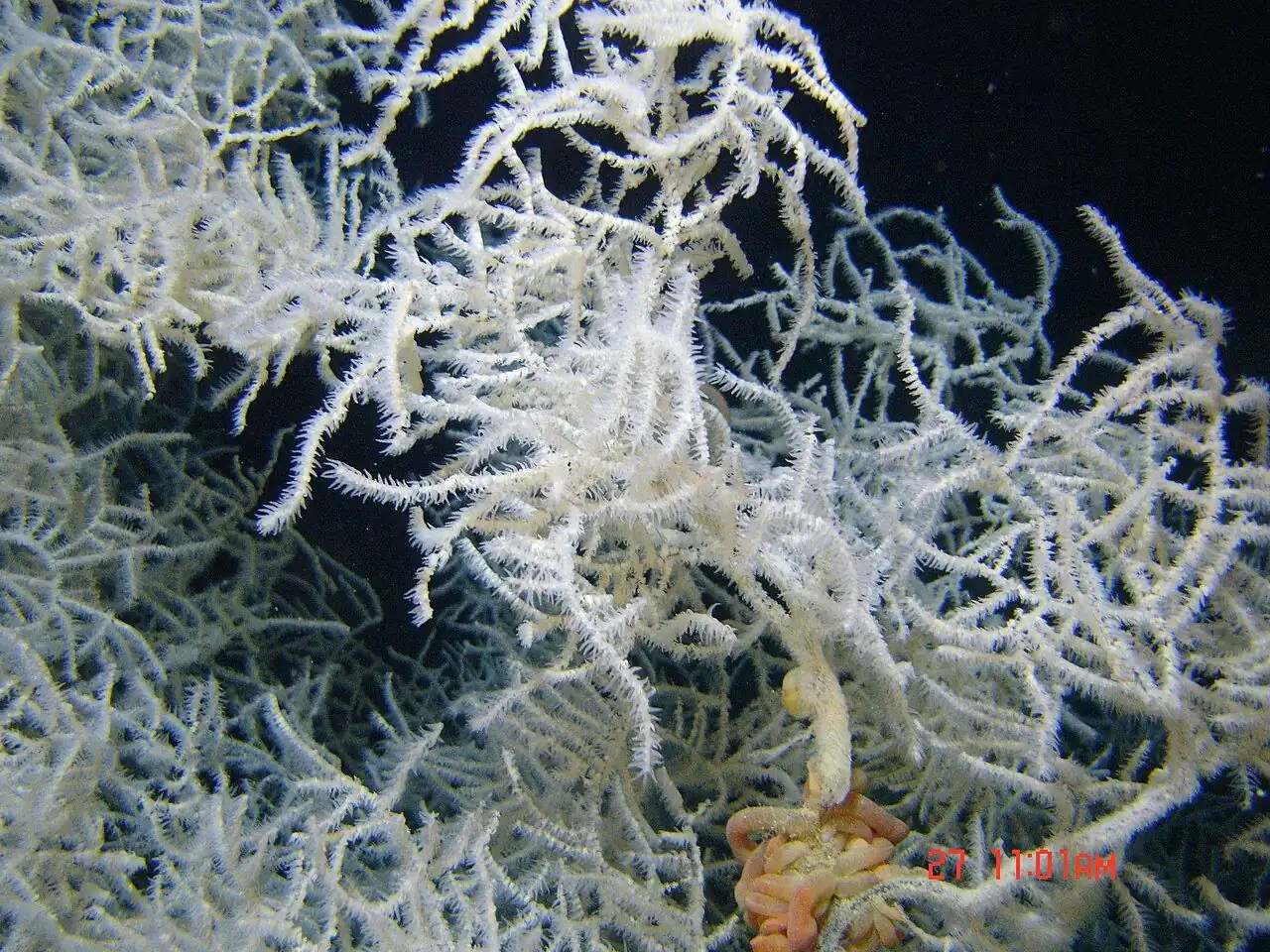
Leiopathes spp.
Slow-growing deep-sea corals with a dark protein skeleton. One Hawaiian colony was radiocarbon-dated at about 4,265 years old.
Photo: Lophelia II 2008: Deepwater Coral Expedition: Reefs, Rigs, and Wrecks / Public domain
A dark, tough skeleton made of protein gives black corals their name, even though the living tissue of Leiopathes can be white or bright orange. Leiopathes is the only genus in its family. Its colonies grow as branching trees or fans 1 meter (3 feet) or more tall. Like other black corals, they are suspension feeders: the polyps catch food from the passing water, and radiocarbon in the skeleton shows that the carbon comes mainly from organic particles sinking from the surface.
Black corals live in all oceans, usually deeper than 30 meters (100 feet). The Leiopathes colonies that have been dated came from around 400 meters (1,300 feet) off Hawaii and about 300 meters (1,000 feet) on the De Soto Slope in the Gulf of Mexico, and Leiopathes glaberrima also grows in the Mediterranean.
They grow extremely slowly. In 2009 Brendan Roark and colleagues reported that the base of one Hawaiian colony had been growing for 4,265 years, by radiocarbon dating, with skeleton added at less than 5 micrometers a year. In the Gulf of Mexico, a team led by Nancy Prouty of the US Geological Survey found a Leiopathes at least 2,000 years old, growing 8 to 22 micrometers a year, and growth rings counted under an electron microscope matched the radiocarbon ages, a sign that the coral lays down one ring a year. Individual polyps live only a few years, while the colony goes on for millennia.
News coverage and many later accounts call the old Hawaiian coral Leiopathes glaberrima. In 2015 Daniel Wagner and Dennis Opresko assigned the Hawaiian Leiopathes, previously identified as L. glaberrima or as an unnamed Leiopathes, to a new species, Leiopathes annosa, with tall, fan-shaped colonies that are bright orange when alive.
Deep-sea corals are harvested for jewelry and damaged by deep-water fishing, and the 2009 study's authors called for international conservation strategies that take their great age into account. We found no global IUCN assessment for Leiopathes, but a 2015 regional assessment listed L. glaberrima as Endangered in the Mediterranean.