A Deep-Sea Glass Sponge May Have Lived for About 11,000 Years Page 4

The sponges on the gangplank
In 1960, the gangplank was dropped from a ship near McMurdo Station, a US research base in Antarctica. It came to rest 25 to 30 meters (80 to 100 feet) down. Over the next decades it became an accidental experiment.
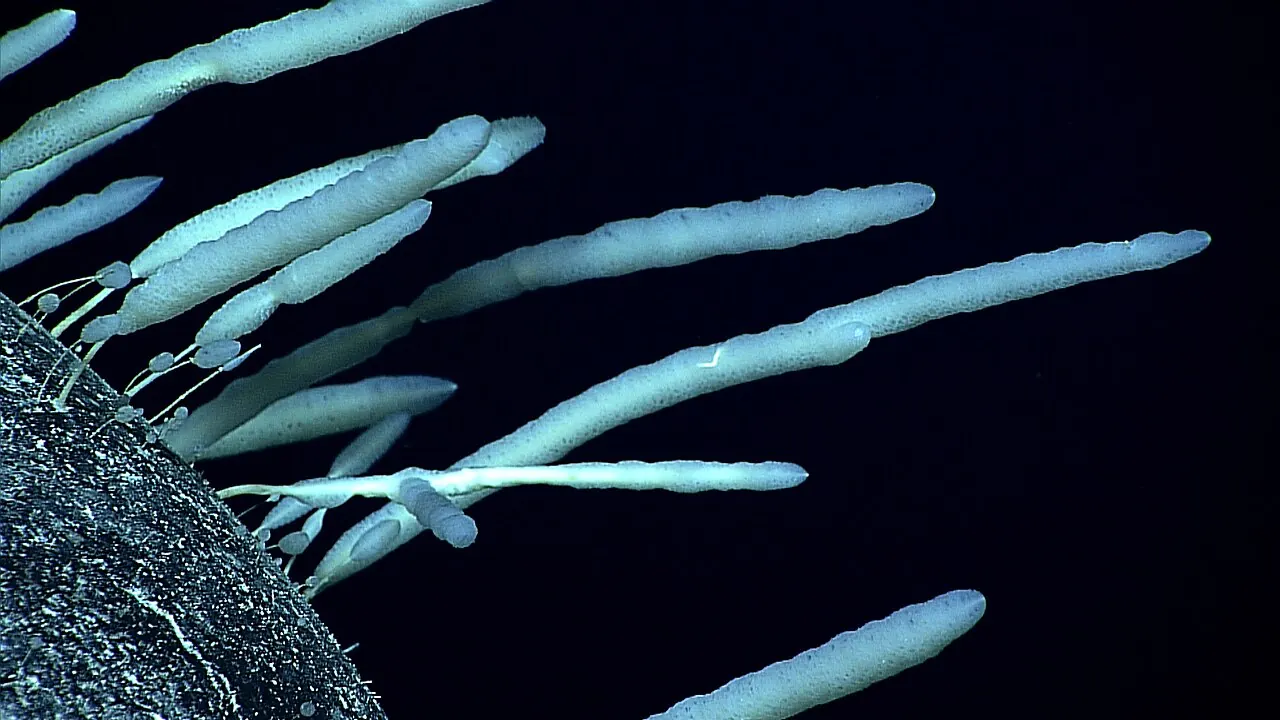
The waters around McMurdo hold giant glass sponges, the same broad group as Monorhaphis. One of them, Anoxycalyx joubini, is shaped like a volcano and can stand 2 meters (about 6.5 feet) tall. Nobody had ever seen it settle or grow. That stillness had led to estimates that the big ones were extremely old.
Paul Dayton of the Scripps Institution of Oceanography in California and his colleagues kept watching. Starting in 1967, researchers there also set out cages, posts and plastic plates as places for animals to settle. For 22 years, no A. joubini settled or grew on any of them. Through 1989, the gangplank stayed bare of glass sponges.
Then the divers came back in 2004 and found A. joubini growing on the gangplank and on structures at Explorers Cove. By 2010, they counted 19 on the gangplank alone. The biggest weighed more than 76 kilograms (about 168 pounds), as much as a grown man, all grown in no more than about two decades.
The team tied the timing to a shift in the plankton after giant icebergs grounded in the region in the 2000s.
None of that disproves the 11,000-year age of the East China Sea spicule. A. joubini is a different species in a different ocean, and its age was judged a different way.
Sources
- Jochum et al. (2012), Siliceous deep-sea sponge Monorhaphis chuni: A potential paleoclimate archive in ancient animals, Chemical Geology
- Max Planck Society (2012), Glass sponge as a living climate archive
- Jochum et al. (2017), Whole-Ocean Changes in Silica and Ge/Si Ratios During the Last Deglacial Deduced From Long-Lived Giant Glass Sponges, Geophysical Research Letters
- Dayton et al. (2013), Recruitment, Growth and Mortality of an Antarctic Hexactinellid Sponge, Anoxycalyx joubini, PLOS ONE
Spotted an error? Tell us and we will fix it and note the change.
3 strange things from the deep
One short email a week with the strangest true ocean stories we found. Free. Unsubscribe any time.
See our privacy policy.