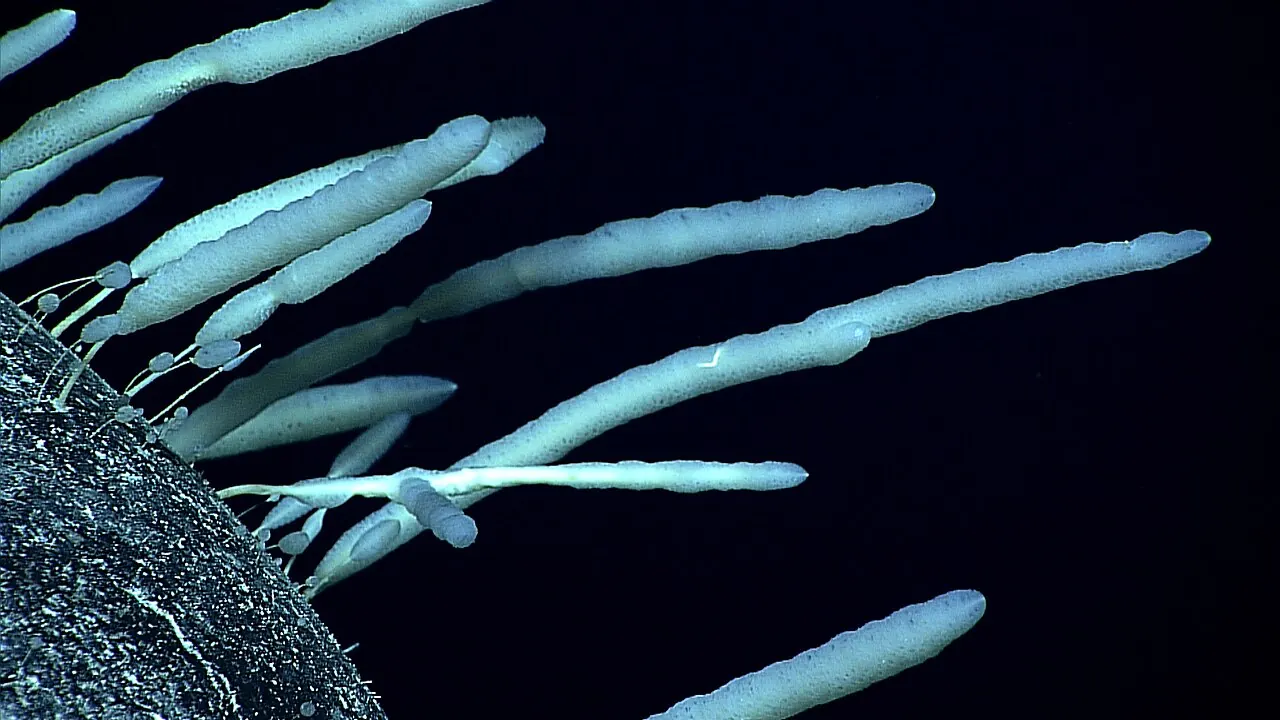
A deep-sea glass sponge anchored by one glass rod up to 3 m long. One spicule was estimated to have been growing for about 11,000 years.
Photo: NOAA Office of Ocean Exploration and Research, 2015 Hohonu Moana / Public domain
Share
3 things to know
Its anchoring spicule is the largest silica structure made by any living thing.
The spicule grows in thin glass layers about 10 micrometers thick, like tree rings.
Its glass spicules carry light along their length, like optical fibers.
Scientific name
Monorhaphis chuni
Depth
500 m – 2,000 m 1,640 – 6,562 ft
Size
Up to about 3 m (10 ft) tall, on a single glass spicule up to 3 m long and 1 cm (0.4 in) thick
Weight
Unknown
Lifespan
Not well known; one spicule was estimated to have been growing for about 11,000 years
Diet
Food particles filtered from seawater
Where
Muddy deep seafloor of the Indo-West Pacific
IUCN status
No IUCN assessment found
Depth zones
Twilight · Midnight
A single giant spicule, a glass rod up to 3 meters (10 feet) long and about 1 centimeter (0.4 inch) thick, anchors Monorhaphis chuni in the seafloor mud. This glass sponge is one of the hexactinellids, which build their skeletons from silica. The soft body wraps around the upper part of the rod. As the sponge grows, the body dies back at the base and leaves bare glass behind. Researchers have called the rod the largest biological silica structure on Earth.
F. E. Schulze described the species from material collected by Germany's Valdivia deep-sea expedition of 1898 and 1899. It lives on muddy bottoms in the Indo-West Pacific, at depths of roughly 500 to 2,000 meters (1,600 to 6,600 feet). Spicules studied in recent years came from the East China Sea, from near New Caledonia, from the Mozambique Channel and from off northwestern Australia.
Like other sponges, it feeds by filtering. Seawater moves through a system of canals in the soft tissue, which strains out particles of food. How it reproduces is not well known, and we found no IUCN Red List assessment for the species.
The giant spicule grows outward in concentric layers about 10 micrometers thick, up to around 800 of them, a little like the rings of a tree. The glass also carries light along its length, much like an optical fiber.
Those layers made the rod a target for dating. In 2012 a team led by Klaus Peter Jochum of the Max Planck Institute for Chemistry analyzed a spicule more than 2 meters long, found in 1986 at about 1,100 meters (3,600 feet) down in the East China Sea. Working from the isotopes and trace elements in its glass, they estimated that it had been growing for about 11,000 years, and the Max Planck Society called it among the longest-living animals known. The estimate comes from one specimen, and it rests on matching the sponge's chemical record to past changes in ocean temperature.