Deepest Known Explosive Eruption Rocks Found Near the Challenger Deep Page 3

Eruptions Under Crushing Pressure
On land, an explosive eruption is driven by gas. Water dissolved in magma turns to steam as the magma rises, expands enormously and blasts the rock apart. Deep in the ocean the water above pushes back.
Below about 2,200 meters (roughly 7,200 feet), the pressure is past the point where water can exist as separate liquid and gas. The authors think the water leaving this magma was a supercritical fluid, which behaves partly like each. They calculate that at these conditions, supercritical water takes up only about 3 percent of the space the same amount of water would fill as steam at sea level.
Less expansion should mean a gentler blast. The team's hypothesis is that these hadal eruptions were much less explosive than their land cousins, so the fragments mixed less with cold seawater and kept their heat. That would explain why the flows welded themselves into hard slabs. "We are still studying this phenomenon and trying to understand it," Stern said.
Much is still unknown. The team has not found the vents that produced the flows. Because the flows ran downslope, the vents must sit higher up, along or south of a ridgeline 40 to 100 kilometers north of the trench. The rock compositions are still being analyzed.
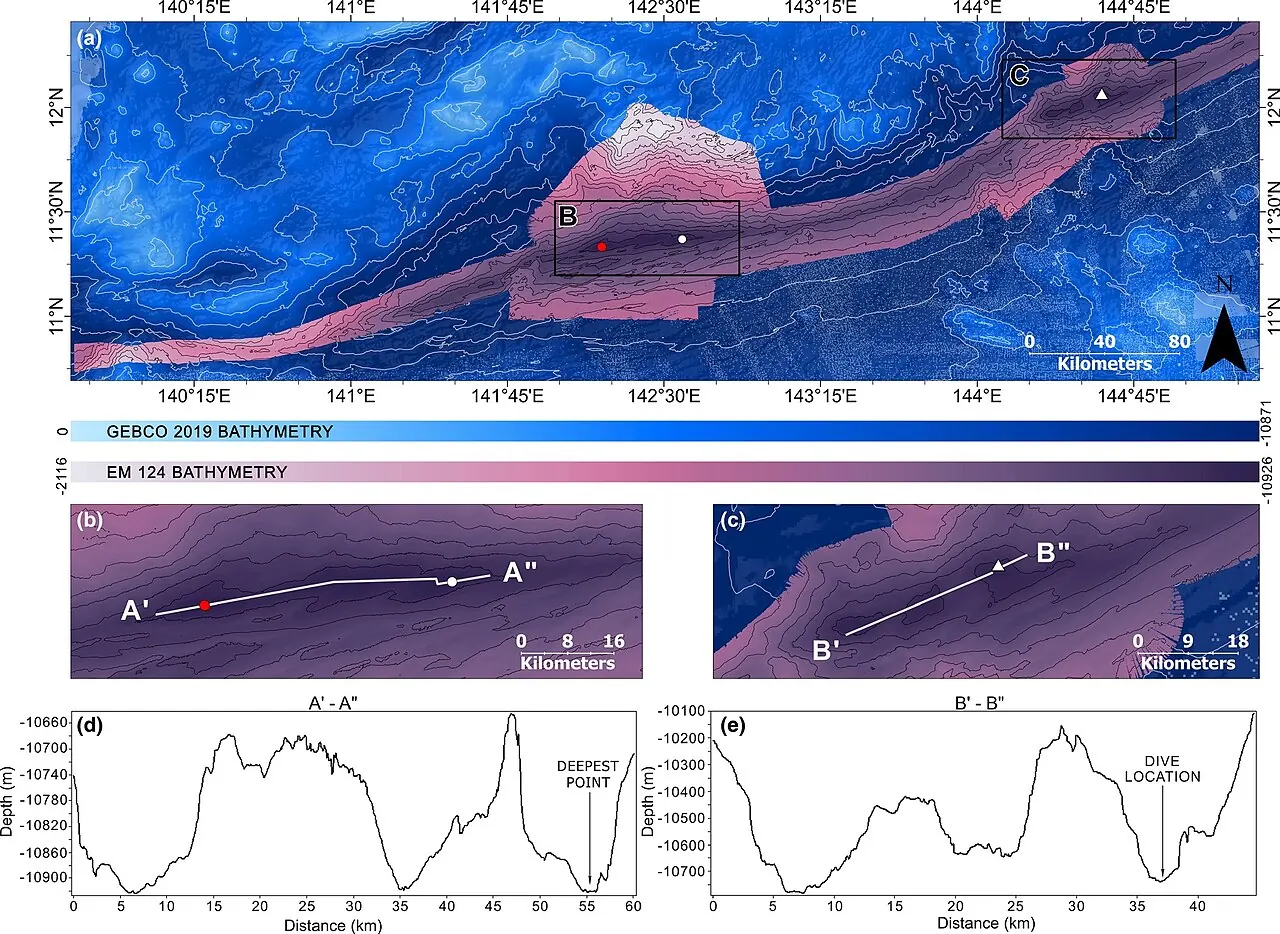
The rocks also help with the cruise's original question. The deepest part of the trench, the Challenger Deep, reaches 10,935 meters (about 35,900 feet). The authors list several causes for that depth, including a narrow, steeply bending piece of the Pacific Plate sinking beneath it.
Jason could not go below 6,500 meters, leaving the lower 4 kilometers of slope unsampled. The paper says the only ways to reach those depths are dredging and crewed ultra-deep submersibles, naming the private US sub Limiting Factor and China's Fendouzhe.
Sources
- Stern et al. (2026), ROVing in the deep: tectonic and magmatic complexities of the Challenger Deep forearc segment, Southern Mariana convergent margin, Frontiers in Earth Science
- Frontiers (2026), Robot submarine exploring world's deepest ocean trench finds unprecedented volcanic activity
- Woods Hole Oceanographic Institution, National Deep Submergence Facility: ROV Jason
- Greenaway et al. (2021), Revised depth of the Challenger Deep from submersible transects; including a general method for precise, pressure-derived depths in the ocean, Deep Sea Research Part I
Spotted an error? Tell us and we will fix it and note the change.
3 strange things from the deep
One short email a week with the strangest true ocean stories we found. Free. Unsubscribe any time.
See our privacy policy.