Three Out of Four Deep-Sea Animals Make Their Own Light Page 4

Mostly blue, and a century in the making
Most of the ocean's living light is blue or blue-green. Those colors travel furthest through seawater, and many deep-sea animals can only see blue light.
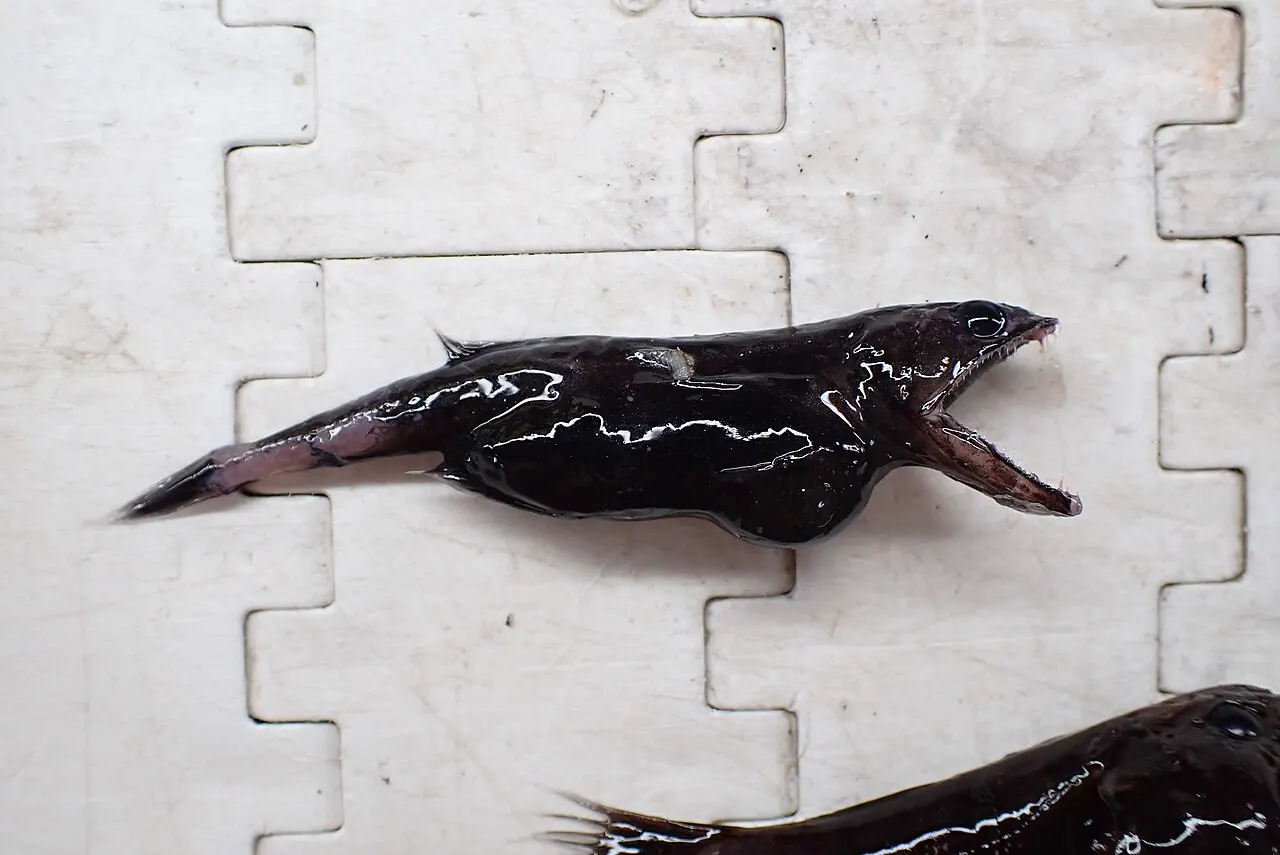
There are exceptions. A few deep-sea dragonfish make red light, which most of their prey can't see. They use it like a hidden searchlight to spot food without being noticed.
The chemistry behind most of the glow is similar: a light-making molecule reacts with oxygen with the help of an enzyme. Animals have evolved the ability again and again, separately, dozens of times, from bacteria all the way up to fish. Chemists later borrowed those molecules as glowing tags for genes and cells, work tied to a Nobel Prize.
Getting from wonder to a hard number took most of a century:
- 1934: William Beebe and Otis Barton make their record bathysphere dive, sealed in a steel ball half a mile under the sea, and humans finally watch deep-sea animals where they live.
- 2010: a sweeping review pulls decades of scattered finds into one picture: light-making turns up all across the ocean's tree of life, from bacteria to fish.
- 2017: Martini and Haddock attach the number: 76%.
Researchers at MBARI and elsewhere still find new light tricks on nearly every deep dive, and many are hard to study because the animals rarely survive the trip to the surface. The next job is the untested animals, the silent 2 to 43%, one species at a time.
Sources
- Martini & Haddock (2017), Quantification of bioluminescence from the surface to the deep sea demonstrates its predominance as an ecological trait, Scientific Reports
- Widder (2010), Bioluminescence in the ocean: origins of biological, chemical, and ecological diversity, Science
- Haddock et al. (2010), Bioluminescence in the Sea, Annual Review of Marine Science
- NOAA Ocean Explorer, Beebe and Barton bathysphere anniversary log (2005)
Spotted an error? Tell us and we will fix it and note the change.