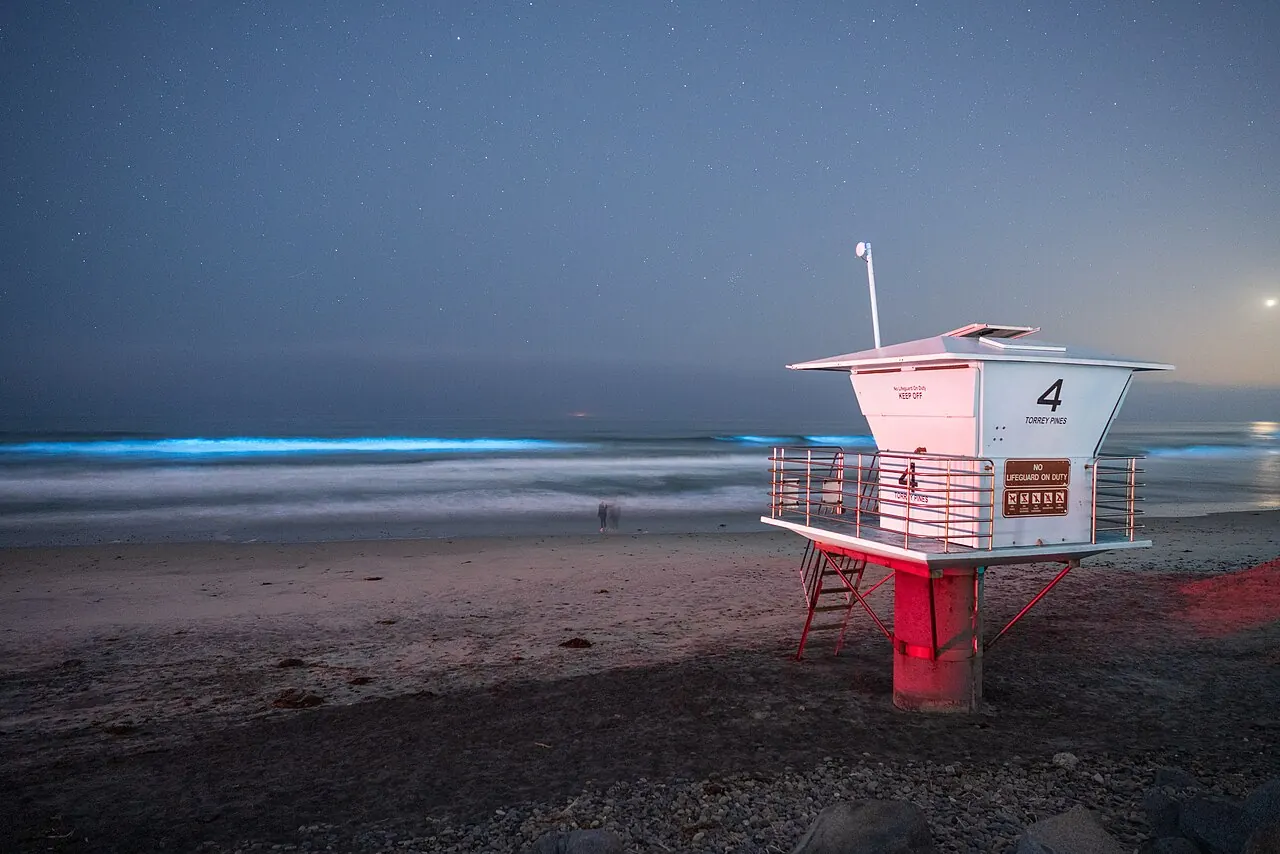
Midnight Zone · 1,000–4,000 m
Three Out of Four Animals in the Open Ocean Make Their Own Light
Below where sunlight reaches, the ocean is still full of light, and the animals make it themselves.
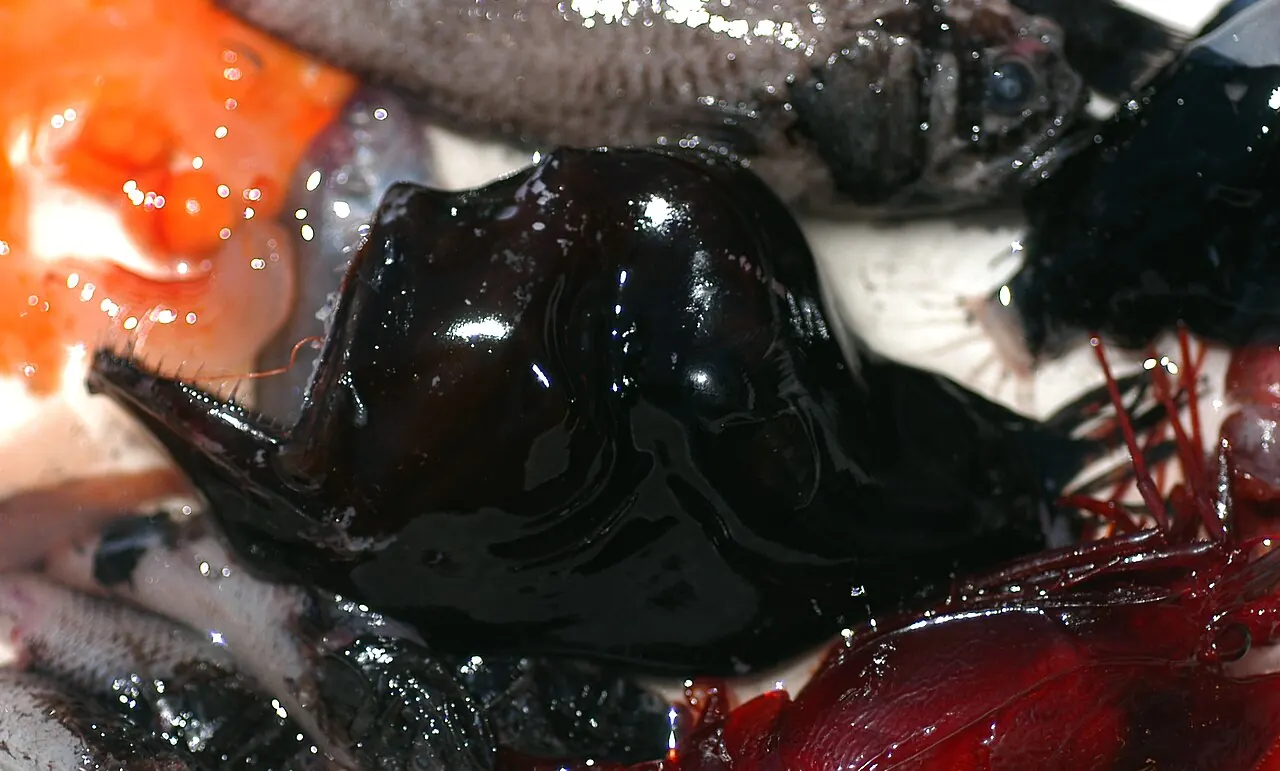
Melanocetus johnsonii
A small, fearsome-looking deep-sea fish that fishes for its food with a glowing lure.
Photo: Personnel of NOAA Ship DELAWARE II / Public domain
A female humpback anglerfish is a soft, black, nearly round fish no longer than about 18 centimeters (7 inches), with a huge mouth that opens almost vertically and long, pointed teeth. A spine on her snout carries a bulb called the esca, and the esca glows. The light comes from bacteria living in it. A 2019 study led by Lydia Baker found that many kinds of deep-sea anglerfish share the same luminous bacteria and pick them up from the surrounding water, instead of inheriting them.
It lives in open water across the tropical and temperate oceans, usually between 100 and 1,500 meters (330 and 4,900 feet) down, and has been recorded as deep as 4,500 meters (14,800 feet). Its larvae drift mostly in the top 100 meters. The female hunts by waiting for food to come to her, and she can swallow meals larger than herself: FishBase records a 6.6-centimeter specimen in New Zealand's national museum collection with a viperfish about 24 centimeters long in its stomach.
Males are dwarfs, less than 3 centimeters (1.2 inches) long, with no lure but large eyes and nostrils that may help them find a female far away. In some deep-sea anglerfish the male fuses to the female for life, but not in this genus. Theodore Pietsch, reviewing anglerfish reproduction in 2005, counted only two known cases of a Melanocetus male attached to a female, both temporary couplings: the males live free and never become parasites.
Seeing one alive is rare. On November 17, 2014, a team from the Monterey Bay Aquarium Research Institute led by Bruce Robison filmed a female with the remotely operated vehicle Doc Ricketts about 580 meters (1,900 feet) down in Monterey Canyon, off California. MBARI said it was the first time scientists had filmed this species, and the video showed the glowing lure at the tip of the fish's "fishing pole."
Nobody fishes for the humpback anglerfish, though it can turn up as bycatch in deep-sea trawls. The IUCN lists it as Least Concern, in an assessment from 2013.



