Put Mount Everest in the Mariana Trench and It Would Still Be a Mile Underwater Page 4

The bottom is not dead
In 2009, Japanese researchers pulled up traps full of amphipods, shrimplike scavengers 2 to 5 centimeters (1 to 2 inches) long, from about 10,900 meters. In 2011, Scripps Institution of Oceanography cameras filmed xenophyophores, giant single-celled organisms, at 10,641 meters in the nearby Sirena Deep. A 2013 study by Ronnie Glud and colleagues found that the mud of the Challenger Deep used oxygen about twice as fast as mud at a 6,000-meter site nearby, likely because more food settles on the trench floor. The deepest hole in the ocean is, oddly, a well-fed one.
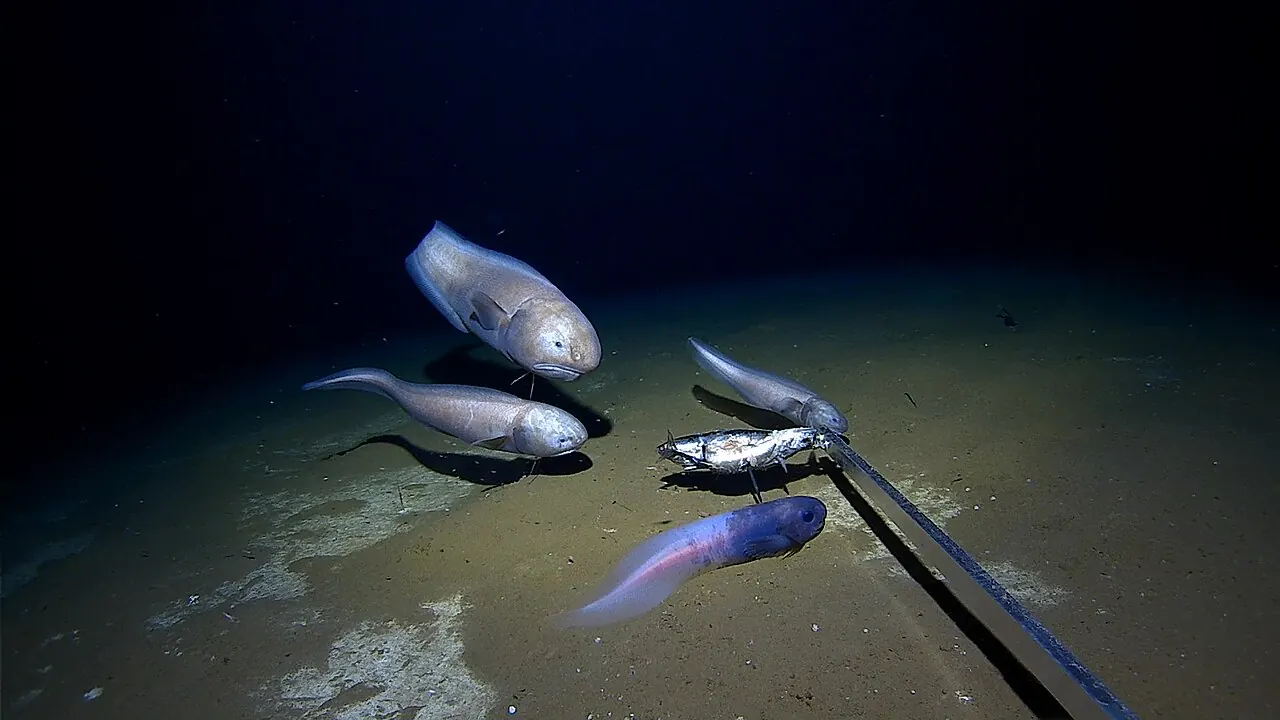
No fish has been seen anywhere near the bottom. The deepest fish ever filmed, a snailfish, was swimming at 8,336 meters in a trench off Japan. That leaves more than 2 kilometers of water below the deepest known fish, a floor the scavengers and single cells apparently have to themselves.
Much of the trench lies in US waters. In January 2009, President George W. Bush created the Marianas Trench Marine National Monument, about 95,216 square miles, larger than Minnesota. Its Trench Unit protects the seafloor out to the southern edge of US waters off Guam. The Challenger Deep itself lies beyond that line: the US Interior Department places it in the exclusive economic zone of the Federated States of Micronesia.
Sources
- Greenaway et al. (2021), Revised depth of the Challenger Deep from submersible transects; including a general method for precise, pressure-derived depths in the ocean, Deep Sea Research Part I
- Dziak et al. (2017), Ambient Sound at Challenger Deep, Mariana Trench, Oceanography
- NOAA National Centers for Environmental Information, Mariana Trench and the Challenger Deep
- NOAA Fisheries, Mariana Trench Marine National Monument
- Bongiovanni, Stewart & Jamieson (2021), High-resolution multibeam sonar bathymetry of the deepest place in each ocean, Geoscience Data Journal
Spotted an error? Tell us and we will fix it and note the change.