A Shark Swimming Today May Have Been Born Before Shakespeare Page 4

Slow life in cold water
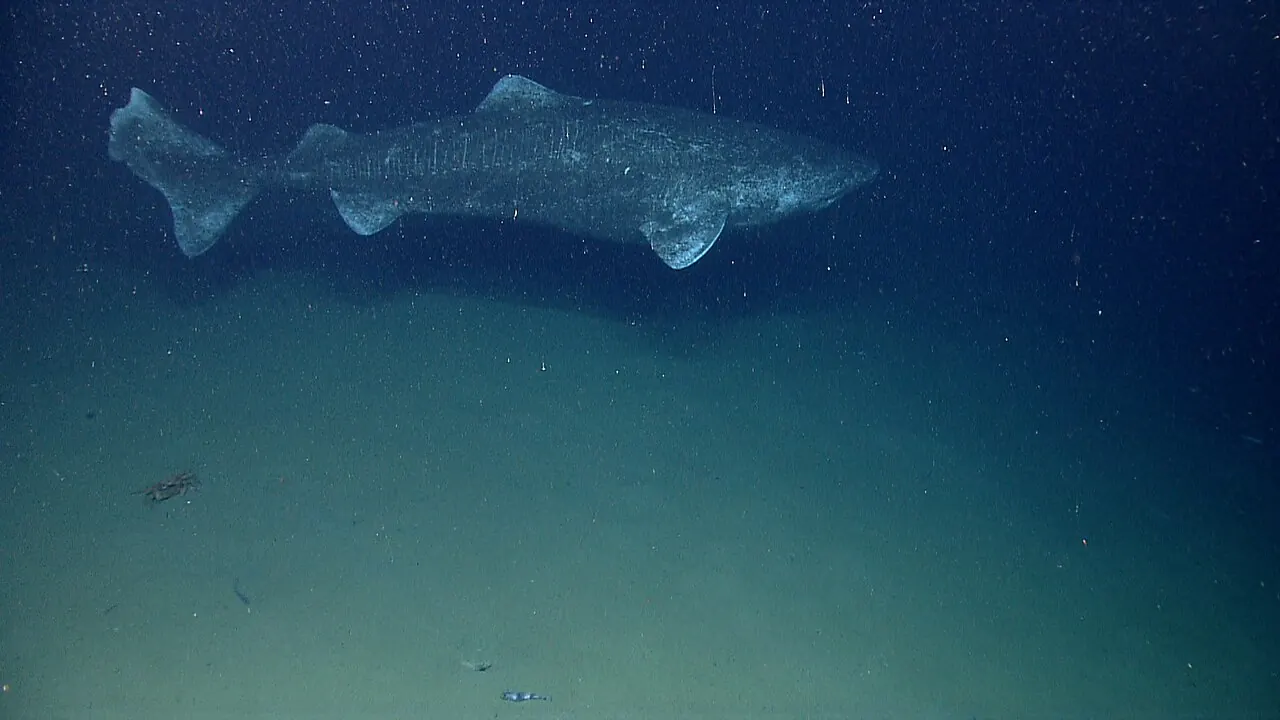
Everything about the Greenland shark is slow. It lives in water near freezing, often hundreds of meters deep, where a slow metabolism makes sense. When a Japanese-led team fitted six free-swimming sharks with data loggers, the tags clocked a cruising speed of 0.34 meters per second, about 1.2 kilometers (0.8 miles) per hour, with the tail swinging through a full beat only about once every seven seconds. For its size, it is the slowest fish ever measured.
That created a puzzle, because the shark is no picky eater. Studies of stomach contents off Greenland found plenty of fish and also seals. How does a shark this slow catch a seal? The tagging team ran the numbers: it can't, not in open pursuit. Arctic seals sleep in the water to avoid polar bears, and the leading idea is that the shark ambushes them mid-nap. Some of what it eats is certainly scavenged.
That extreme slowness is also a weakness. An animal that takes a century and a half to breed can't easily recover from losses. Many Greenland sharks die as accidental catch in fishing nets, and the species is listed as Vulnerable by the IUCN.
Somewhere in the Arctic right now, a shark that was already old when your great-grandparents were born is still slowly swimming. Researchers hope it keeps going a while longer. Sharks are good at the long game; as a group, they have been around longer than trees.
Sources
- Nielsen et al. (2016), Eye lens radiocarbon reveals centuries of longevity in the Greenland shark, Science
- Nielsen et al. (2014), Distribution and feeding ecology of the Greenland shark in Greenland waters, Polar Biology
- Watanabe et al. (2012), The slowest fish: Swim speed and tail-beat frequency of Greenland sharks, Journal of Experimental Marine Biology and Ecology
- Discover Magazine (2016), Yes, Some Greenland Sharks Are Old, But 400 Years Old?
Spotted an error? Tell us and we will fix it and note the change.