Twilight Zone · 200–1,000 m
A Shark Swimming Today May Have Been Born Before Shakespeare
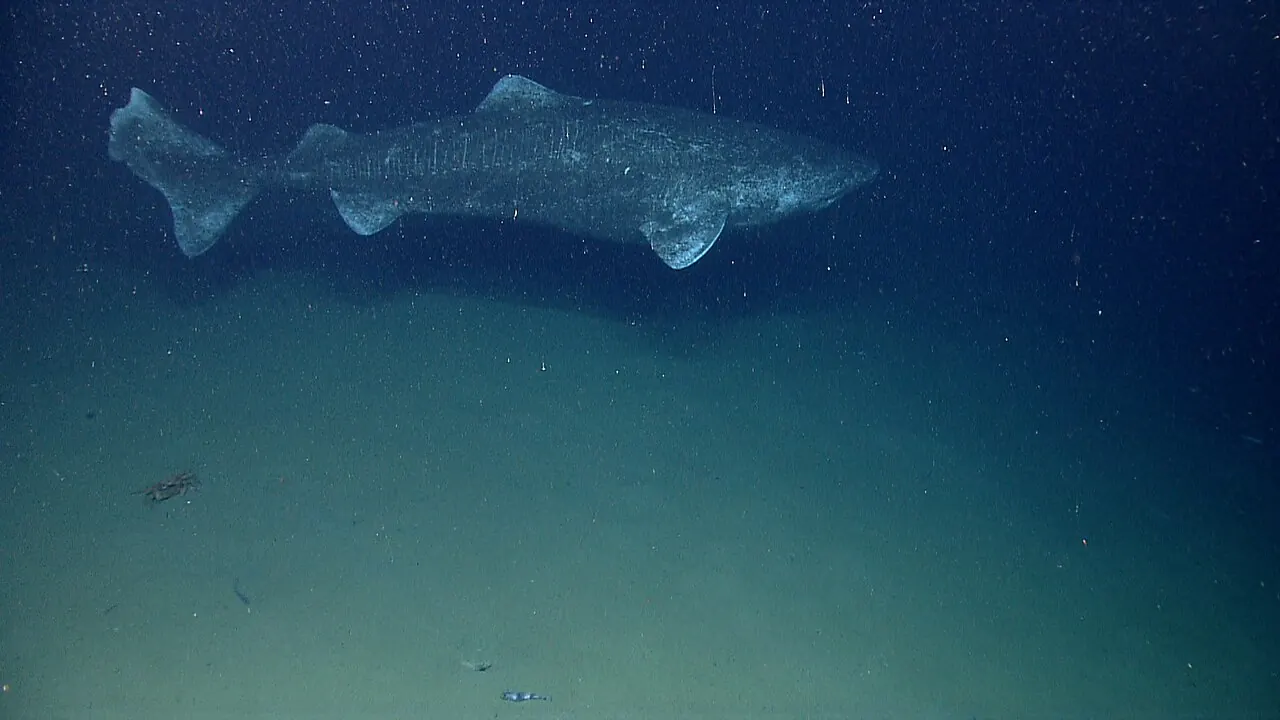
Greenland sharks grow about a centimeter a year and may live for centuries. One was estimated to be around 400 years old.
Somniosus microcephalus
The longest-lived vertebrate known to science, a slow-moving giant of the cold North Atlantic and Arctic.
Photo: NOAA Photo Library / Public domain
Gray or brown and heavy-bodied, the Greenland shark is one of the biggest sharks in the sea, commonly 2.4 to 4.3 meters (8 to 14 feet) long and able to pass 6 meters (20 feet). It has a short, rounded snout, small, low dorsal fins, small pointed teeth in the upper jaw and slicing teeth in the lower one. Many carry a copepod, Ommatokoita elongata, that attaches itself to the shark's eyes. Its fresh flesh is said to be toxic, which has been blamed on high levels of a compound called trimethylamine N-oxide.
According to NOAA's National Ocean Service, it is the only shark that can withstand Arctic waters year-round. It ranges across the North Atlantic, usually in water below 5°C (41°F). In the colder months it comes into shallow bays and river mouths, even to the surface, and when the water warms it retreats to 180 to 550 meters (590 to 1,800 feet). It is found down the continental slopes to at least 1,200 meters (3,900 feet) and has been recorded as deep as 2,200 meters. A NOAA remotely operated vehicle exploring canyons off New England met one 783 meters (2,569 feet) down.
Its top speed is under 2.9 kilometers (1.8 miles) an hour, yet its diet includes herring, salmon, cod, halibut, skates, seals, small whales, seabirds and squid. Some of that is scavenged. Greenland sharks are drawn to the smell of rotting meat and have been found with reindeer and moose remains inside.
Its age is what made it famous. In 2016 Julius Nielsen of the University of Copenhagen and colleagues radiocarbon-dated the eye lenses of 28 females. Only sharks 220 centimeters long or shorter carried the carbon spike from 1960s bomb tests, and the largest, at 502 centimeters, came out at 392 years old, give or take 120. That makes the minimum lifespan 272 years, the longest known for any vertebrate, and puts sexual maturity at no less than about 156 years.
An animal that takes that long to grow up cannot quickly replace losses. Greenland sharks were once hunted for their liver oil. Now most of those killed are caught by accident in fishing nets and on lines, about 3,500 a year in the Arctic and Atlantic, and the IUCN lists the species as Vulnerable.



