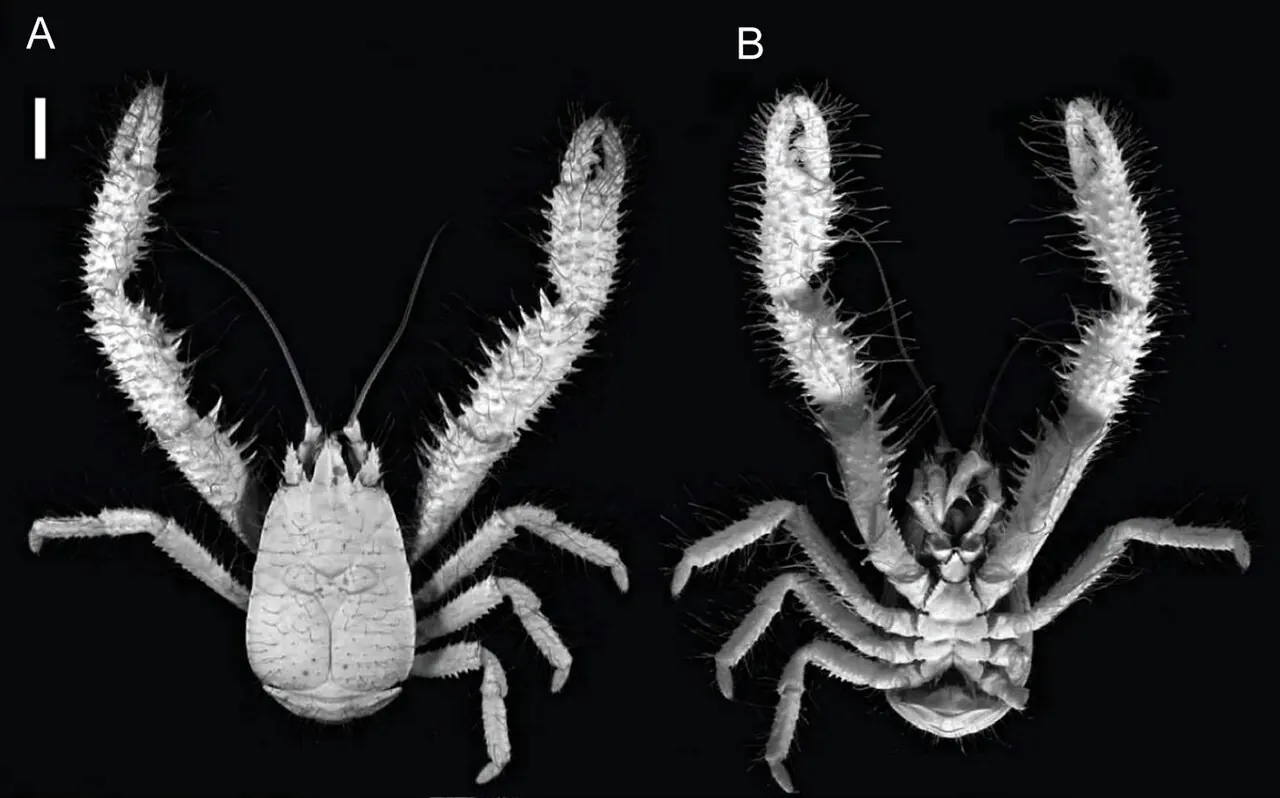
Yeti Crab
Kiwa puravida
A hairy deep-sea crab from Costa Rica's methane seeps that grows bacteria on its arms and combs them off to eat.
Photo: Shane Ahyong, NIWA (Thurber, Jones & Schnabel 2011, PLoS ONE) / CC BY 2.5
3 things to know
- Its main food is bacteria growing on its own hair.
- It sways its claws back and forth through the seeping fluid.
- It was only the second yeti crab species ever named.
- Scientific name
- Kiwa puravida
- Depth
- 1,000 m – 1,040 m
3,281 – 3,412 ft - Size
- Shell up to about 3.9 cm (1.5 in) long, including the rostrum, in the largest male collected
- Weight
- Unknown
- Lifespan
- Unknown
- Diet
- Bacteria that grow on the hairs of its own limbs and body
- Where
- Methane seeps off the Pacific coast of Costa Rica
- IUCN status
- Not Evaluated
- Depth zones
- Midnight
Kiwa puravida is a crab-like crustacean whose long front limbs are covered in thick hair, and the hair is coated in bacteria. It belongs to the yeti crabs, a small family whose nickname comes from those shaggy arms, and it lives on methane seeps about 1,000 meters (3,300 feet) down off the Pacific coast of Costa Rica.
Scientists diving in the submersible Alvin collected the first specimens in 2006 at a seep called Mound 12, between 1,000 and 1,040 meters deep. Andrew Thurber, William Jones and Kareen Schnabel described the species in 2011 and named it after the Costa Rican saying "pura vida," or "pure life." It was only the second yeti crab ever named. The largest male collected had a shell about 3.9 centimeters (1.5 inches) long, including the pointed rostrum between the eyes, and the holotype went to the Smithsonian Institution.
Its food grows on its own body. The bacteria on its hair are chemosynthetic: they make food from chemicals in the seeping fluid instead of from sunlight. Chemical signatures in the crabs' muscle and fats showed that these bacteria are their main food source. One of the crab's mouthparts carries rows of comb-like bristles, and video showed the crabs scraping bacteria off their limbs and bodies and passing them to their mouths.
On the seafloor the crabs swing their claws rhythmically back and forth. Thurber's team suggested the motion washes fresh seep fluid over the bacteria, much as a current refreshes the water around a coral, though the paper presents that as a hypothesis.
Much of its life is still unknown. The one egg-carrying female collected held 88 eggs, each about 1 millimeter across. Its lifespan and weight have not been reported, and it has not been assessed for the IUCN Red List. In the 2011 description, every specimen came from Mound 12 except one from nearby Mound 11. The first yeti crab, Kiwa hirsuta, came from a hydrothermal vent more than 2,200 meters deep, about 6,500 kilometers (4,000 miles) away.