Midnight Zone · 1,000–4,000 m
The Black Swallower Eats Fish Bigger Than Itself, Sometimes Fatally
This 10-inch deep-sea fish has a stomach that stretches like a balloon. Many specimens have been found floating dead with a meal inside.
Chiasmodon niger
A small deep-sea fish that swallows prey longer than itself and sometimes floats to the surface dead, with the meal still inside.
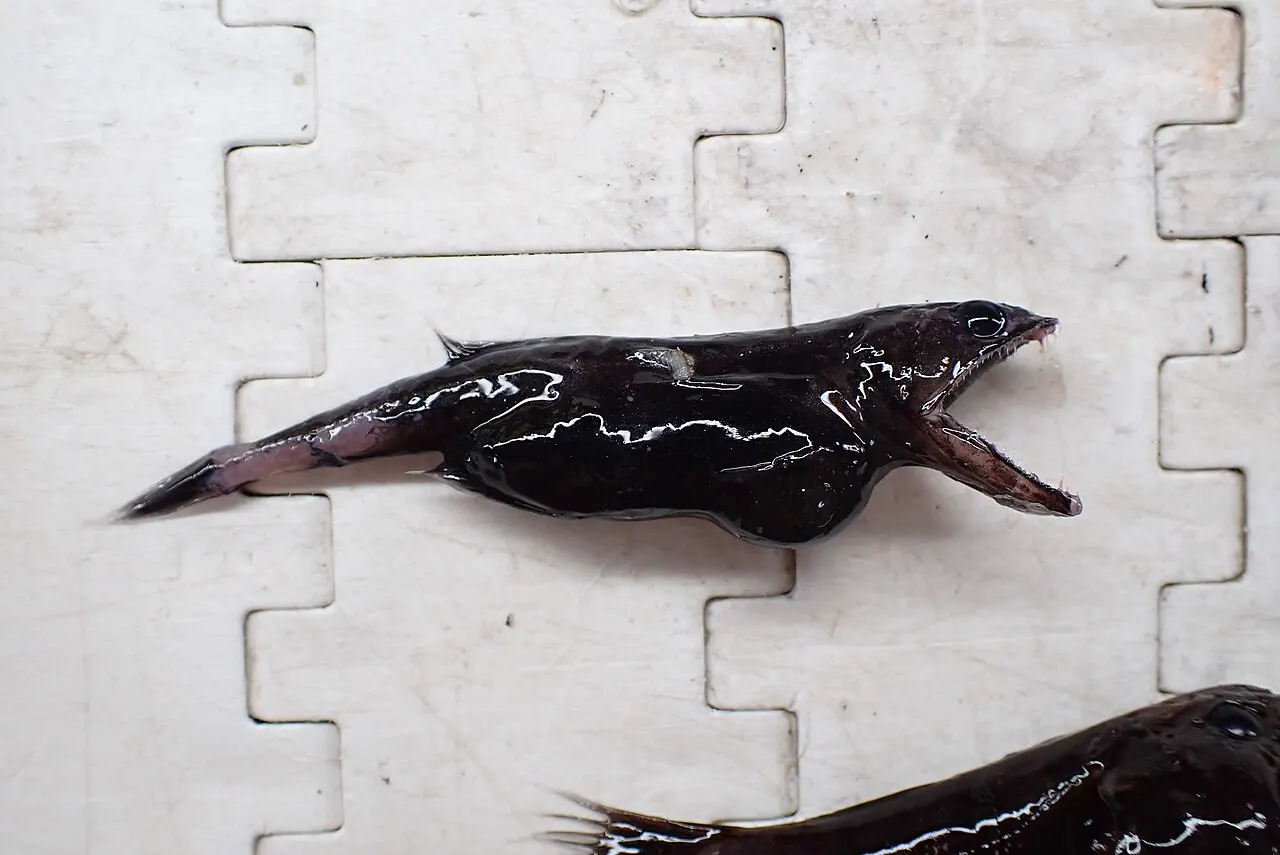
Photo: HulloThere / CC0
A black swallower is mostly mouth and stomach. This small, dark, scaleless fish has a long lower jaw, a wide gape and a belly that stretches like a balloon. The largest specimen on record measured about 25 centimeters (10 inches), according to Woods Hole Oceanographic Institution (WHOI). Its teeth are hooked and point backward. They fold down to let prey slide in, then interlock so it cannot back out.
It lives in open water across the tropical and temperate North Atlantic, including the Gulf of Mexico, and FishBase also lists records off Argentina. Most specimens are caught deeper than 750 meters (2,460 feet), and FishBase gives a depth range of 700 to 2,745 meters. Age changes the address. Catch records compiled by FishBase put juveniles in the top 1,050 meters, averaging 542 meters, while fish longer than 4.5 centimeters average about 1,390 meters (4,560 feet) down.
The menu is other fish, swallowed whole and often longer than the swallower itself. WHOI says it can take prey up to ten times its own weight. On length, WHOI's page gives two limits, twice the swallower's length in one place and four times in another. A meal that big is slow to digest. If it starts to rot first, gas from the decaying prey builds up in the stomach and can carry the swallower to the surface, where it dies. That is how dead specimens have turned up floating with a larger fish inside.
Those floaters shape what anyone knows about the species. Living black swallowers have rarely been seen in their habitat, so most information comes from dead fish and from trawl catches. Little is recorded about how it breeds or how long it lives, and WHOI lists its predators as unknown.
The IUCN Red List rates the black swallower as Least Concern, based on an assessment dated 2014.