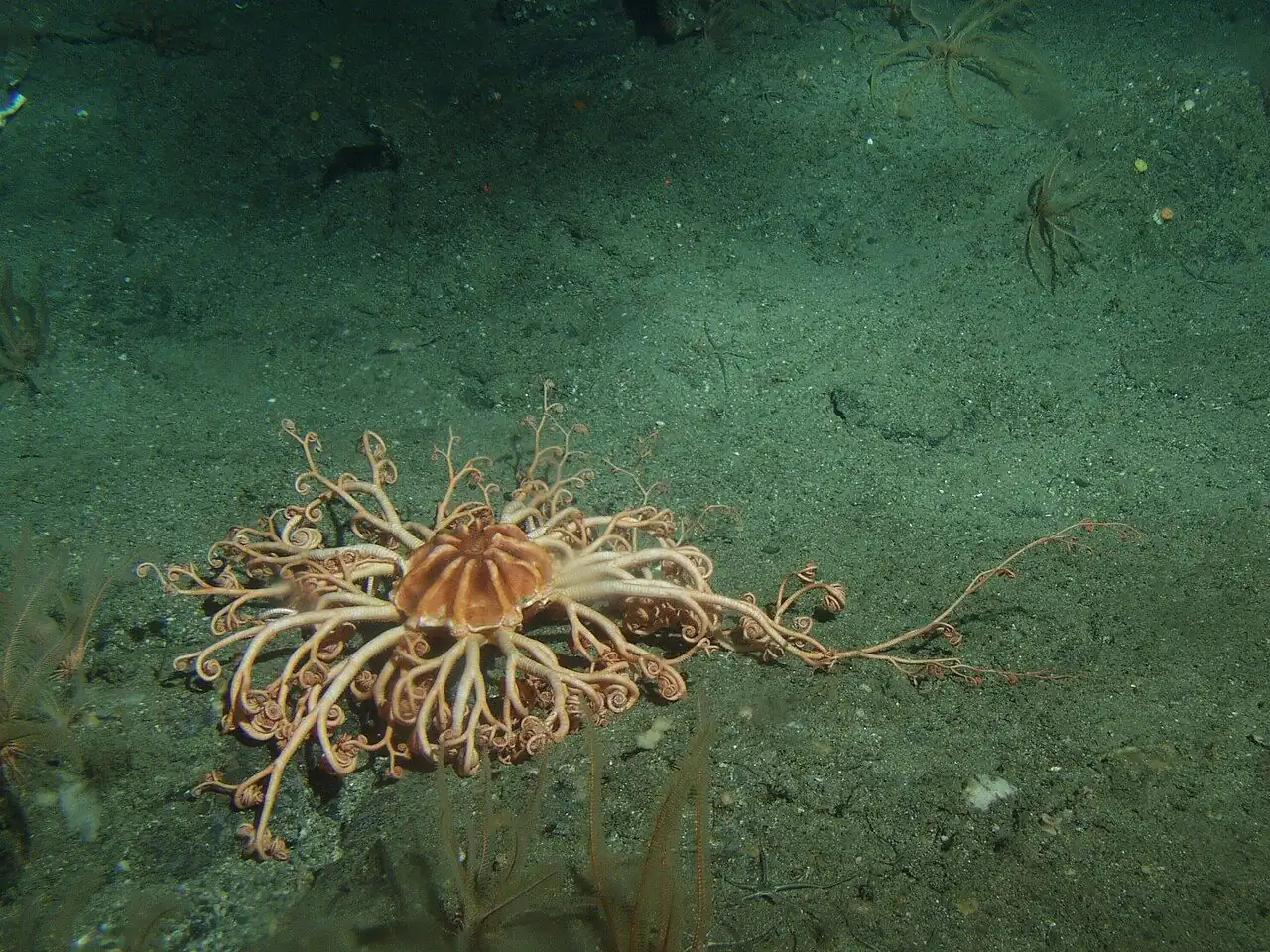
Basket Star
Several genera, family Gorgonocephalidae (order Euryalida)
Brittle stars whose arms split again and again into a living net, unfurled at night to catch plankton from the current.
Photo: NOAA / Cordell Bank National Marine Sanctuary / Public domain
3 things to know
- Each arm forks again and again, ending in fine tendrils armed with tiny hooks.
- Many hide by day and climb to a high perch at night to feed.
- Researchers once counted 111 young basket stars on a single soft coral less than 5 cm (2 in) tall.
- Scientific name
- Several genera, family Gorgonocephalidae (order Euryalida)
- Depth
- 2 m – 1,993 m
7 – 6,539 ft - Size
- Arms up to about 1 m (3.3 ft) long, according to NOAA
- Weight
- Unknown
- Lifespan
- Unknown
- Diet
- Zooplankton, including small crustaceans, plus jellyfish and other small drifting animals
- Where
- From tropical reefs to Arctic seas; Astrophyton in the western Atlantic and Caribbean, Gorgonocephalus in the Arctic and the cold North Atlantic and North Pacific
- IUCN status
- Not Evaluated (for the species we checked)
- Depth zones
- Sunlight · Twilight · Midnight
A basket star is a brittle star taken to extremes. Its arms fork, and fork again, and keep dividing into finer and finer branches until the animal looks like a tangle of curling tendrils around a small central disc. The best known belong to the family Gorgonocephalidae, the largest basket star family, named for the genus Gorgonocephalus, Greek for Gorgon's head, after the monster of myth with snakes for hair. NOAA describes arms that can measure up to a meter (3.3 feet), and each branch carries tiny sharp hooks.
Those hooks are for fishing. Many basket stars hide in crevices by day and climb to a high point at night, then spread their arms into a net across the current to catch small crustaceans, jellyfish and other small animals drifting past. In a 1976 study, Donald Macurda described how quickly the Caribbean basket star Astrophyton reacts when plankton touch its arms, and how spines on the arm bones impale the prey. The winding arms then carry the catch to the mouth in the central disc. Basket stars can also regrow arms that break off.
They live from warm reefs to polar seas. The giant basket star, Astrophyton muricatum, ranges through the western Atlantic from North Carolina through the Caribbean to Brazil, usually 2 to 70 meters (7 to 230 feet) deep. Gorgonocephalus eucnemis lives in the Arctic and the North Pacific, including Alaska, from 8 to 1,850 meters (26 to 6,070 feet), and its relative G. arcticus has been recorded down to 1,993 meters (6,540 feet). NOAA has photographed G. eucnemis at Cordell Bank off California, and another basket star perched on a rock in Noyes Canyon off Alaska.
In cold northern seas, the young seem to grow up on soft corals. In 2020, Bárbara de Moura Neves of Fisheries and Oceans Canada and colleagues examined more than 4,500 soft coral colonies brought up in trawl surveys off Newfoundland, Labrador and Baffin Bay. Juvenile Gorgonocephalus turned up on all four kinds of soft coral they studied, and on one colony just 4.8 centimeters (1.9 inches) tall they counted 111 young basket stars. The authors note that these soft corals are easily damaged by bottom-fishing gear.
How long basket stars live is unknown, and the species we checked have not been assessed by the IUCN.
Sources
- oceantoday.noaa.gov/fullmoon-basketstar/welcome.html
- oceanexplorer.noaa.gov
- sealifebase.se/summary/Astrophyton-muricatum.html
- sealifebase.se/summary/Gorgonocephalus-eucnemis.html
- sealifebase.se/summary/Gorgonocephalus-arcticus.html
- Study: doi:10.1017/s0094837300003262
- Study: doi:10.3389/fmars.2020.547896
- en.wikipedia.org/wiki/Gorgonocephalidae
- en.wikipedia.org/wiki/Gorgonocephalus_eucnemis
- marinespecies.org/aphia.php



