Black Dragonfish
Idiacanthus atlanticus
A Southern Hemisphere dragonfish whose fanged females dwarf the males, and whose see-through larvae carry their eyes on long stalks.
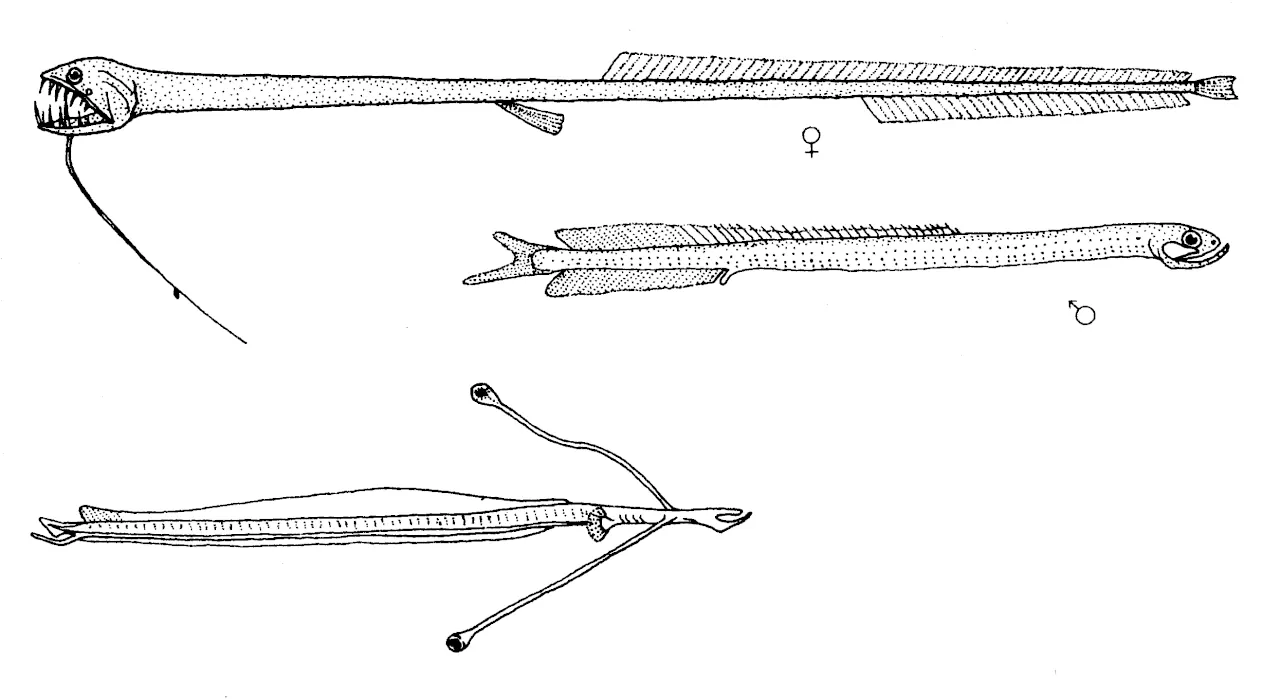
Illustration: Dr Tony Ayling / CC BY-SA 1.0
3 things to know
- Adult males lack the female's fangs and chin barbel, and their gut does not work.
- The female's chin barbel ends in a slender glowing tip.
- Its larvae carry their eyes on stalks that can be up to half as long as the body.
- Scientific name
- Idiacanthus atlanticus
- Depth
- 500 m – 2,000 m
1,640 – 6,562 ft - Size
- Up to about 53 cm (21 in) long; males much smaller
- Weight
- Unknown
- Lifespan
- Unknown
- Diet
- Mostly other fishes; adult males have no working gut
- Where
- Subtropical and temperate waters of the Southern Hemisphere, roughly 25°S to 60°S
- IUCN status
- Least Concern
- Depth zones
- Twilight · Midnight
Female and male black dragonfish hardly look like the same species. The female is long, slender and black, with small eyes, long fang-like teeth and a barbel hanging from her chin. The barbel's slender tip glows, and the Australian Museum suggests it may lure prey. Tiny light organs are scattered over her body, with two rows of larger ones along each side. FishBase gives a maximum length of 53 centimeters (21 inches). The male is much smaller and dark brown. He lacks the female's fangs, chin barbel and pelvic fins, and his gut does not work.
The species lives in subtropical and temperate waters of the Southern Hemisphere, roughly between 25°S and 60°S, and occasionally turns up in sub-Antarctic waters. It is found down to about 2,000 meters (6,600 feet). According to FishBase, females apparently spend the day below 500 meters (1,600 feet) and rise to shallower water at night, while males stay deep, around 1,000 to 2,000 meters (3,300 to 6,600 feet). The genus also includes the Pacific blackdragon of the eastern Pacific.
The larvae are stranger still. They are long, slender and transparent, and their eyes sit at the ends of stalks that can be up to half the length of the body, according to the Australian Museum. In 1981, D. Weihs of the Technion's aeronautical engineering department in Israel and H. G. Moser of the National Marine Fisheries Service's Southwest Fisheries Center in La Jolla, California, asked why the larvae of some midwater fishes evolved narrow or stalked eyes. They noted that in this family the stalks are supported by a rod of cartilage, and their mathematical analysis suggested that eyes held out from the head let a larva scan a larger volume of water, making it a more efficient feeder.
The Australian Museum says the species eats mostly other fishes. How long it lives is unknown. The IUCN lists the species as Least Concern.
Sources
- australian.museum/learn/animals/fishes/black-dragonfish-idiacanthus-atlanticus-brauer-1906
- australian.museum/learn/animals/fishes/eyes-of-larval-black-dragonfish
- fishbase.se/summary/Idiacanthus-atlanticus.html
- fishbase.se/summary/Idiacanthus-antrostomus.html
- swfsc-publications.fisheries.noaa.gov/publications/CR/1981/8170.PDF
- marinespecies.org/aphia.php
- commons.wikimedia.org/wiki/File:Idiacanthus_atlanticus_(no_common_name).gif