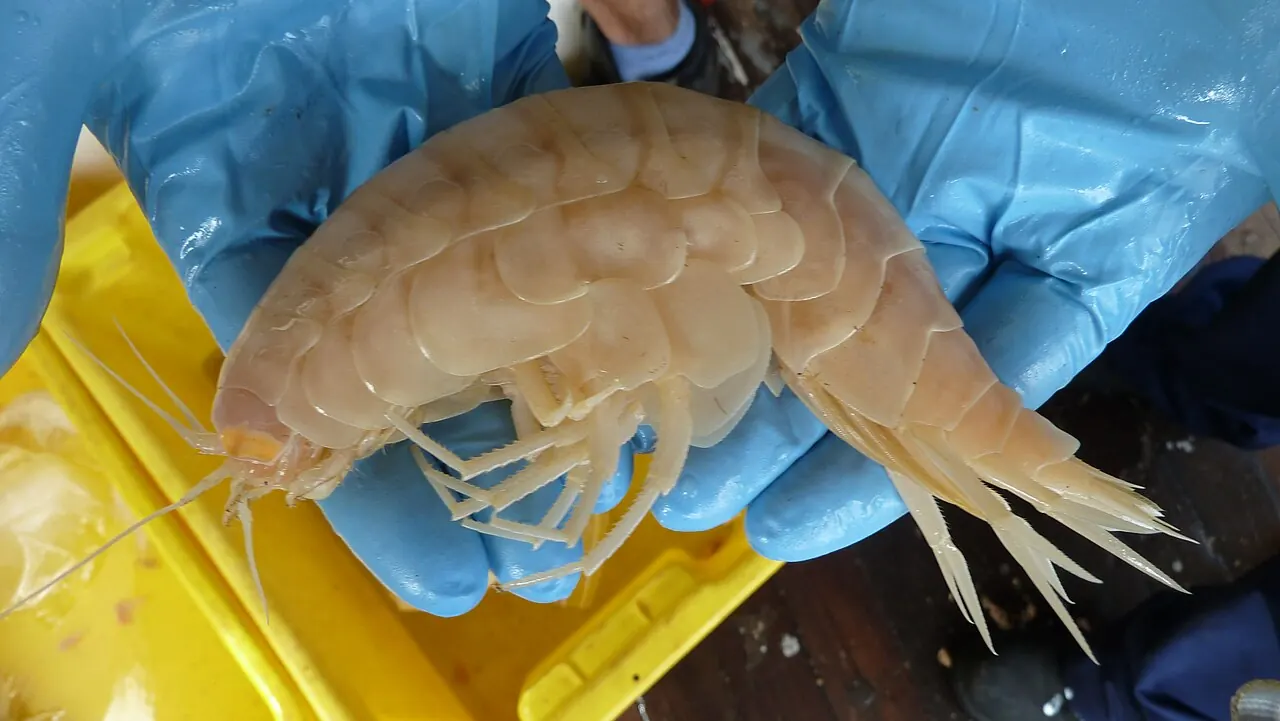
Supergiant Amphipod
Alicella gigantea
The world's largest amphipod, a pale deep-sea scavenger up to 34 cm long that was long thought rare and is now known from three oceans.
Photo: Alan Jamieson / CC BY-SA 4.0
3 things to know
- It grows to 34 cm (13.4 in) long, about ten times the size of most amphipods.
- A baited camera 5,304 m (17,400 ft) down in the North Pacific photographed one before anyone knew what species it was.
- It has been recorded at 75 sites in three oceans, from 3,890 to 8,931 m (12,760 to 29,300 ft) deep.
- Scientific name
- Alicella gigantea
- Depth
- 3,890 m – 8,931 m
12,763 – 29,303 ft - Size
- Up to 34 cm (13.4 in) long
- Weight
- Not well known
- Lifespan
- Unknown
- Diet
- Scavenger that comes readily to bait; described as a mobile omnivore
- Where
- Deep seafloor and trenches of the Pacific, Atlantic and Indian oceans
- IUCN status
- Not Evaluated
- Depth zones
- Midnight · Abyss · Hadal
Alicella gigantea is the largest amphipod known, a pale, shrimplike crustacean that reaches 34 centimeters (13.4 inches) long. New Zealand's National Institute of Water and Atmospheric Research (NIWA) describes it as ten times larger than most amphipods. It was named in 1899 by the zoologist Chevreux, from material gathered on cruises of the yacht Princesse Alice.
Its first portrait came long before anyone could name it. In 1972, Robert Hessler and John Isaacs of the Scripps Institution of Oceanography in La Jolla, California, and Eric Mills of Dalhousie University reported in Science that a baited camera on the floor of the eastern North Pacific, 5,304 meters (17,400 feet) down, had photographed an amphipod twice as large as the largest one previously recorded. They called it a mobile omnivore. A few animals caught later were identified as A. gigantea in a 1986 study by J. L. Barnard and C. L. Ingram.
Then the records stopped for more than two decades, until a team led by Alan Jamieson, then at the University of Aberdeen in Scotland, worked the Kermadec Trench northeast of New Zealand with baited cameras and traps. Their 2013 paper gave the first record from the Southern Hemisphere and extended the species' known depth by more than 1,000 meters, to 7,000 meters (23,000 feet). Traps at 6,265 and 7,000 meters brought up nine animals from 102 to 290 millimeters (4 to 11.4 inches) long.
Such scattered catches made it look rare. In 2025, Paige Maroni, Yakufu Niyazi and Jamieson, of the University of Western Australia, pulled together 195 records from 75 sites in the Pacific, Atlantic and Indian oceans, from 3,890 to 8,931 meters (12,760 to 29,300 feet) deep. Animals from the Kermadec and Japan trenches, about 8,000 kilometers (5,000 miles) apart, shared the same genetic type, and the authors concluded that it is a single species spread across the globe. A model based on depth alone suggested it could live across about 59 percent of the world's oceans, though 67 of the 75 sites were in the Pacific and there are no records from the Arctic or Antarctic.
The new specimens in that study were all caught in traps baited with whole mackerel. Jamieson's 2013 paper discussed why the species grows so large, but how long it lives and how it breeds are unknown. The IUCN has not assessed it.
Sources
- Study: doi:10.1098/rsos.241635
- pmc.ncbi.nlm.nih.gov/articles/PMC12092127
- uwa.edu.au/news/article/2025/may/study-finds-deep-sea-giant-may-inhabit-more-than-half-…
- Study: doi:10.1126/science.175.4022.636
- Study: doi:10.1016/j.dsr2.2012.12.002
- manuscript.isc.ac/Inventory/10/2316291.htm
- niwa.co.nz/news/2013-kermadec-trench
- sealifebase.se/summary/Alicella-gigantea.html
- api.gbif.org/v1/species/2218256/iucnRedListCategory