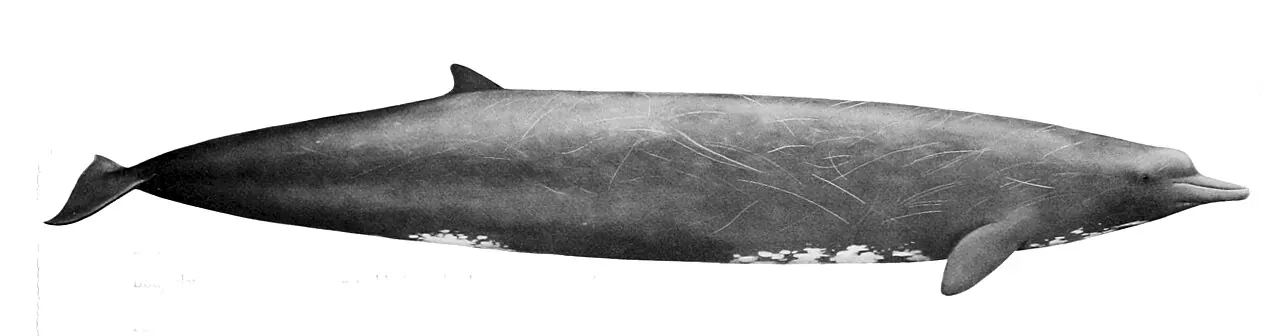
Baird's Beaked Whale
Berardius bairdii
The largest beaked whale, a long-beaked North Pacific diver that feeds 760 to 1,220 m (2,500 to 4,000 ft) down and can live past 80.
Illustration: NOAA National Marine Fisheries Service / Public domain
3 things to know
- It is the largest member of the beaked whale family.
- Its longest known dive lasted 81.7 minutes.
- Whaling records include a male 84 years old.
- Scientific name
- Berardius bairdii
- Depth
- 0 m – 1,200 m
0 – 3,937 ft - Size
- Females about 11 m (36 ft); males about 10.7 m (35 ft)
- Weight
- Up to about 12,000 kg (26,455 lb)
- Lifespan
- Whaling records show females to 54 years and males to 84
- Diet
- Deep-sea and open-ocean fish, squid, octopus, crustaceans and sea cucumbers
- Where
- North Pacific and adjacent seas; in the US, off the West Coast from California to Alaska
- IUCN status
- Least Concern
- Depth zones
- Sunlight · Twilight · Midnight
No beaked whale grows bigger. Females reach about 11 meters (36 feet) and males about 10.7 meters (35 feet), and NOAA Fisheries gives adults weights up to about 12,000 kilograms (26,455 pounds). The beak is long and cylindrical. In both sexes, two pairs of teeth erupt from the front of the lower jaw around the time the whale matures. Baird's beaked whales travel in tight groups of usually 5 to 20 and occasionally up to 50, and their size and sociability make them some of the most commonly sighted beaked whales.
They live across the North Pacific and its neighboring seas, and in US waters off the West Coast from California to Alaska. On dives they feed 760 to 1,220 meters (2,500 to 4,000 feet) down on deep-sea and open-ocean fish, crustaceans, sea cucumbers, squid and octopus. Typical dives last 11 to 30 minutes, and the longest on record lasted 81.7 minutes.
On August 1, 2012, researchers off Southern California put a sound-and-motion recording tag on one whale in a group of seven, the first such tag ever placed on the species. Stimpert and colleagues reported in 2014 that it made shallow dives averaging 23 meters (75 feet), intermediate dives averaging 324 meters (1,063 feet) and deep dives averaging 1,138 meters (3,734 feet). On two deep dives it clicked and maneuvered as if catching prey, swimming upside down for long stretches near the bottom of the dive. Four hours after tagging, the team played simulated Navy sonar. Within three minutes the whale sped up and moved more, and its next three dives were all unusual, the first experimental evidence that the species reacts to sonar.
Females mature at 10 to 15 years and males at 6 to 11. A single calf is born, usually in March or April, after a pregnancy of about 17 months. Killer whales are their main predators. Commercial whalers, mainly from Japan, killed at least 4,000 in the North Pacific, and Japanese whalers still hunt the species. In 2019 Yamada and colleagues described a related whale, Sato's beaked whale, as a new species. The IUCN lists Baird's beaked whale as Least Concern, and it is protected in US waters under the Marine Mammal Protection Act.



