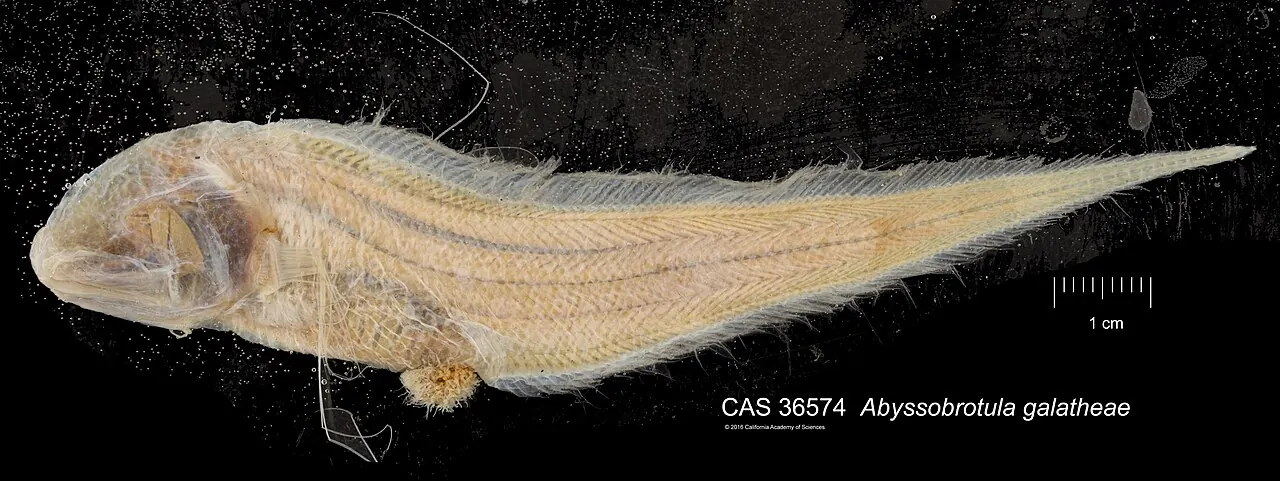
Abyssobrotula galatheae
Abyssobrotula galatheae
A small, pale cusk eel of the abyssal seafloor, long credited with the deepest catch of any fish until its record depth was corrected.
Photo: California Academy of Sciences / CC0
3 things to know
- Jørgen Nielsen described it in 1977 and named it after the research ship Galathea.
- It is known from depths of 3,110 to 7,965 m (10,200 to 26,130 ft).
- A catch once logged at 8,370 m (27,460 ft) is now put at 7,965 m (26,130 ft) after a logbook error was found.
- Scientific name
- Abyssobrotula galatheae
- Depth
- 4,000 m – 6,000 m
13,124 – 19,686 ft - Size
- Up to about 16.5 to 18 cm (6.5 to 7 in) standard length
- Weight
- Unknown
- Lifespan
- Unknown
- Diet
- Bottom-living crustaceans, mollusks and small fish
- Where
- Deep waters of tropical and subtropical areas in all oceans
- IUCN status
- Least Concern
- Depth zones
- Abyss
A small cusk eel with a long, tapering tail, Abyssobrotula galatheae lives on the deep seafloor. FishBase describes a short head bent downward, a swollen snout, small eyes and a weak spine on the gill cover. Specimens reach about 16.5 centimeters (6.5 inches) in standard length, measured without the tail fin, and the IUCN cites 18 centimeters (7 inches). Jørgen Nielsen named the genus and species in 1977, in a paper titled "The deepest living fish," after the research ship Galathea.
The species is uncommon but known from deep tropical and subtropical waters of every ocean, at depths from 3,110 to 7,965 meters (10,200 to 26,130 feet). The IUCN rates abyssal plains and hills, 4,000 to 6,000 meters down, as its most important habitat. In a 2021 review in Marine Biology, Mackenzie Gerringer, Thomas Linley and Nielsen wrote that cusk eels live on the abyssal plains but can extend into the trenches, while hadal snailfish stay mostly in the trenches. It eats bottom-living crustaceans, mollusks and small fish, and is thought to lay floating eggs in a gelatinous mass, like other members of its family.
In 1970, a specimen was trawled from a depth logged as 8,370 meters (27,460 feet), and London's Natural History Museum notes it is often credited as the deepest fish ever found. But the trawl was open, so it may have caught the fish shallower, on the way down or up. The depth itself was later revised. Gerringer, Linley and Nielsen give the species' deepest collection, in the Puerto Rico Trench, as 7,965 meters (26,130 feet), and FishBase says the older figure came from a mistake in the station logbook. That put it one meter shallower than the deepest Mariana snailfish collected at the time, taken at 7,966 meters.
Snailfish have since gone deeper. In 2022 two Pseudoliparis belyaevi were trapped at 8,022 meters in the Japan Trench, the first fish collected from deeper than 8,000 meters, according to the University of Western Australia. The IUCN lists A. galatheae as Least Concern, in a 2014 assessment that still gives its lower depth limit as 8,370 meters.