Bamboo Coral
Families Keratoisididae and Isididae (Keratoisis, Isidella and related genera)
Deep-sea octocorals with jointed, bamboo-like skeletons that grow a fraction of a millimeter a year and can live for well over a century.
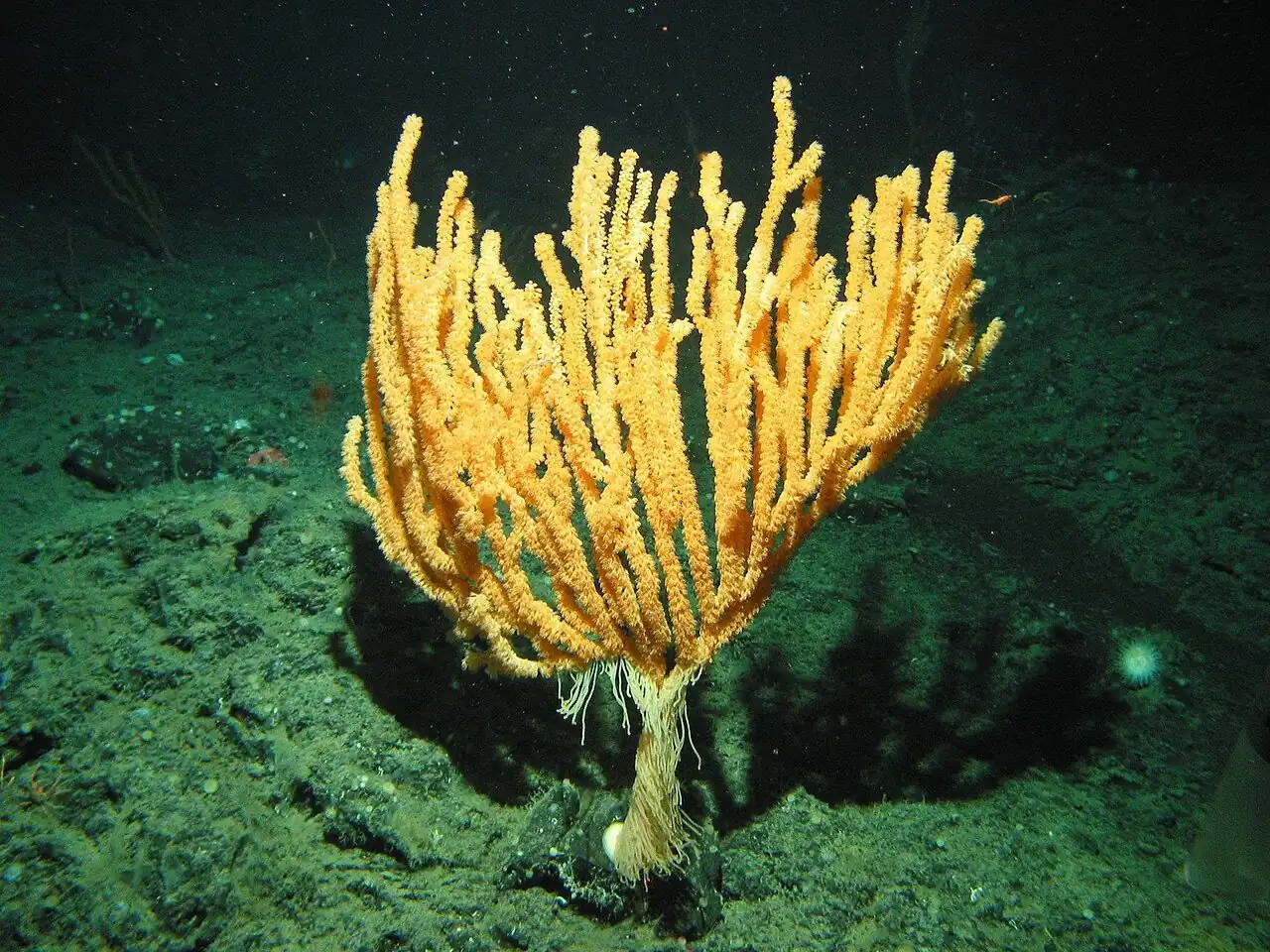
Photo: NOAA Office of Ocean Exploration / Public domain
3 things to know
- The skeleton alternates dark protein joints with white calcium carbonate sections.
- Davidson Seamount colonies off California thickened by only about 0.055 mm a year.
- One Davidson Seamount bamboo coral was dated at more than 145 years old.
- Scientific name
- Families Keratoisididae and Isididae (Keratoisis, Isidella and related genera)
- Depth
- 200 m – 4,000 m
656 – 13,124 ft - Size
- Fan-shaped colonies about 2 m (6 ft) tall and 3 m (10 ft) wide have been seen; whip-like colonies grow over 2.4 m (8 ft) high
- Weight
- Unknown
- Lifespan
- Decades to centuries; dated colonies range from about 53 to more than 145 years old
- Diet
- Food particles caught from the passing current
- Where
- Deep slopes, canyons and seamounts in all oceans
- IUCN status
- No global IUCN assessment found
- Depth zones
- Twilight · Midnight
The skeleton of a bamboo coral is jointed. Short, dark nodes made of protein alternate with longer white sections of calcium carbonate, a pattern that reminded early biologists of bamboo, Scott France of the University of Louisiana at Lafayette wrote during a 2013 NOAA expedition. The living tissue is so thin that the skeleton shows through it. These are octocorals, whose polyps each have eight tentacles, and they catch food particles from the passing current.
They live on deep slopes, canyons and seamounts. The group France was filming, the subfamily Keratoisidinae, is found in all oceans from about 200 meters (650 feet) to deeper than 4,000 meters (13,100 feet). In canyons off the US Northeast, he reported dense stands in Block Canyon below 1,300 meters, fan-shaped colonies about 2 meters (6 feet) tall and 3 meters (10 feet) wide, and spiraling whip-like colonies more than 8 feet (2.4 meters) high. Shrimp, crinoids, anemones and other animals perch on the branches, and sea urchins and sea stars feed on them.
They grow slowly. Using radiocarbon, Brendan Roark and colleagues estimated in 2005 that bamboo corals from the Gulf of Alaska were 75 to 126 years old, and noted that their layered skeletons hold records of deep-water conditions over decades to centuries. In 2009 Allen Andrews of Moss Landing Marine Laboratories and colleagues refined lead-210 dating on colonies from Davidson Seamount, an undersea mountain 80 miles (129 kilometers) southwest of Monterey, California. Two Keratoisis colonies there thickened by only about 0.055 millimeters a year, and one was more than 145 years old. A Gulf of Alaska Keratoisis came out at about 116 years and an Isidella tentaculum at about 53.
The authors concluded that recovery from damage could take decades to a century. Since 2006, NOAA has banned fishing at Davidson Seamount with bottom-contact gear, or with any gear set deeper than 3,000 feet (914 meters), and the seamount was added to Monterey Bay National Marine Sanctuary in 2008. The family tree is being redrawn: the World Register of Marine Species now places Keratoisis, Isidella and several other deep-sea genera in the family Keratoisididae, separate from Isididae. We found no global IUCN Red List assessment for bamboo corals.
Sources
- web.archive.org/web/20250622025443/https://oceanexplorer.noaa.gov/okeanos/explorations/…
- userweb.ucs.louisiana.edu/~scf4101/Res_isididae.htm
- Study: doi:10.3354/meps08193
- Study: doi:10.1029/2004GL021919
- sanctuaries.noaa.gov/science/condition/monterey-bay-2015/davidson-seamount.html
- montereybay.noaa.gov/science/characterization/davidson-seamount.html
- marinespecies.org/aphia.php
- api.gbif.org/v1/species/2261671/iucnRedListCategory