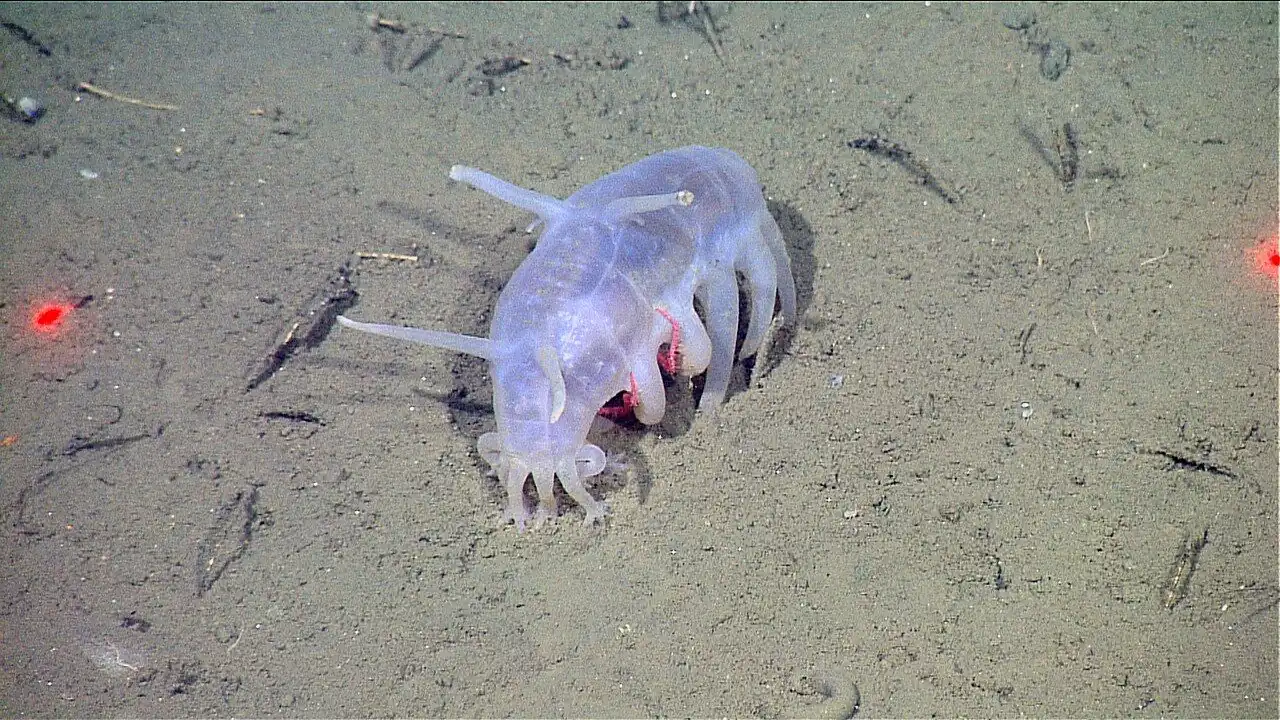
Sea Pig
Scotoplanes spp.
Plump, see-through sea cucumbers that walk the deep seafloor on stilt-like tube feet, sometimes with a young king crab riding underneath.
Photo: NOAA/MBARI / CC BY-SA 3.0
3 things to know
- Its legs are tube feet, inflated and deflated with water to walk across the mud.
- Groups often face the same way, upstream, which likely helps them sense food.
- Off central California, 96% of young king crabs seen in one study area were riding on sea pigs.
- Scientific name
- Scotoplanes spp.
- Depth
- 1,000 m – 6,000 m
3,281 – 19,686 ft - Size
- Usually 10–15 cm (4–6 in) long; up to about 17 cm (6.5 in)
- Weight
- Unknown
- Lifespan
- Unknown
- Diet
- Fresh detritus: bits of dead organic matter that settle on the mud
- Where
- Deep seafloor worldwide
- IUCN status
- Not Evaluated
- Depth zones
- Midnight · Abyss
Sea pigs are sea cucumbers that walk. Species in the genus Scotoplanes hold their plump, see-through bodies up off the soft mud on long, stilt-like tube feet, the same kind of projections sea stars have. They pump these up and let them down with a water vascular system to move across the seafloor. Most sea cucumbers have stumpy tube feet tucked under the body instead. Sea pigs are usually 10 to 15 centimeters (4 to 6 inches) long, and MBARI gives a maximum of about 17 centimeters (6.5 inches). Two pairs of antenna-like appendages help tell them apart from similar deep-sea cucumbers in the genus Peniagone, which have one pair.
They live on the deep seafloor worldwide, mostly from about 1,000 to 6,000 meters (3,300 to 19,500 feet) down, and off Monterey Bay they are among the animals MBARI sees most often on the bottom. Some go deeper still. In 2009, a Woods Hole Oceanographic Institution team led by biologist Tim Shank collected a Scotoplanes 8,984 meters (5.58 miles) down in the Mariana Trench, possibly a species new to science.
Sea pigs are deposit feeders. They roam the mud in herds, picking out fresh detritus, the bits of organic material that settle from the water above. Many individuals in a group often point the same way, upstream, which likely helps them detect food. Huge groups have been filmed feasting near sunken whale carcasses, and MBARI's long-term surveys show that deep seafloor communities, sea pigs included, can change dramatically over time. How long sea pigs live is unknown, and they have not been assessed for the IUCN Red List.
Their oddest habit involves passengers. During robot dives on a flat mud plain off central California, James Barry of MBARI and colleagues found young king crabs, Neolithodes diomedeae, on or under the sea pigs. In their 2016 study, 574 of the 599 juvenile crabs they saw, 96 percent, were with a sea pig, and 22 percent of the 2,596 sea pigs carried at least one crab. The crabs likely gain a refuge from predators. Whether the sea pig gets anything in return is unknown.