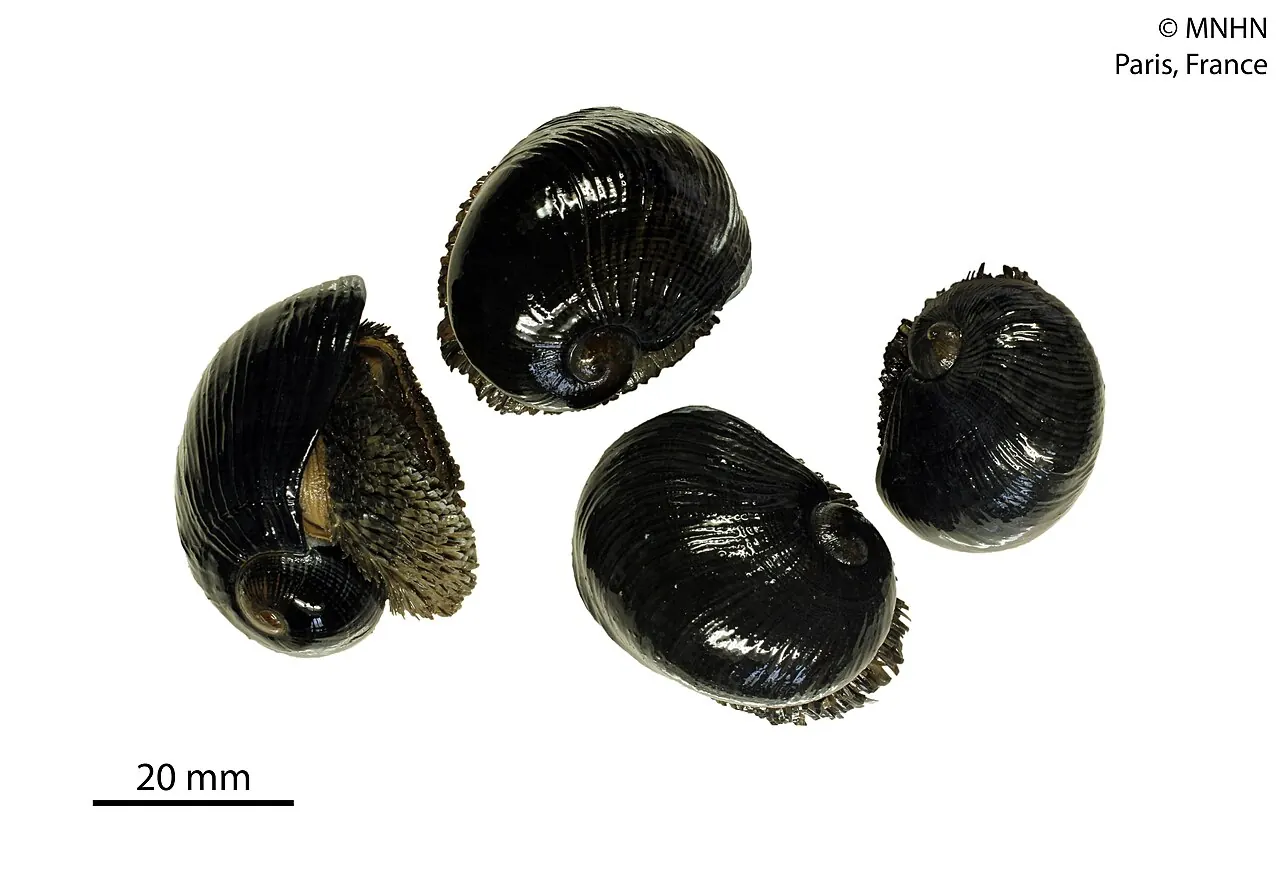
Scaly-Foot Snail
Chrysomallon squamiferum
An Indian Ocean vent snail whose foot is armored with hundreds of scales, in some places coated with iron sulfide.
Photo: Marie Hennion, MNHN (Muséum national d'Histoire naturelle) / CC BY 4.0
3 things to know
- Iron-coated scales make some populations magnetic.
- Bacteria inside a gland in its throat make its food.
- In 2019 it became the first species Red Listed with deep-sea mining as a threat.
- Scientific name
- Chrysomallon squamiferum
- Depth
- 2,415 m – 2,785 m
7,924 – 9,138 ft - Size
- Shell about 5 cm (2 in) long
- Weight
- Unknown
- Lifespan
- Unknown
- Diet
- Food made by chemosynthetic bacteria living inside cells of its esophageal gland
- Where
- Hydrothermal vent fields on mid-ocean ridges of the Indian Ocean
- IUCN status
- Endangered
- Depth zones
- Midnight
Where an ordinary snail has a soft foot, the scaly-foot snail has armor: hundreds of overlapping scales, called sclerites, each about 1 by 5 millimeters. In some populations the scales and the outside of the shell carry a coating of iron sulfide that turns them metallic black and makes them magnetic. A 2015 paper describing the species called it the only living multicellular animal known to use iron sulfide as part of its skeleton. The shell itself is about 5 centimeters (2 inches) long.
The snail lives only at hydrothermal vents in the Indian Ocean, on active black-smoker chimneys and around gentler, diffuse flows. SeaLifeBase lists it from roughly 2,400 to 2,800 meters (7,900 to 9,100 feet) down. Two well-known populations look different. Snails from the Kairei field have black scales infused with iron sulfide, while a "white" population at the Solitaire field has scales without iron. By early 2026, according to JAMSTEC, the species had been collected from at least eight vent fields on three mid-ocean ridges.
It hardly needs to hunt. Chemosynthetic bacteria living inside the cells of a gland in its esophagus make its food from vent chemicals. JAMSTEC says the snail also gets rid of sulfide by sending sulfur compounds out into its scales. In 2010, an MIT team including Christine Ortiz tested the shell, a layered wall with an iron-rich crust outside, against a simulated predator's attack and found the layers good at resisting penetration and stopping cracks.
In 2019 the IUCN listed the snail as Endangered, the first Red List case that took deep-sea mining into account. At the time it was known from just three vent fields, together about the size of two soccer fields, and two of them, Kairei and Longqi, were under mining exploration licenses from the International Seabed Authority. Genetic work announced in 2026 found that snails from Longqi and its neighbor Duanqiao, and from Wocan in the north, are the most distinct populations, and the authors flagged them as priorities for protection. How long the snail lives is unknown.