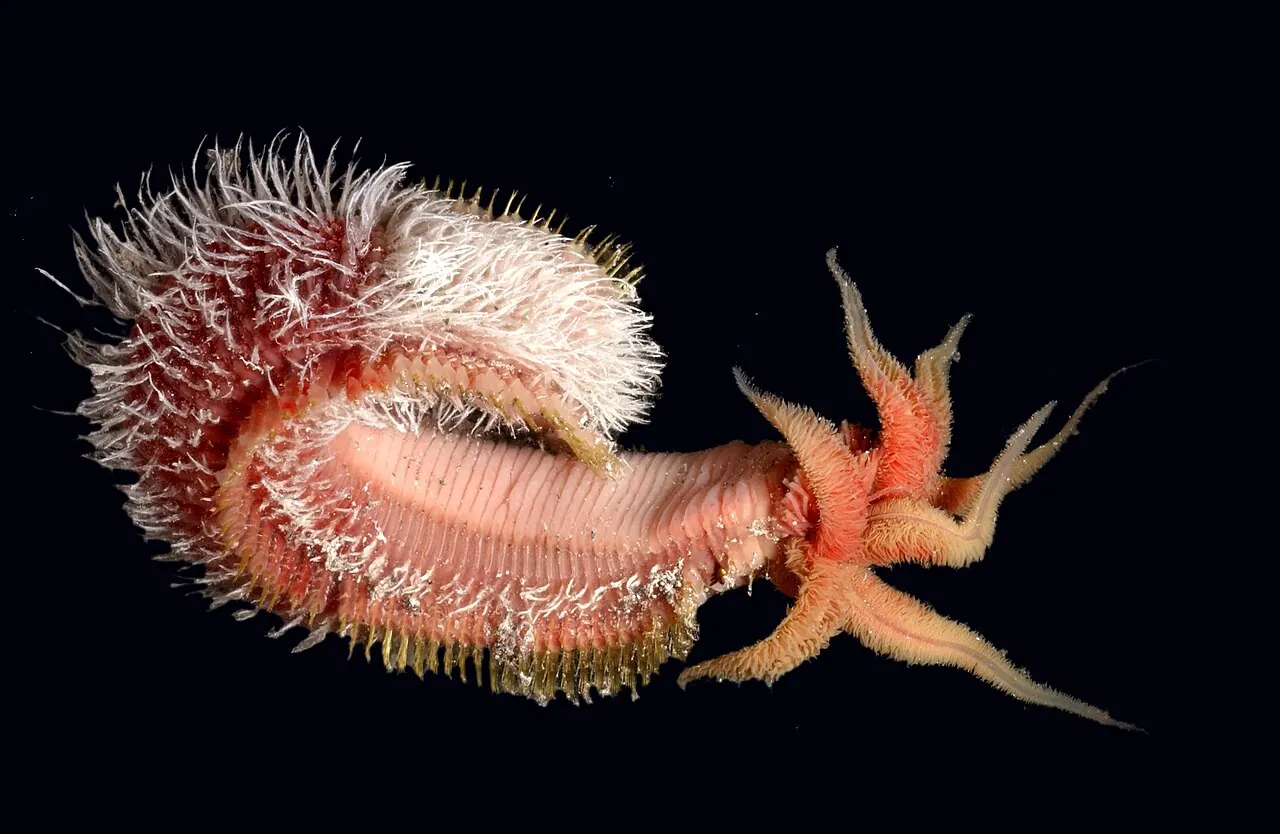
Pompeii Worm
Alvinella pompejana
A deep-sea worm that lives in tubes on the walls of black smoker vents, wrapped in a fleece of bacteria, among the most heat-tolerant animals known.
Photo: Olivier Dugornay / CC BY 4.0
3 things to know
- It builds paper-thin tubes directly on the walls of hydrothermal vent chimneys.
- A woolly coat of bacteria covers its back.
- In a 2013 experiment, two hours at 50–55°C (122–131°F) killed it, so its upper limit is below 55°C.
- Scientific name
- Alvinella pompejana
- Depth
- 1,500 m – 3,500 m
4,922 – 11,484 ft - Size
- Up to about 15 cm (6 in) long
- Weight
- Unknown
- Lifespan
- Unknown
- Diet
- Bacteria
- Where
- Hydrothermal vents of the East Pacific Rise from the Gulf of California southward, the Galápagos Rift and the Pacific-Antarctic Ridge
- IUCN status
- Not Evaluated
- Depth zones
- Midnight
The Pompeii worm lives where few animals can, on the walls of the mineral chimneys that form over deep-sea hot springs. Colonies crowd side by side, each worm in a paper-thin tube it builds directly on the rock, darting in and out and waving rust-colored gills from the opening. It grows to about 15 centimeters (6 inches) long, and its back is covered in a pale, fleece-like coat of bacteria.
It is found along the East Pacific Rise, a mid-ocean ridge running from the Gulf of California south toward Easter Island, and on the Galápagos Rift and the Pacific-Antarctic Ridge, usually 1,500 to 3,500 meters (5,000 to 11,500 feet) down. Its food is bacteria. The first black smoker chimneys ever seen were found by the submersible Alvin on the East Pacific Rise in April 1979, and the Pompeii worm was formally described in 1980 by Desbruyères and Laubier.
The temperatures around it made it famous. The base of a tube can reach 105°C (221°F), and continuous recordings inside worm tubes have shown sustained temperatures of 60°C (140°F) with spikes above 80°C (176°F). Taken at face value, those readings put the worm well past the roughly 50°C (122°F) expected to be the limit for animal life. The question stayed open because the worms rarely survived the trip up from 2,500 meters (8,200 feet), so nobody could test a live one.
In 2012, Juliette Ravaux and colleagues used the French submersible Nautile to bring 70 worms up from vents on the East Pacific Rise in a container that kept them under pressure, then moved them into a pressurized aquarium. A two-hour exposure at 50 to 55°C (122 to 131°F) proved lethal, damaging their tissues and setting off a heat-stress response. The team concluded in 2013 that the worm's upper limit is below 55°C and that it does not live for long above 50°C in the wild, though its optimum temperature is still above 42°C (108°F). That still ranks it among the most heat-tolerant animals known.
MBARI describes two ways it copes: the worm moves between hot, mineral-rich water and cooler, oxygen-rich water, mixing cooler water into its tube, and its bacterial fleece helps insulate it from the heat.
The Pompeii worm has not been evaluated for the IUCN Red List.