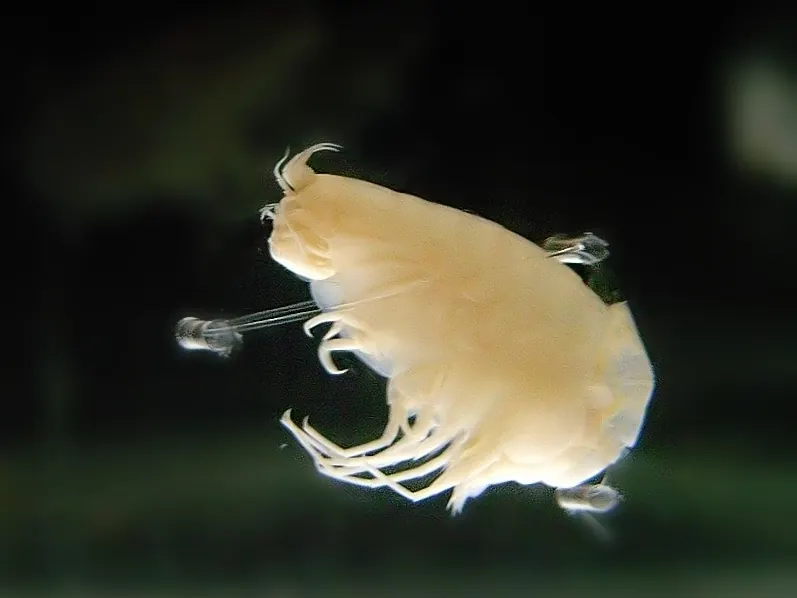
Hirondellea gigas
Hirondellea gigas
A small, pale amphipod that scavenges the floors of the deepest trenches, down to the Challenger Deep nearly 11 km below the surface.
Photo: Daiju Azuma (OpenCage) / CC BY-SA 2.5
3 things to know
- Baited traps set nearly 10.9 km down caught 185 of them in about three hours.
- It makes an enzyme that turns cellulose into sugar under trench pressure.
- A claimed aluminum shield on its shell turned out to be a measurement error.
- Scientific name
- Hirondellea gigas
- Depth
- 6,770 m – 10,897 m
22,212 – 35,753 ft - Size
- 2 to 5 cm (about 1 to 2 in) long
- Weight
- About 0.3 to 0.6 g dry weight (Challenger Deep specimens)
- Lifespan
- Unknown
- Diet
- Scavenger; carries enzymes that can digest plant material such as wood
- Where
- Deep trenches of the northwest Pacific, including the Mariana Trench; recently also reported from the Southern Hemisphere
- IUCN status
- Not Evaluated
- Depth zones
- Hadal
Drop a baited trap onto the floor of the Challenger Deep, the deepest point in the Mariana Trench, and it may come back full of Hirondellea gigas. When a team from the Japan Agency for Marine-Earth Science and Technology (JAMSTEC) did this in 2009, at about 10,897 meters (35,750 feet), the traps held 185 of these small, pale, shrimplike scavengers and nothing else. They were 2 to 5 centimeters (about 1 to 2 inches) long. The name gigas refers to its large size for an amphipod, a group of crustaceans that is common at great depths.
It is a hadal species, known from trenches below 6,000 meters. A 2022 study gives its range as 6,770 to 10,897 meters (about 22,200 to 35,750 feet) in the trenches of the northwest Pacific, and a 2026 study co-written by University of Western Australia scientists reported it from the Southern Hemisphere as well. A 2017 genetics paper, based on animals caught at 10,929 meters, called it the world's deepest-living animal.
Food is scarce that deep, and these amphipods eat whatever sinks. In 2012, Hideki Kobayashi and colleagues at JAMSTEC reported that H. gigas carries a cellulase, an enzyme that turns cellulose into sugar, and that it worked under trench pressure and near-freezing cold. They found no microbes that could have made it for the animal. They suggested the amphipods feed partly on sunken wood and other plant debris, though that idea rests on the enzyme. The guts they examined held bits of mackerel bait and one stick-like fragment they could not identify as plant matter.
Another claim about it did not hold up. In 2019 the same group reported an aluminum "shield" coating its shell. A second JAMSTEC team noted in 2022 that bromine gives off an X-ray signal almost identical to aluminum's, and with methods designed to avoid false aluminum signals they found no shield. Instead, parts of its body were rich in bromine, especially the hard pieces of its stomach's grinding mill and its bristles.
Like other amphipods, females carry their eggs in a brood pouch, SeaLifeBase notes, but little else is known about how this species breeds or how long it lives. It has not been assessed for the IUCN Red List.