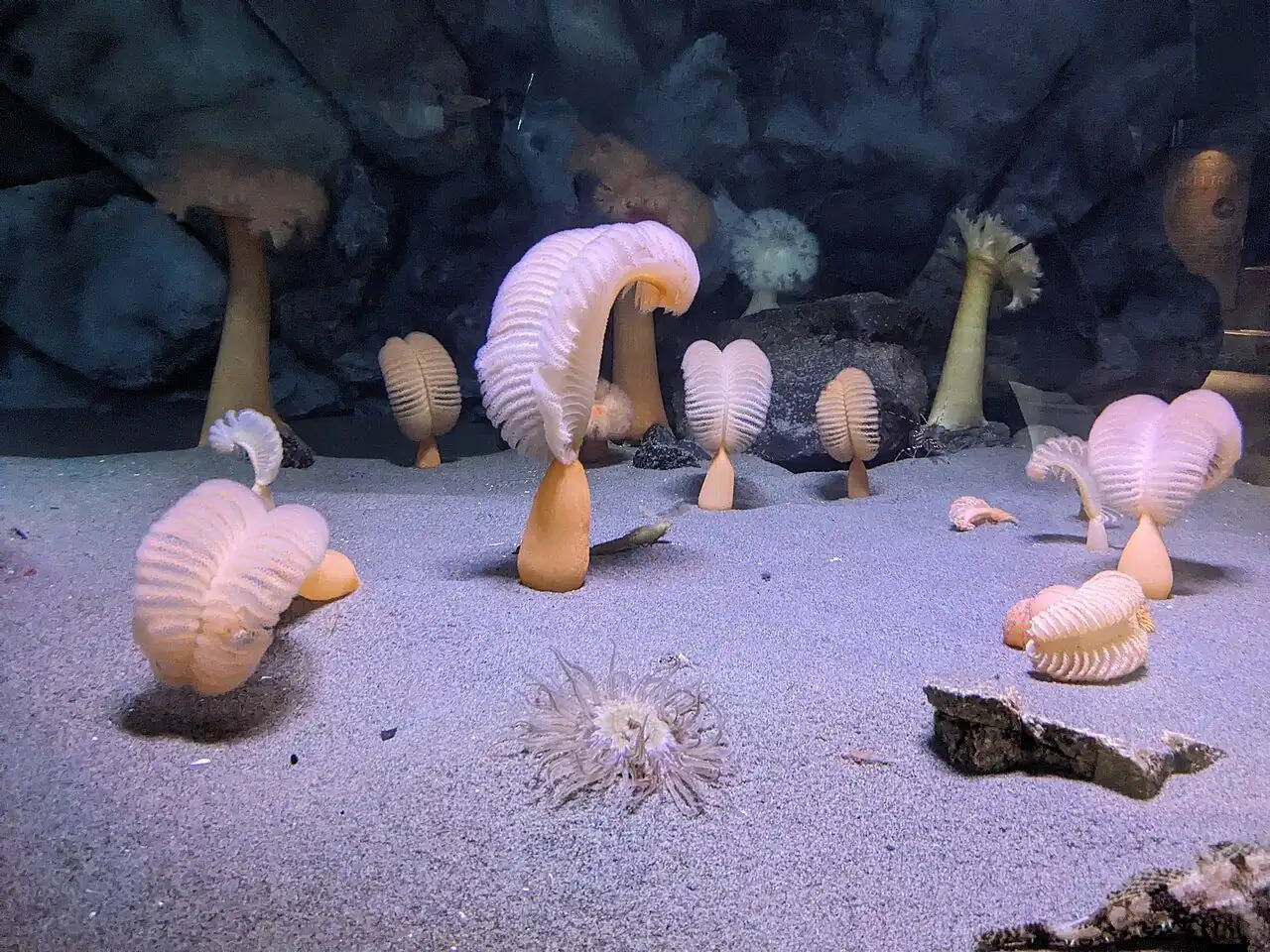
Sea Pen
Superfamily Pennatuloidea (long treated as the order Pennatulacea)
Feather-shaped colonies of polyps anchored in soft seafloor, found from tidal flats to more than 6,000 meters down. Many can glow.
Photo: Jlahorn / CC BY-SA 4.0
3 things to know
- Sea pens live from intertidal flats to at least 6,100 m (20,000 ft) deep.
- Each colony grows from a single large polyp that anchors it in mud or sand.
- Orange sea pens burrow away from a predatory leather star but mostly ignore a harmless ochre star.
- Scientific name
- Superfamily Pennatuloidea (long treated as the order Pennatulacea)
- Depth
- 0 m – 6,100 m
0 – 20,014 ft - Size
- Varies by species; the orange sea pen of the US Pacific coast grows to about 46 cm (18 in) tall
- Weight
- Varies by species
- Lifespan
- Varies by species; the orange sea pen lives about 10 years, according to Washington State's Department of Ecology
- Diet
- Plankton caught by the colony's feeding polyps
- Where
- All oceans, from polar seas to the tropics
- IUCN status
- Varies by species (the orange sea pen is Not Evaluated; the phosphorescent sea pen is listed as Vulnerable in the Mediterranean only)
- Depth zones
- Sunlight · Twilight · Midnight · Abyss · Hadal
Sea pens are named for the old quill pen. The classic kinds look like a feather stuck upright in the seafloor, though some are shaped like whips or worms. Each one is a colony. It starts as a single large polyp, which becomes the muscular stalk anchored in mud or sand and the central shaft above it. Smaller polyps bud along the shaft, some catching plankton and others pumping water in and out so the colony can swell or shrink. They are octocorals, related to soft corals and sea fans.
In a 2011 review, Gary Williams of the California Academy of Sciences counted about 450 described species, of which about 200 are probably valid. They live in every ocean, from polar seas to the tropics and from intertidal mud flats to at least 6,100 meters (20,000 feet) down. The deepest known belong to Kophobelemnon, Porcupinella and Umbellula. Many glow. The official account of the HMS Challenger voyage of 1873 to 1876 described an Umbellula whose polyps and stem shone with a brilliant phosphorescence when it came up in the trawl.
In Puget Sound the signature species is the orange sea pen, Ptilosarcus gurneyi, which forms dense beds on sandy and muddy bottoms in shallow water from the Gulf of Alaska to California. It grows slowly, taking more than a year to reach an inch, but can reach about 46 centimeters (18 inches). It can inflate itself and drift to a new spot, glows greenish blue when disturbed, and a single colony may release about a million eggs over a life of roughly 10 years.
It also seems to know who is touching it. In experiments published in 2002, Janice Weightman and David Arsenault touched orange sea pens with three kinds of sea star. After contact with the leather star, a specialist sea pen predator, 73 percent of the colonies quickly burrowed into the sediment. The sunflower star, which eats many things, drew a burrowing response from only 23 percent. The ochre star, which does not eat sea pens, got about the same weak reaction as a glass rod. Chemical cues in the water alone triggered nothing; the colonies waited for a touch.
The orange sea pen has not been evaluated by the IUCN, while the phosphorescent sea pen, Pennatula phosphorea, is listed as Vulnerable in a 2014 regional assessment for the Mediterranean.
Sources
- Study: doi:10.1371/journal.pone.0022747
- ecology.wa.gov/blog/september-2017/eyes-under-puget-sound-critter-of-the-month-the
- eopugetsound.org/articles/orange-sea-pen
- aquarium.org/animals/orange-sea-pen
- Study: doi:10.1139/z01-211
- iucnredlist.org/species/50015525/51217617
- api.gbif.org/v1/species/2258713/iucnRedListCategory



