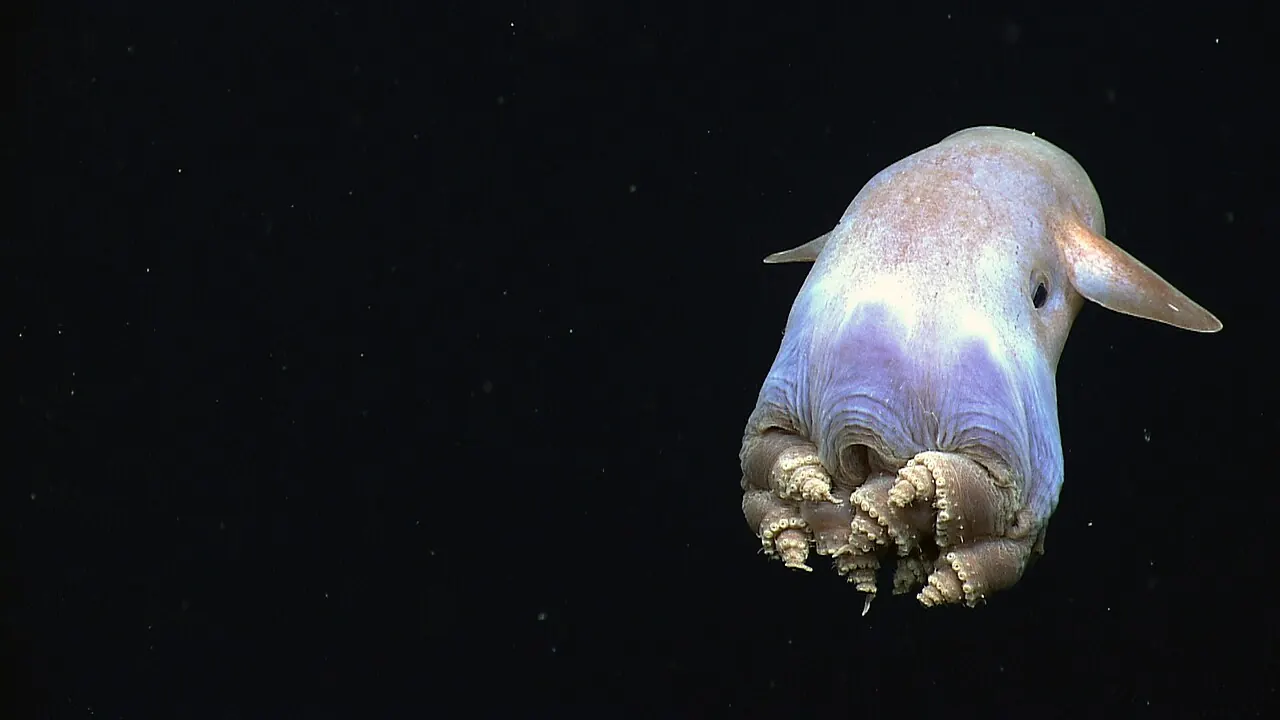
Dumbo Octopus
Grimpoteuthis spp.
Small deep-sea octopuses that swim by flapping ear-like fins. One filmed at 6,957 meters is the deepest octopus on record.
Photo: NOAA Okeanos Explorer / Public domain
3 things to know
- It swims by flapping two fins above its eyes, which earned it the name of Disney's flying elephant.
- It has no ink sac, and its beak is weak or missing, so it swallows prey whole.
- One filmed in the Java Trench in 2019, at 6,957 meters (22,825 feet), is the deepest octopus on record.
- Scientific name
- Grimpoteuthis spp.
- Depth
- 1,000 m – 7,000 m
3,281 – 22,967 ft - Size
- Most species about 20–30 cm (8–12 in) long
- Weight
- Not well known
- Lifespan
- Not well known (one estimate: 3–5 years)
- Diet
- Small seafloor animals such as copepods, isopods, amphipods, bristle worms and snails
- Where
- Deep water in oceans worldwide
- IUCN status
- Least Concern or Data Deficient, by species; some not evaluated
- Depth zones
- Midnight · Abyss · Hadal
Two rounded fins poke out above the eyes of a dumbo octopus, and it flaps them to swim. That habit earned the genus Grimpoteuthis its nickname, after Disney's flying elephant. The body is short, soft and bell-shaped, partly see-through, with a web of skin stretched between the eight arms. Each arm carries a single row of suckers flanked by hair-like cirri, which places dumbos among the deep-sea cirrate octopuses.
The Natural History Museum in London counts 17 valid species so far, found in deep water around the world. Most are 20 to 30 centimeters (8 to 12 inches) long. They are usually reported near the seafloor at about 3,000 to 4,000 meters (9,800 to 13,000 feet), though the museum gives the group as a whole a range of 1,000 to 7,000 meters. Specimens are rare and often reach the surface damaged, so telling one species from another is hard.
A dumbo hovers just above the bottom and pounces. With a weak or missing beak, it swallows its prey whole: copepods, isopods, amphipods and bristle worms, according to the Aquarium of the Pacific; the US Bureau of Ocean Energy Management adds snails. It has no ink sac. Females carry eggs at several stages of development at once and lay them under small rocks or on shells whenever the chance comes, so there seems to be no set breeding season. The young hatch large and able to fend for themselves. One estimate cited by the Natural History Museum puts the lifespan at three to five years.
The IUCN assessed several species in 2014 and listed them as Least Concern or Data Deficient. Because dumbos live so close to the seabed, the museum notes that deep-sea mining could affect them.
The genus also holds the depth record for octopuses. In April 2019, a video camera lander in the Java Trench, in the eastern Indian Ocean, filmed a dumbo at 6,957 meters (22,825 feet). Alan Jamieson and Michael Vecchione described the footage in 2020. No specimen was collected, so the animal has no species name yet, and Vecchione suspects it belongs to one new to science.
Sources
- boem.gov/newsroom/ocean-science-news/dumbo-octopus-whimsical-survivor-deep
- ocean.si.edu/ocean-life/invertebrates/grimpoteuthis-dumbo-octopus
- aquariumofpacific.org/onlinelearningcenter/species/dumbo_octopus
- nhm.ac.uk/discover/what-is-a-dumbo-octopus.html
- Study: doi:10.1007/s00227-020-03701-1
- hakaimagazine.com/news/how-low-can-an-octopus-go
- en.wikipedia.org/wiki/Grimpoteuthis_bathynectes
- en.wikipedia.org/wiki/Grimpoteuthis_umbellata
- sealifebase.se/summary/Grimpoteuthis-bathynectes.html
- gbif.org/species/176599439
- gbif.org/species/176599433