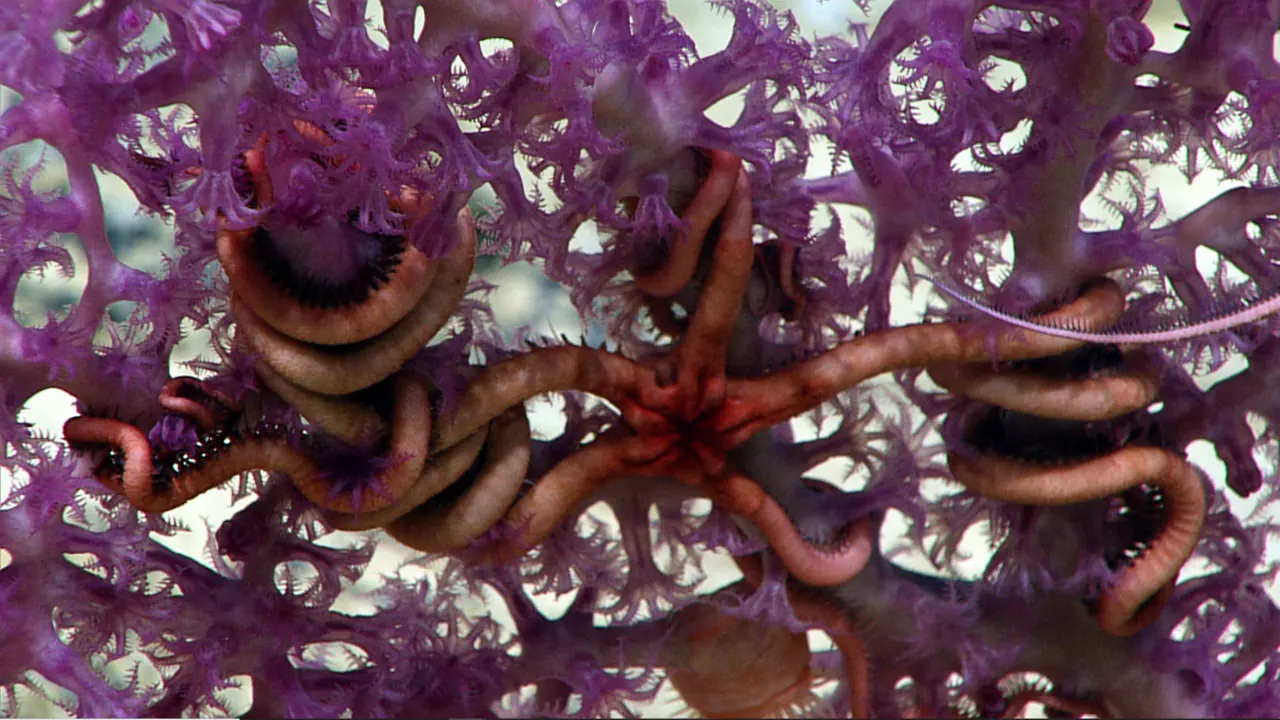
Brittle Star
Class Ophiuroidea (more than 2,000 species)
Echinoderms with five snaking arms that live from tide pools to trenches, shed arms when stressed and, in one species, see without eyes.
Photo: NOAA Office of Ocean Exploration and Research / Public domain
3 things to know
- With 2,064 species known in 2012, brittle stars are the largest class of echinoderms.
- A brittle star species was collected at 7,729 m (25,358 ft) in the Philippine Sea in 2021.
- The red brittle star of Caribbean reefs can find shelter by sight, without any eyes.
- Scientific name
- Class Ophiuroidea (more than 2,000 species)
- Depth
- 0 m – 7,729 m
0 – 25,359 ft - Size
- Most have discs 3 to 50 mm (0.1 to 2 in) across, with arms 2 to more than 20 times as long as the disc is wide
- Weight
- Unknown
- Lifespan
- Not well known for most species
- Diet
- Varies by species: food filtered from the water, organic matter in sediment, carrion and live prey
- Where
- All oceans, from the equator to the poles and from the shore to the deep trenches
- IUCN status
- Varies by species; not evaluated for the species we checked
- Depth zones
- Sunlight · Twilight · Midnight · Abyss · Hadal
Five thin arms that bend and coil like snakes give a brittle star away. Their class, Ophiuroidea, takes its name from the Greek words for snake and tail, and in a 2012 review Sabine Stöhr, Timothy O'Hara and Ben Thuy counted 2,064 known species, the largest class of echinoderms, the group that also includes sea stars and sea urchins. Basket stars, whose arms branch again and again, belong to the same class. Most brittle stars have a central disc between 3 and 50 millimeters (0.1 and 2 inches) across, with arms anywhere from two or three times to more than 20 times as long as the disc is wide.
The name fits. Brittle stars shed arms easily when stressed, thanks to a kind of connective tissue, found in all echinoderms, that can change its stiffness. Some six-armed species go further and reproduce by splitting the disc in two, after which each half regrows what is missing.
They live in every ocean, from the equator to the poles and from the intertidal zone to the trenches. The review found about as many species on continental shelves (1,313) as on the deeper slopes (1,297), but only 109 at abyssal depths. In 2021, the crewed submersible Fendouzhe collected a new species, Ophiuroglypha fendouzhe, at 7,729 meters (25,358 feet) in the Philippine Sea, a depth record for its genus. Their feeding is as varied: different species filter food from the water, pick through sediment, scavenge or hunt.
One species can see without eyes. The red brittle star, Ophiocoma wendtii (now placed in the genus Ophiomastix), lives on Caribbean reefs and is covered in thousands of light-sensitive cells. It turns from deep red by day to beige at night. Lauren Sumner-Rooney of Oxford University Museum of Natural History, who had studied the species at the Smithsonian Tropical Research Institute in Panama and in Berlin, ran hundreds of behavioral tests with colleagues, published in Current Biology in 2020. By day the animals headed for areas of contrast that could mean shelter; at night the response vanished. The team's models suggest the daytime pigment narrows the angle of light reaching each sensor, enough for coarse vision. Sumner-Rooney called it only the second known example of vision in an animal lacking eyes, after a sea urchin.
Lifespans are not well known for most species, and the species we checked has not been assessed by the IUCN.



