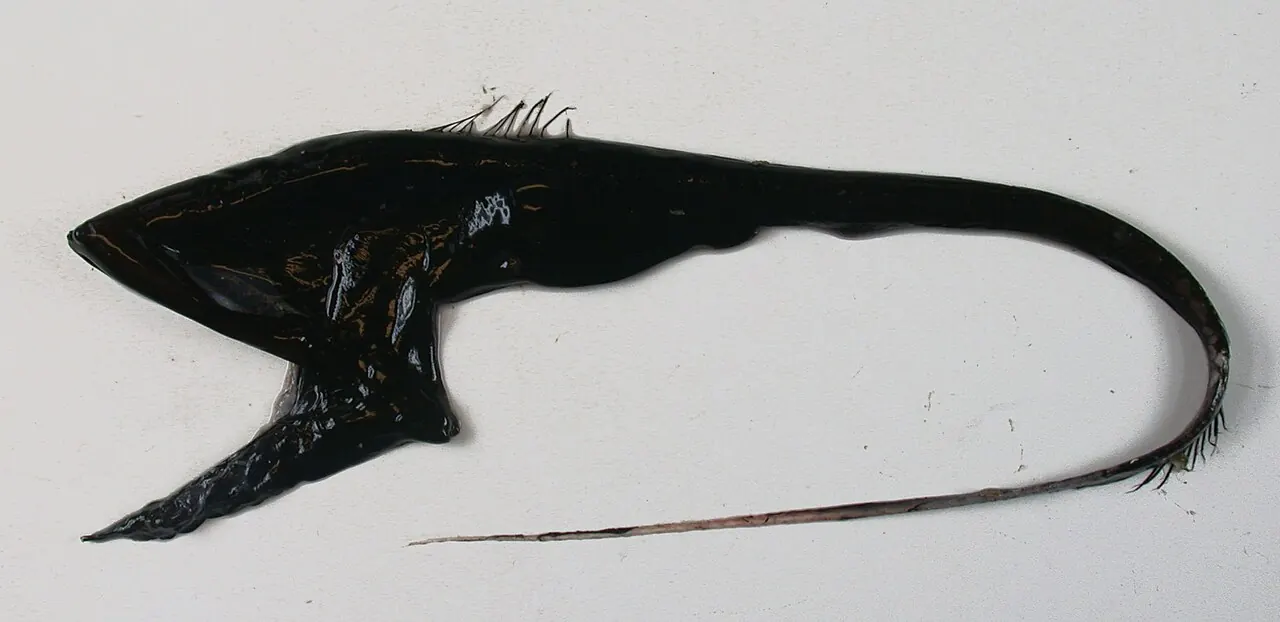
Gulper Eel
Eurypharynx pelecanoides
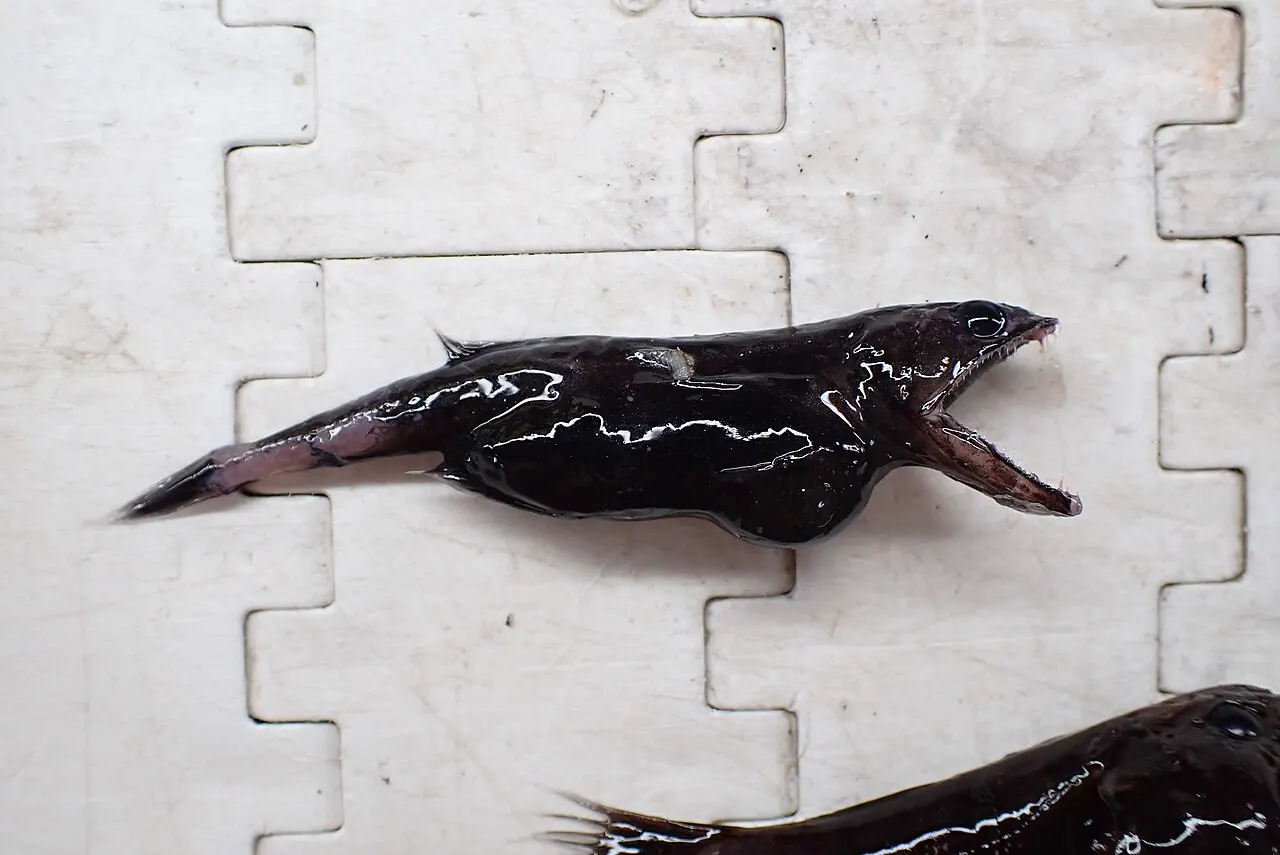
A deep-sea eel with a mouth like a pelican's pouch and a whip of a tail tipped with a light, which feeds mostly on small crustaceans.
Photo: Alexei Orlov / CC BY 3.0
3 things to know
- Its gape takes up half or more of the body's length in front of the vent.
- The thin tip of its tail carries a light organ.
- In 2018 a young gulper eel was filmed puffing its mouth up like a balloon off Hawaii.
- Scientific name
- Eurypharynx pelecanoides
- Depth
- 1,200 m – 1,400 m
3,937 – 4,593 ft - Size
- Up to about 1 m (3.3 ft) long
- Weight
- Not well known
- Lifespan
- Unknown (adults may spawn once and die)
- Diet
- Mainly crustaceans; also fish, squid and other invertebrates
- Where
- Tropical and temperate oceans worldwide; in the eastern Pacific from northern California to Peru
- IUCN status
- Least Concern
- Depth zones
- Midnight
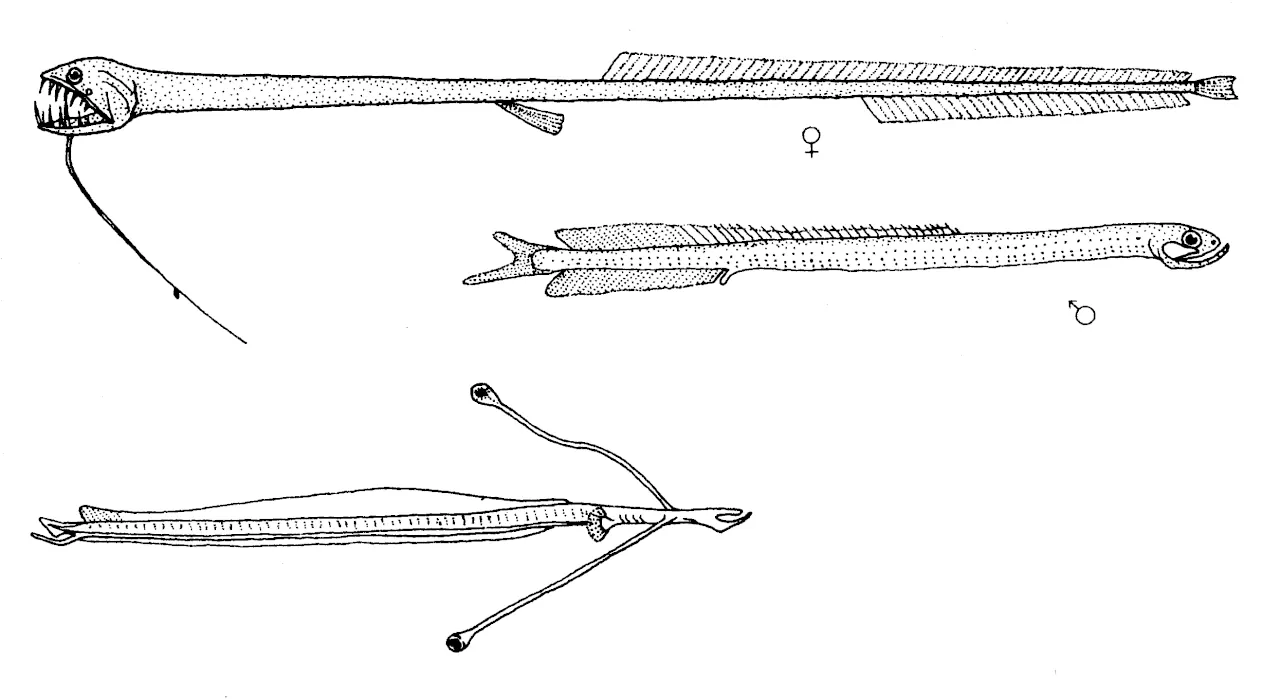
Most of a gulper eel is mouth and tail. Its jaws reach so far back that, according to FishBase, the gape takes up half or more of the body's length in front of the vent, and the mouth cavity can stretch enormously. There are no scales and no tail fin; the tail thins to a whip that ends in a light-producing organ. The Australian Museum describes tiny eyes close to the snout, several rows of small teeth and a black body, and notes that it is the only species in its family. FishBase gives a maximum length of 1 meter (3.3 feet).
Gulper eels, also called pelican eels, live in open water in tropical and temperate seas worldwide, including the eastern Pacific from northern California to Peru. FishBase records them from 500 to 7,625 meters (1,640 to 25,000 feet) deep, but usually at 1,200 to 1,400 meters (3,900 to 4,600 feet).
For all that mouth, the Australian Museum says the main food is crustaceans, with some fish, squid and other invertebrates. The eel is believed to take in prey with a quantity of water, then push the water out through its gill openings.
In September 2018, the team aboard the exploration ship Nautilus filmed one in Papahānaumokuākea Marine National Monument off Hawaii, the largest contiguous marine protected area in the United States. On camera, the eel blew its mouth up into a black balloon, then abruptly deflated it and swam away. The team thought it was a juvenile, since adults can reach about 3 feet. National Geographic reported that a separate sighting in the Gulf of Mexico had some researchers wondering whether the ballooning happens when the fish feels threatened.
Its eggs drift in the plankton and hatch into drifting larvae of the type called leptocephali. As males mature, the Australian Museum says, their smell organs enlarge while their teeth and jaws degenerate. FishBase notes signs of breakdown in both sexes, which suggest they spawn once and die. How long they live is unknown. The IUCN lists the species as Least Concern.
Sources
- fishbase.se/summary/Eurypharynx-pelecanoides.html
- australian.museum/learn/animals/fishes/pelican-eel-eurypharynx-pelecanoides
- nautiluslive.org/video/2018/09/20/gulper-eel-balloons-its-massive-jaws
- nationalgeographic.com/animals/article/gulper-eel-video-deep-sea-fish-nautilus-news
- marinespecies.org/aphia.php
- commons.wikimedia.org/wiki/File:Eurypharynx.jpg