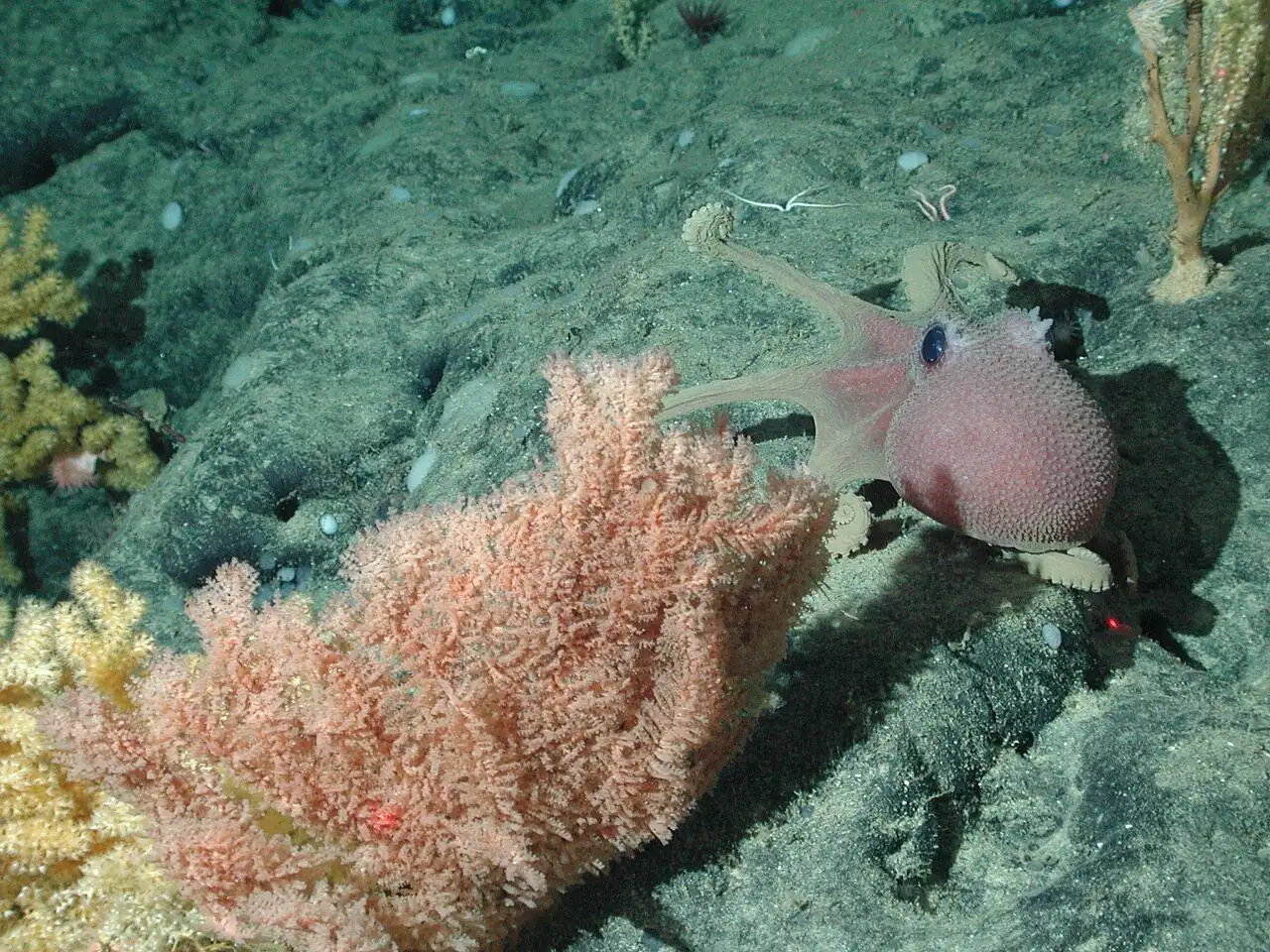
Graneledone Octopus
Graneledone boreopacifica
A deep-sea octopus of the North Pacific. One female in Monterey Canyon guarded her eggs for 53 months, longer than any other animal on record.
Photo: NOAA/Monterey Bay Aquarium Research Institute / Public domain
3 things to know
- One female in Monterey Canyon guarded her eggs for 53 months, the longest brooding period known for any animal.
- Its young hatch as miniature adults, the largest and most developed hatchlings known among octopuses and squid.
- Researchers never saw the Monterey Canyon mother eat during her years on the nest.
- Scientific name
- Graneledone boreopacifica
- Depth
- 1,200 m – 2,000 m
3,937 – 6,562 ft - Size
- Mantle (body) about 21 cm (8 in) long in one measured female
- Weight
- Unknown
- Lifespan
- Unknown; one female brooded her eggs for 53 months
- Diet
- Not well known (crabs and shrimp are potential prey)
- Where
- Deep seafloor of the North Pacific; common in the northeastern Pacific
- IUCN status
- Least Concern
- Depth zones
- Midnight
Pale purple, with heavily textured skin on its body, Graneledone boreopacifica is a deep-sea octopus of the North Pacific. MBARI counts it among the most common deep-sea octopuses in the northeastern Pacific, where brooding females are routinely seen 1,200 to 2,000 meters (3,900 to 6,600 feet) down. Northeast Pacific octopuses of the genus Graneledone differ dramatically in skin texture. A 2020 study led by Janet Voight of Chicago's Field Museum measured 50 of them, collected between 36°N and 46°N, roughly the latitudes from central California to the Oregon-Washington line, at depths of 1,116 to 2,850 meters (3,660 to 9,350 feet). Animals from deeper water were smaller and had rougher skin, and the authors concluded the variation is likely a gradual change with depth.
What it eats is not well documented. Researchers have seen crabs and shrimp, its potential prey, gathering around a brooding female. In May 2007, scientists from the Monterey Bay Aquarium Research Institute found a female clinging to a rock face about 1,400 meters (4,600 feet) down in Monterey Canyon, off central California, guarding a fresh clutch. They went back 18 times over four and a half years and found the same animal, recognizable by her scars, in the same spot each time. Bruce Robison, Brad Seibel and Jeffrey Drazen reported in 2014 that she brooded for 53 months, the longest egg-brooding period known for any animal. Nobody saw her eat, and her skin turned pale and loose.
The clutch held roughly 155 to 165 eggs. Each teardrop-shaped capsule grew from about 1.5 to 3.3 centimeters (0.6 to 1.3 inches) long, and MBARI compares them to small olives. The water at the site stays near 3°C (37°F), and the slow development pays off: the young hatch as miniature adults, ready to hunt small prey. They are the largest and most advanced hatchlings known for any octopus or squid.
Females of most octopuses lay one clutch and die around the time it hatches, and this one was gone by the next visit. How long the species lives is unknown. If brooding fills about a quarter of its life, as the 2014 authors note is typical for octopuses, it may be among the longest-lived cephalopods. The IUCN lists it as Least Concern.
Sources
- Study: doi:10.1371/journal.pone.0103437
- interactiveoceans.washington.edu/05/2023/graneledone-octopus
- mbari.org/news/deep-sea-octopus-broods-eggs-for-over-four-years-longer-than-any-known-a…
- Study: doi:10.5343/bms.2019.0039
- sealifebase.se/summary/Graneledone-boreopacifica.html
- en.wikipedia.org/wiki/Graneledone_boreopacifica