Twilight Zone · 200–1,000 m
The Goblin Shark Fires Its Jaws Out of Its Head Like a Slingshot
Rare video from Japan showed the deep-sea shark's jaws shooting forward at 3.1 meters per second. In 2014, a Gulf of Mexico shrimper caught one.
Mitsukurina owstoni
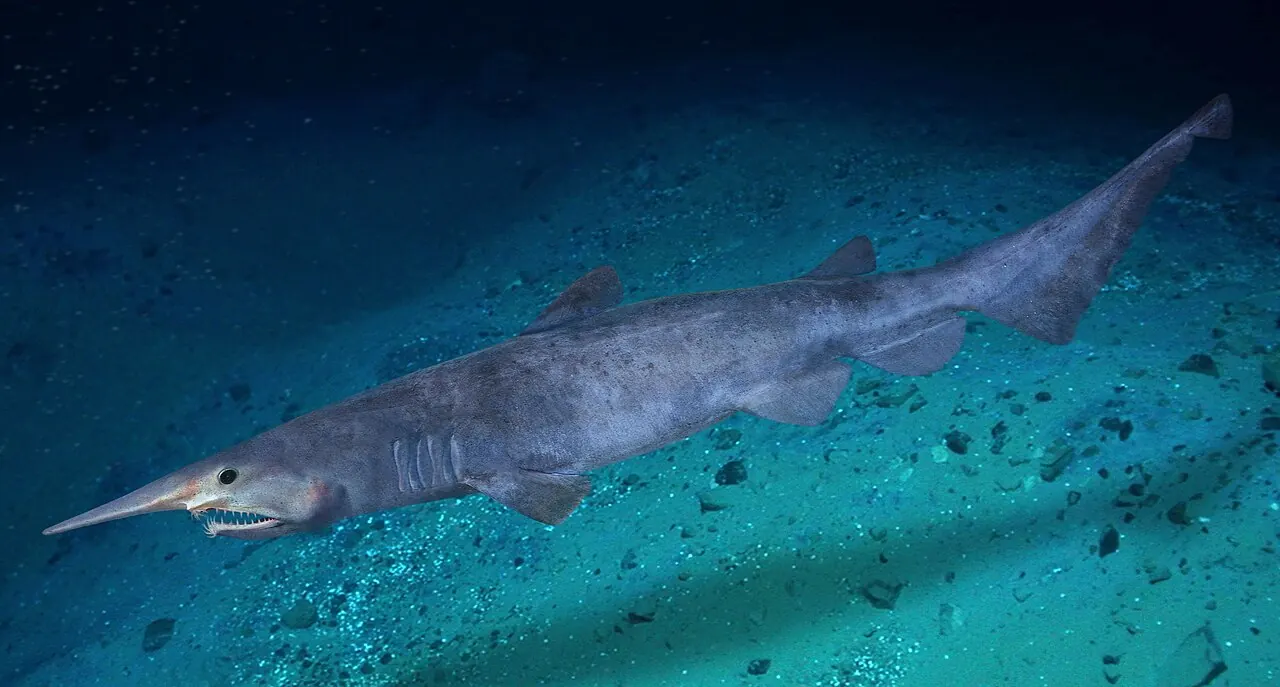
A pink, soft-bodied deep-sea shark with a blade-shaped snout and jaws that shoot forward out of its head to grab prey.
Photo: Michigan State University/USFWS / Public domain
A long, flat, blade-like snout and a pinkish-white body make the goblin shark hard to confuse with anything else. The pink comes from blood vessels showing through the skin. The fins are bluish gray, the eyes tiny, the body soft and flabby, and the long tail has no lower lobe. Specimens turn brownish after death.
Goblin sharks live along outer continental shelves, upper slopes and seamounts, most often 270 to 960 meters (about 890 to 3,150 feet) down. Records are scattered. Most come from Japan, and others from the Atlantic, the Indian Ocean, Australia, New Zealand, Southern California and the northern Gulf of Mexico. In 2026, researchers reported the first goblin sharks filmed alive in their natural habitat: one recorded by a robot at 1,237 meters near Jarvis Island in the Pacific, and one by a baited camera at 1,997 meters on the slope of the Tonga Trench, about 700 meters deeper than the species was known to live.
Mature adults measured so far run about 2.6 to 3.8 meters (9 to 13 feet). Measurements taken from photographs suggest some reach 5.4 to 6.2 meters (18 to 20 feet), though the true maximum is unknown. The front teeth are long and slender, suited to soft prey such as shrimp, octopus, squid and fish, while flatter teeth at the back may crush crabs. It is thought to give birth to live young, but nobody has ever caught a pregnant female.
Those teeth sit in jaws that normally stay tucked under the snout. When the shark strikes, the jaws launch forward. Video of two young sharks off Japan, analyzed by Kazuhiro Nakaya's team at Hokkaido University, showed the jaws shooting out at up to 3.1 meters per second (about 7 mph) and reaching 8.6 to 9.4 percent of the shark's body length, by far the fastest and farthest jaw protrusion known in sharks. The team suggests it evolved for the food-poor deep sea, possibly at the cost of strong swimming.
The IUCN lists the goblin shark as Least Concern. It turns up only as occasional bycatch in deep trawls, longlines and gill nets, and there is no major market for it.