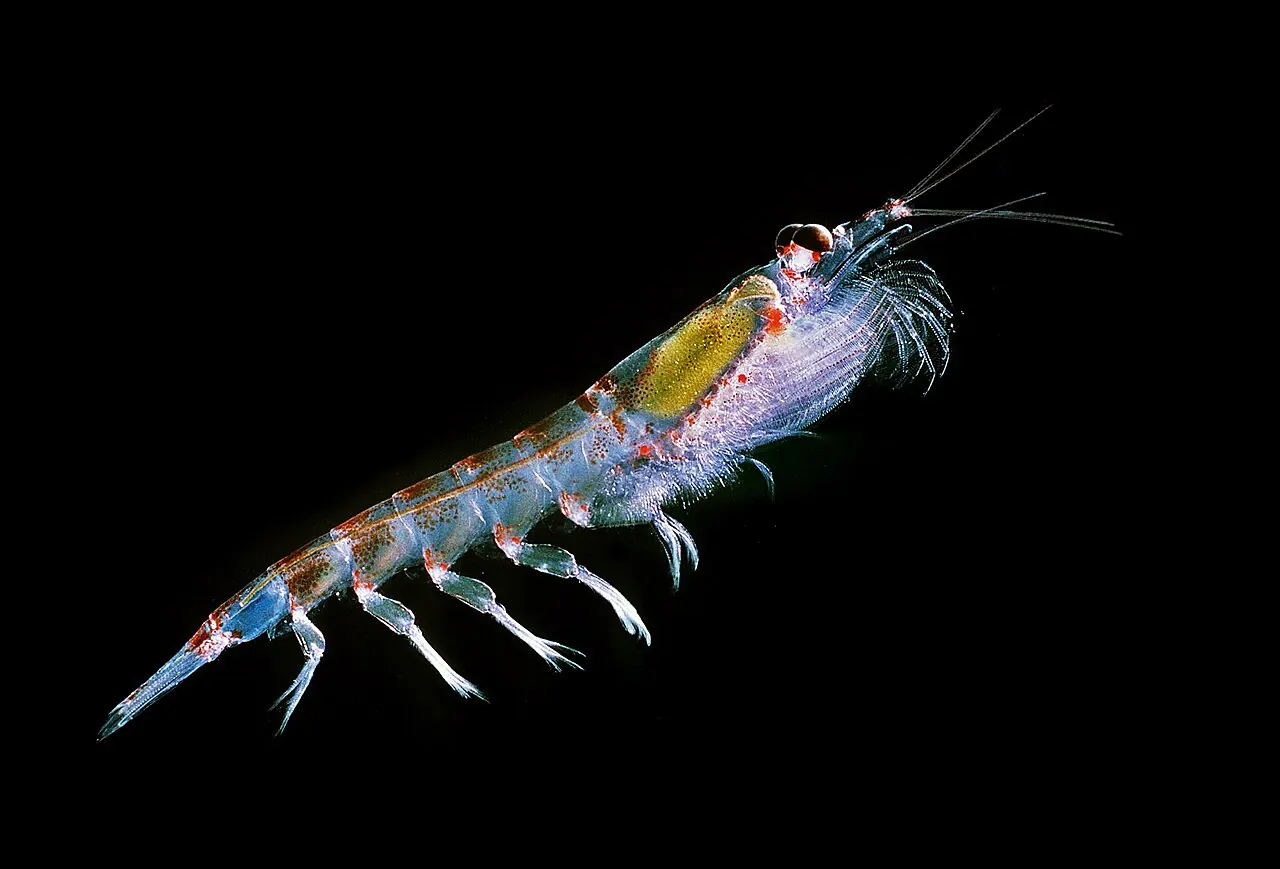
Antarctic Krill
Euphausia superba
A shrimp-like animal about 6 cm long whose Southern Ocean swarms add up to hundreds of millions of tons and feed whales, seals and penguins.
Photo: Uwe Kils / CC BY-SA 3.0
3 things to know
- A single swarm can hold up to 30,000 krill in one cubic meter of water.
- Krill keep molting all their lives and can shrink when food runs out.
- Their total weight is estimated at 300 million to 500 million metric tons.
- Scientific name
- Euphausia superba
- Depth
- 0 m – 300 m
0 – 984 ft - Size
- About 6 cm (2.4 in) long as adults
- Weight
- A little over 1 g (0.04 oz) as adults
- Lifespan
- Estimated 5 to 10 years
- Diet
- Mainly phytoplankton; in winter, algae under the sea ice, seafloor detritus and small animals
- Where
- Southern Ocean, all the way around Antarctica
- IUCN status
- Least Concern
- Depth zones
- Sunlight · Twilight
Swarms of Antarctic krill can pack up to 30,000 animals into one cubic meter of seawater, enough to turn the sea reddish brown. Each krill is a shrimp-like crustacean about 6 centimeters (2.4 inches) long and a little over a gram in weight. The body is mostly see-through, with red pigment spots and large black eyes, and the gut often shows green from the algae it has eaten, according to the Australian Antarctic Division.
Antarctic krill live only in the Southern Ocean, all the way around the continent. SeaLifeBase lists them from the surface to about 300 meters (980 feet), usually 15 to 130 meters down, with adults gathering near the edge of the continental shelf and eggs and larvae farther offshore. They usually feed near the surface at night and sink deeper by day. Their main food is phytoplankton. In winter, when that runs short, they graze algae off the underside of the sea ice, eat detritus from the seafloor or catch other small animals.
A female may lay several broods in a season, each with as many as 8,000 eggs. The eggs sink for about a week, as deep as 1,000 meters, before hatching, and the larvae swim back up toward the light. Adults are estimated to live 5 to 10 years, though aging them is hard, partly because krill never stop molting. In lab studies they have survived more than 200 days without food by molting into smaller bodies and burning their own protein. At the end of summer, adults can lose their sexual features and molt back into something that looks like a two-year-old juvenile.
Whales, seals, penguins and fish all depend on them. A 2020 review put their combined weight at 300 million to 500 million metric tons, the largest of any wild multicellular animal species. In 2024, Emma Cavan and colleagues estimated that their sinking fecal pellets lock away about 20 million metric tons of carbon each productive season. The IUCN lists the species as Least Concern, in an assessment from 2015. Whether krill numbers are falling in the southwest Atlantic, where a commercial fishery concentrates, is still argued over by krill scientists.



