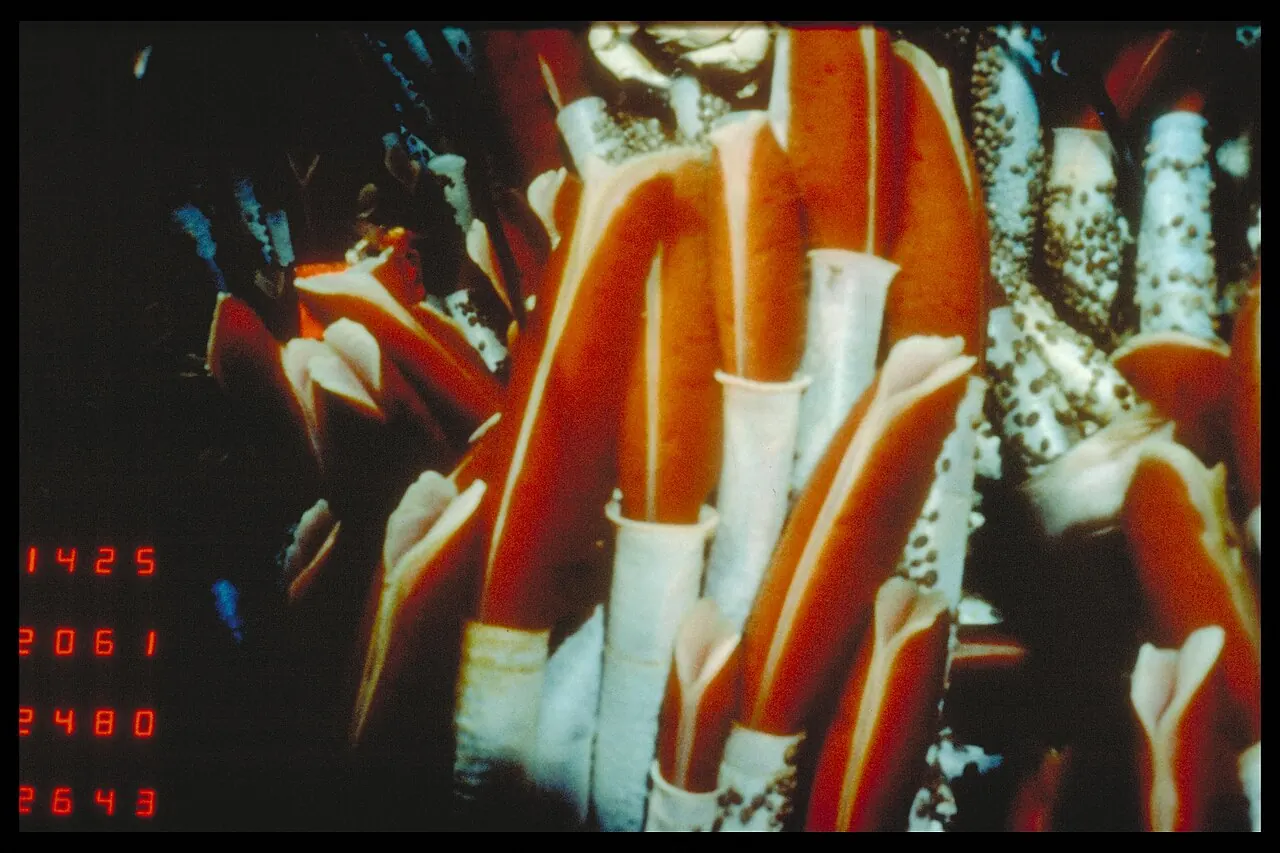
Giant Tube Worm
Riftia pachyptila
A deep-sea vent worm up to 2 meters long with no mouth or gut, fed by bacteria living inside its body.
Photo: Ifremer / CC BY 4.0
3 things to know
- Its red plume works like a gill for oxygen and hydrogen sulfide.
- Young worms take in their bacteria through the skin.
- Adults have no mouth and no gut.
- Scientific name
- Riftia pachyptila
- Depth
- 1,900 m – 3,600 m
6,234 – 11,812 ft - Size
- Up to about 2 m (6.6 ft) long by MBARI's figure; tubes up to 3 m (10 ft) reported
- Weight
- Not well known
- Lifespan
- Unknown
- Diet
- No mouth or gut as an adult; fed by sulfur-oxidizing bacteria living inside its body
- Where
- Hydrothermal vents of the East Pacific Rise and the Galapagos Rift
- IUCN status
- Not Evaluated
- Depth zones
- Midnight
Most of a giant tube worm stays hidden. What shows is a white tube capped with a bright red plume, and the plume is red for the same reason your blood is: it is full of hemoglobin. MBARI gives a maximum size of about 2 meters (6.6 feet), while SeaLifeBase reports tubes up to 3 meters (10 feet) long, holding a worm of only about 1 meter. Inside the tube, the adult worm has no mouth and no gut.
Riftia pachyptila lives at hydrothermal vents on the East Pacific Rise and the Galapagos Rift, 1,900 to 3,600 meters (6,200 to 11,800 feet) down, according to MBARI. Colonies crowd where warm, mineral-laden water flows out of the seafloor. When a vent stops flowing, the whole colony may die off, but tubeworm larvae quickly settle on new hot springs that open, often dozens or even hundreds of miles away. Biologists who came to the Galapagos Rift vents in 1979 found tubeworms with no mouth to take in food and no guts to digest it.
Its food comes from bacteria packed inside an organ called the trophosome. In 1981, Colleen Cavanaugh and colleagues reported evidence that these were chemoautotrophic bacteria, microbes that make food from chemicals instead of sunlight. The feather-like plume acts as a gill, taking up oxygen from seawater and hydrogen sulfide from the vent fluid, and a special hemoglobin in the worm's blood carries both at once to the bacteria. The bacteria use the sulfide's energy to make organic carbon, and the worm lives on what they produce.
The partnership starts from scratch every generation. Larvae settle with no bacteria and a temporary digestive system. In 2006, Andrea Nussbaumer, Charles Fisher and Monika Bright reported that the bacteria colonize the tube of a settled larva and then push in through its skin. Later the young worm destroys large parts of its own skin and muscle in a wave of programmed cell death, and the adult is left fully dependent on its bacteria.
The plume is a vulnerable target, and when a predator such as a vent crab comes close, the worm can pull it back into the tube. How long a giant tube worm lives is unknown, and the species has not been assessed for the IUCN Red List.