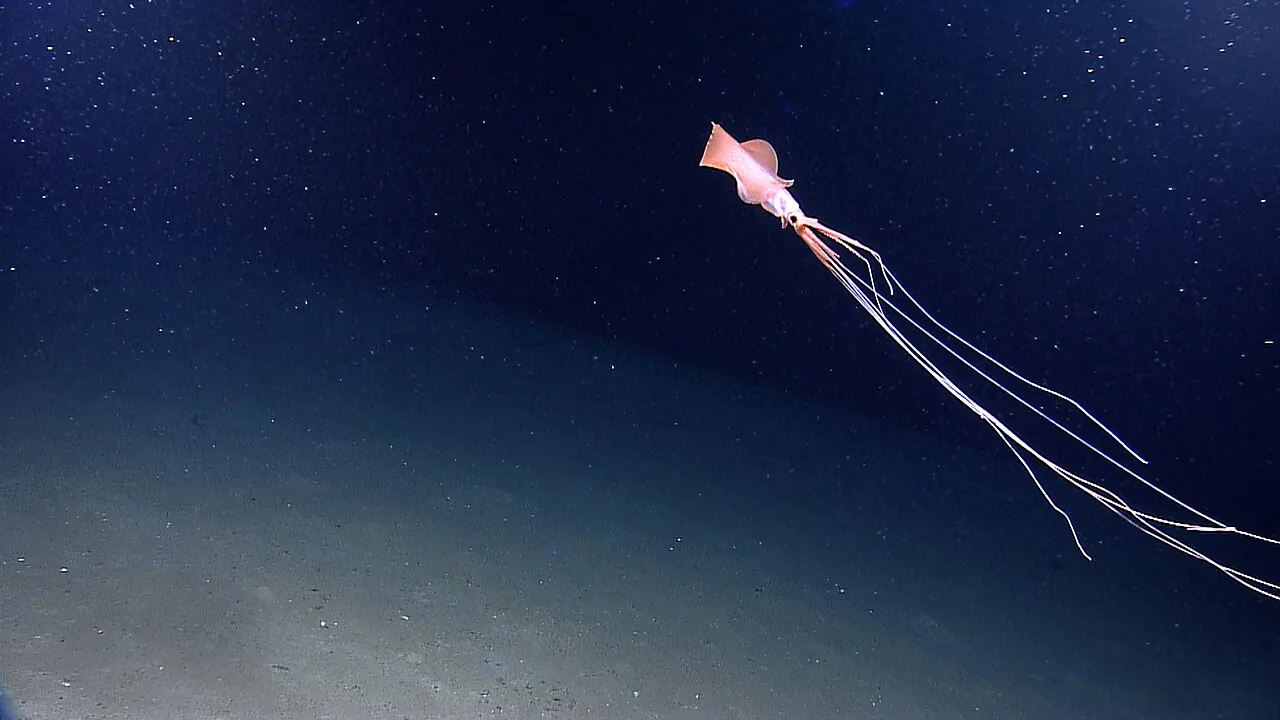
Bigfin Squid
Magnapinna spp. (family Magnapinnidae)
A rarely seen deep-sea squid with huge fins and arms that bend at an elbow into long, thread-like filaments.
Photo: NOAA Okeanos Explorer Program, Gulf of Mexico 2012 Expedition / CC BY 2.0
3 things to know
- Its arm filaments may be up to 20 times the length of its body.
- Only about 70 have ever been seen by submersibles or caught in scientific trawls.
- One seen at 6,212 m (20,380 ft) in the Philippine Trench is the deepest squid on record.
- Scientific name
- Magnapinna spp. (family Magnapinnidae)
- Depth
- 1,600 m – 6,200 m
5,250 – 20,342 ft - Size
- Estimated up to about 6.4 m (21 ft) long, mostly arm and tentacle filaments
- Weight
- Unknown
- Lifespan
- Unknown
- Diet
- Unknown
- Where
- Deep water in tropical and temperate oceans worldwide
- IUCN status
- Data Deficient (the two species assessed)
- Depth zones
- Midnight · Abyss · Hadal
A bigfin squid holds its eight arms and two tentacles out to the sides, then bends them at a sharp, elbow-like joint and lets them trail behind as long, thin, sticky filaments. MBARI, the Monterey Bay Aquarium Research Institute, says the filaments may be up to 20 times the length of the body and estimates the whole animal at up to 6.4 meters (21 feet). Two large fins on the teardrop-shaped body give the group its name, and the squid swims by rippling them.
The genus is Magnapinna. One was collected as early as 1883, but the family was not described until 1998, by Michael Vecchione and Richard Young, from damaged young squid netted near the surface in the eastern Pacific. No adult has ever been collected. In 2001 Vecchione and colleagues pulled together sightings of the long-armed adults from submersibles around the world in the journal Science, and three species now carry names.
Adults live in the midnight zone and deeper, often hovering near the seafloor. MBARI gives a range of 1,600 to 6,200 meters (5,200 to 20,300 feet), while the young drift near the surface. One seen at 6,212 meters (20,380 feet) in the Philippine Trench is the deepest squid on record.
Sightings are rare. MBARI counts only about 70 bigfin squid ever seen by submersibles or caught in scientific trawls. Its own robots have met the animal twice in four decades: off Oʻahu, Hawaiʻi, in 2001, and near Davidson Seamount off Central California in 2026, with NOAA collaborators. In the Great Australian Bight, a towed camera and remotely operated vehicles recorded five in 2015 and 2017, the first in Australian waters, at about 2,100 to 3,060 meters. Deborah Osterhage and colleagues measured one with paired lasers at about 1.8 meters long and saw another with several filaments coiled, a behavior not seen before in squid.
What it eats is unknown. The filaments snap back quickly when disturbed, and MBARI scientists suspect the squid uses them to catch food. The IUCN lists the two species it has assessed, M. pacifica and M. atlantica, as Data Deficient; the listed range of M. pacifica includes US waters off California and Hawaii.