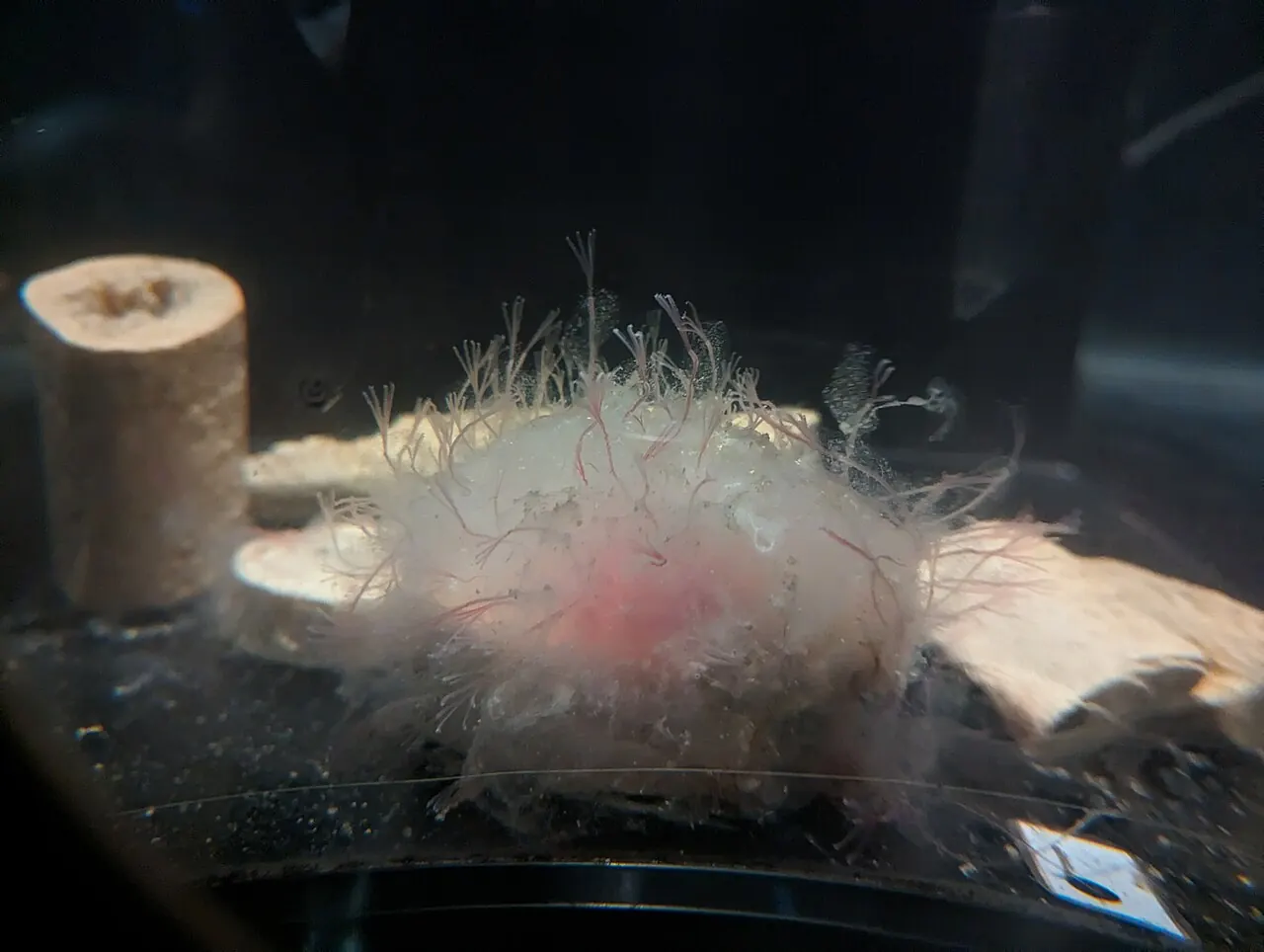
Bone-Eating Worms
Osedax spp.
Mouthless, gutless worms that drill into sunken bones with acid and live on the fats and collagen inside, helped by bacteria.
Photo: Syced / CC0
3 things to know
- The adults have no eyes, legs, mouths or stomachs.
- Males are microscopic and live inside the female's tube.
- They can strip a sunken whale skeleton in about a decade.
- Scientific name
- Osedax spp.
- Depth
- 10 m – 4,204 m
33 – 13,793 ft - Size
- Females up to about 15 cm (6 in) long; dwarf males usually under 1 mm
- Weight
- Unknown
- Lifespan
- Unknown
- Diet
- Bone: collagen and fats from sunken skeletons, digested with help from symbiotic bacteria
- Where
- Sunken bones in many oceans; first found off California, later off Sweden, Japan and elsewhere
- IUCN status
- Not Evaluated
- Depth zones
- Sunlight · Twilight · Midnight · Abyss
Osedax worms have no eyes, legs, mouths or stomachs. A female shows only a feathery red plume waving in the water. Below it, her body reaches down into a bone and ends in green, root-like tissue that spreads into the marrow cavity. The genus name is Latin for "bone devourer." Females reach at most about 15 centimeters (6 inches).
MBARI scientists found the first ones in 2002 on a dead gray whale in Monterey Canyon, off central California, almost 3,000 meters (about 9,800 feet) down. Greg Rouse, Shana Goffredi and Robert Vrijenhoek named the genus and its first two species in 2004. Within a year of the find, the worms also turned up on whale carcasses sunk on purpose off Sweden and Japan. By 2017, MBARI counted 18 species in Monterey Bay and 32 worldwide, from about 10 to 4,000 meters (33 to 13,100 feet) deep. A new species reported in 2016 from a whale skeleton 4,204 meters (13,790 feet) down off Brazil lives deeper still.
The roots do the eating. In a 2013 study, Martín Tresguerres, Sigrid Katz and Rouse found the roots loaded with a proton pump that secretes acid, along with an enzyme that supplies it. They proposed that the worm dissolves the bone's mineral with acid, much as our own bone cells called osteoclasts do, and then absorbs the nutrients through its skin. Symbiotic bacteria in the roots help break down the collagen and fats. The worms are not fussy: MBARI found species that colonize the bones of fish, birds, turtles, and marine and land mammals, and they can remove visible traces of a whale skeleton in as little as a decade.
Their sex lives are lopsided. Larvae that settle on bare bone become females, while later arrivals that land on a female become dwarf males, usually less than a millimeter long. These males live inside the gelatinous tube around her body and never feed on bone, and females of some larger species have been found with more than 600 of them. One species, Osedax priapus, breaks the pattern with bone-eating males nearly as large as the females. Fossil traces in plesiosaur and sea turtle bones point to an origin in the age of marine reptiles. How long an individual worm lives is unknown.
Sources
- mbari.org/project/osedax-studies
- annualreport.mbari.org/2017/story/uncovering-the-deep-sea-world-of-bone-eating-worms
- mbari.org/news/fleshing-out-the-life-histories-of-dead-whales
- Study: doi:10.1126/science.1098650
- Study: doi:10.1098/rspb.2013.0625
- pmc.ncbi.nlm.nih.gov/articles/PMC4832464
- Study: doi:10.1038/srep22139
- commons.wikimedia.org/wiki/File:Osedax_Japonicus,_at_Enoshima_Aquarium.jpg



