Xenophyophores
Xenophyophoroidea
Giant single-celled protists that build fragile shells of seafloor grains, some as wide as 24 cm, from 500 m down to the deepest trenches.
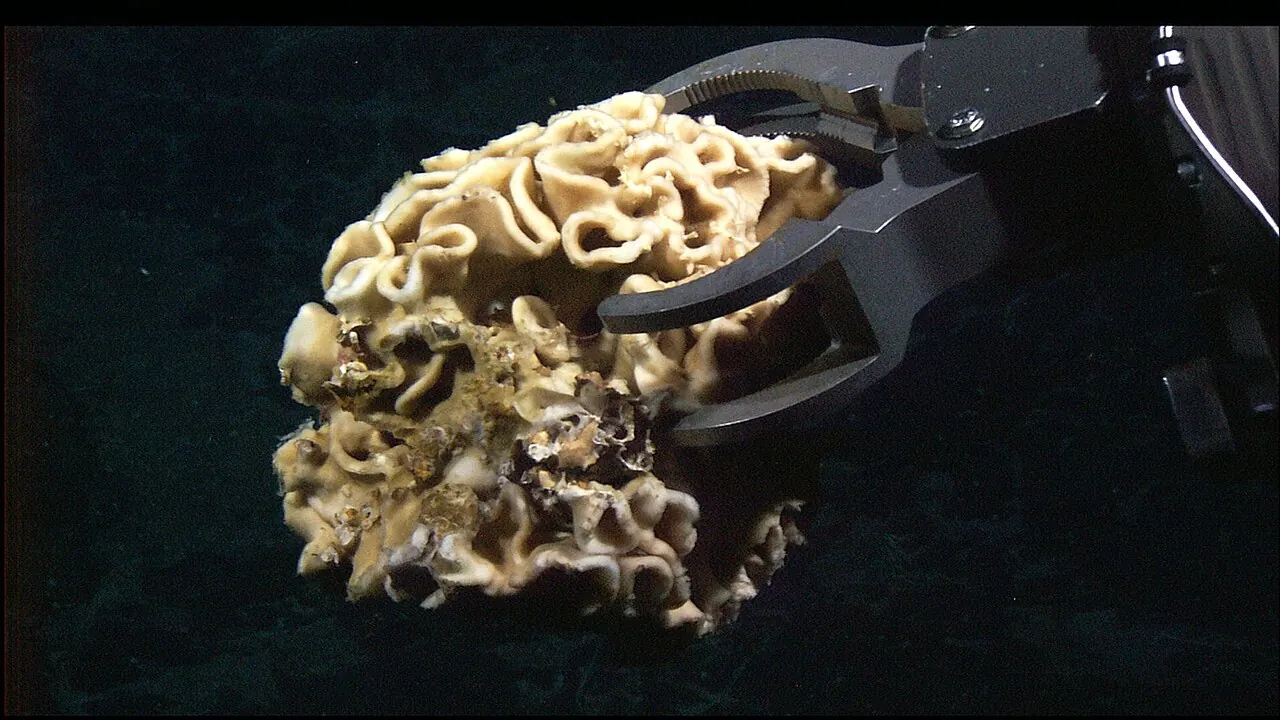
Photo: IFE, URI-IAO, UW, Lost City Science Party; NOAA/OAR/OER / Public domain
3 things to know
- Each one is a single cell, among the largest known.
- They have been filmed 10,641 meters down in the Mariana Trench.
- Three tracked on the Atlantic seafloor grew tenfold in volume in 291 days.
- Scientific name
- Xenophyophoroidea
- Depth
- 500 m – 10,641 m
1,640 – 34,913 ft - Size
- Large ones over 10 cm (4 in) across; up to about 24 cm (9 in)
- Weight
- Unknown
- Lifespan
- Unknown
- Diet
- Organic particles gathered from the sediment, caught from the water or trapped in the test; possibly dissolved organic matter
- Where
- Deep seafloor in all oceans, below about 500 m
- IUCN status
- Not Evaluated
- Depth zones
- Twilight · Midnight · Abyss · Hadal
A xenophyophore is a single cell that builds its home out of the seafloor. It gathers grains and other particles from the sediment around it and cements them into a fragile shell, called a test, that can be shaped like a plate, a ball, a lump or a branching tangle. Large tests exceed 10 centimeters (4 inches) across and can reach 24 centimeters (9 inches), which puts xenophyophores among the largest single-celled organisms known.
They were once treated as a group of their own, but genetic studies showed they are giant foraminifera, relatives of the mostly tiny single-celled organisms that build shells. Xenophyophores live on hard and soft bottoms in all the oceans below about 500 meters (1,600 feet). They are most common where the seafloor gets extra food, such as under upwelling areas, on seamounts and in submarine canyons. In 2011, a Scripps Institution of Oceanography expedition filmed them 10,641 meters (about 6.6 miles) down in the Mariana Trench, the deepest known record for the group at the time.
The living cell fills only a small part of its test. How it feeds is still unsettled. A 2020 review led by Andrew Gooday of the National Oceanography Centre in Southampton, England, lists the likely options: gathering material from the sediment surface, catching particles from the water, trapping them in the test, or absorbing dissolved organic compounds. Tests can also concentrate metals such as lead, uranium and mercury, and they shelter many small animals. Off Costa Rica, Lisa Levin and Greg Rouse of Scripps found snailfish eggs tucked inside them.
Some grow fast. Time-lapse photos on the Madeira Abyssal Plain in the northeast Atlantic showed three xenophyophores increasing tenfold in volume over 291 days. Eighty-three species had been formally described by 2020. They dominate the large life on the abyssal plains of the Clarion-Clipperton Zone in the Pacific, where 63 species have been recognized, 39 of them not yet named, and where companies are exploring for seabed mining. The 2020 review expects species that live on the metal-rich nodules not to recover from mining, since nodules take millions of years to form.