Tripod Fish
Bathypterois grallator
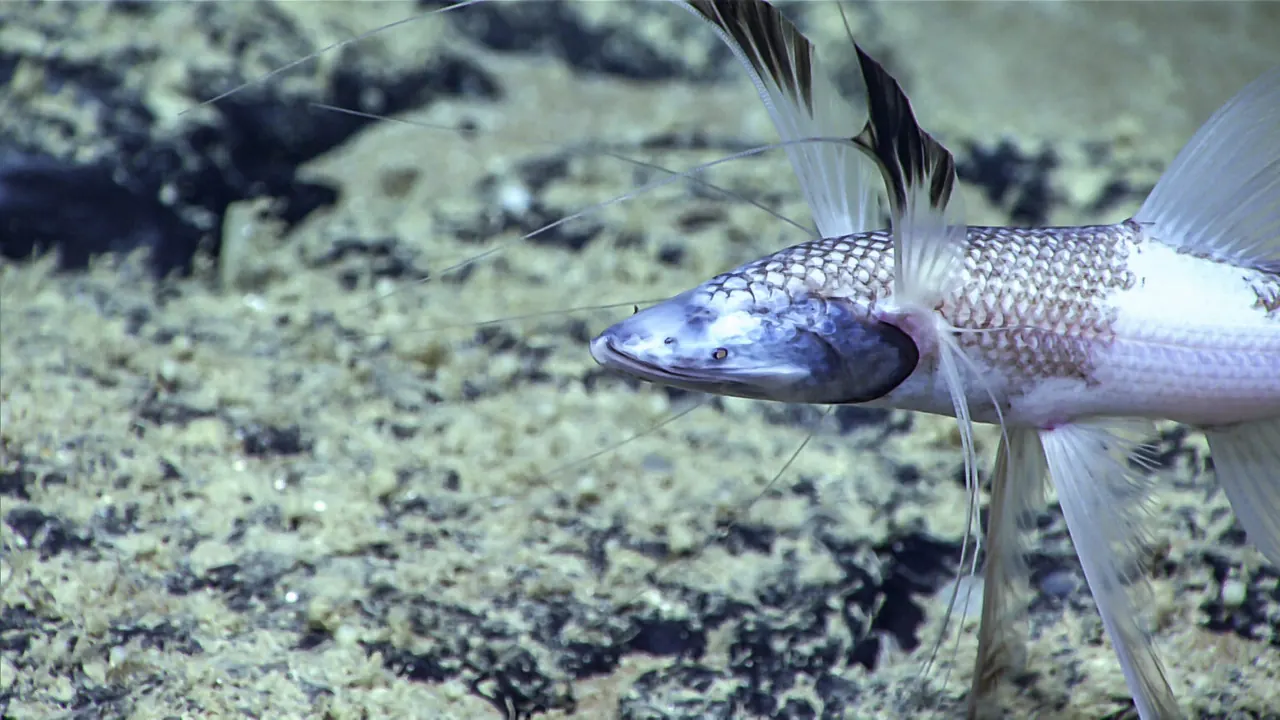
A deep-sea fish that stands on three long fin rays above the seafloor, facing the current and waiting for food to drift within reach.
Photo: NOAA Office of Ocean Exploration and Research, Windows to the Deep 2019 / Public domain
3 things to know
- Its three stilts are single rays from the two pelvic fins and the lower lobe of the tail.
- It holds its winglike pectoral fins forward, and NOAA says their tips work as feelers.
- Each fish carries working male and female reproductive tissue at the same time.
- Scientific name
- Bathypterois grallator
- Depth
- 900 m – 4,720 m
2,953 – 15,486 ft - Size
- About 37 cm (15 in) long without the tail fin; up to 43 cm (17 in) in total
- Weight
- Unknown
- Lifespan
- Unknown
- Diet
- Copepods, other small crustaceans and soft-bodied plankton drifting in the current
- Where
- Tropical and warm temperate Atlantic, Indian and western central Pacific oceans, including the US East Coast and the Gulf of Mexico
- IUCN status
- Least Concern
- Depth zones
- Twilight · Midnight · Abyss
Bathypterois grallator spends its time propped above the seafloor on three long, thin fin rays. Rays in the two pelvic fins, under the belly, are longer than the fish's body, and a third support comes from the lower lobe of the tail. Small pads on their tips keep it from sinking into soft mud. Observers describe the rays as flexible while the fish swims and stiff once it perches. Fishes of Australia, which calls it the tripod spiderfish, gives its length as about 37 centimeters (15 inches) not counting the tail fin, and FishBase lists a total length of 43 centimeters (17 inches).
It lives on the lower continental slope, the continental rise, ocean ridges and the abyssal plain, at roughly 900 to 4,720 meters (about 3,000 to 15,500 feet). The range covers tropical and warm temperate parts of the Atlantic, Indian and western central Pacific oceans. In US waters, FishBase places it along the East Coast from about 40 degrees north, the latitude of New Jersey, south into the Gulf of Mexico and the Caribbean. NOAA's 2019 Windows to the Deep expedition photographed one propped up on the seafloor off the Southeast.
Standing still is how it eats. The tripod fish perches alone, faces upstream and holds its long pectoral fins up or forward. NOAA describes it as a blind ambush predator whose pectoral fins are tipped with sensitive feelers that let it sense nearby prey. Its food is whatever the current brings: copepods and other tiny crustaceans, plus soft-bodied plankton.
Like the rest of its family, the spiderfishes, it is a simultaneous hermaphrodite. Each fish has a single combined organ, an ovotestis, that holds working male and female tissue at once. How long it lives is not known.
Goode and Bean named the species in 1886 from specimens that included one taken in the deep Gulf of Mexico at 1,850 fathoms, about 3,380 meters. Its name fits: grallator is Latin for one who walks on stilts. The IUCN Red List rates it as Least Concern.