Triplewart Seadevil
Cryptopsaras couesii
A deep-sea anglerfish named for three glowing bumps on its back, whose tiny males fuse to females for life.
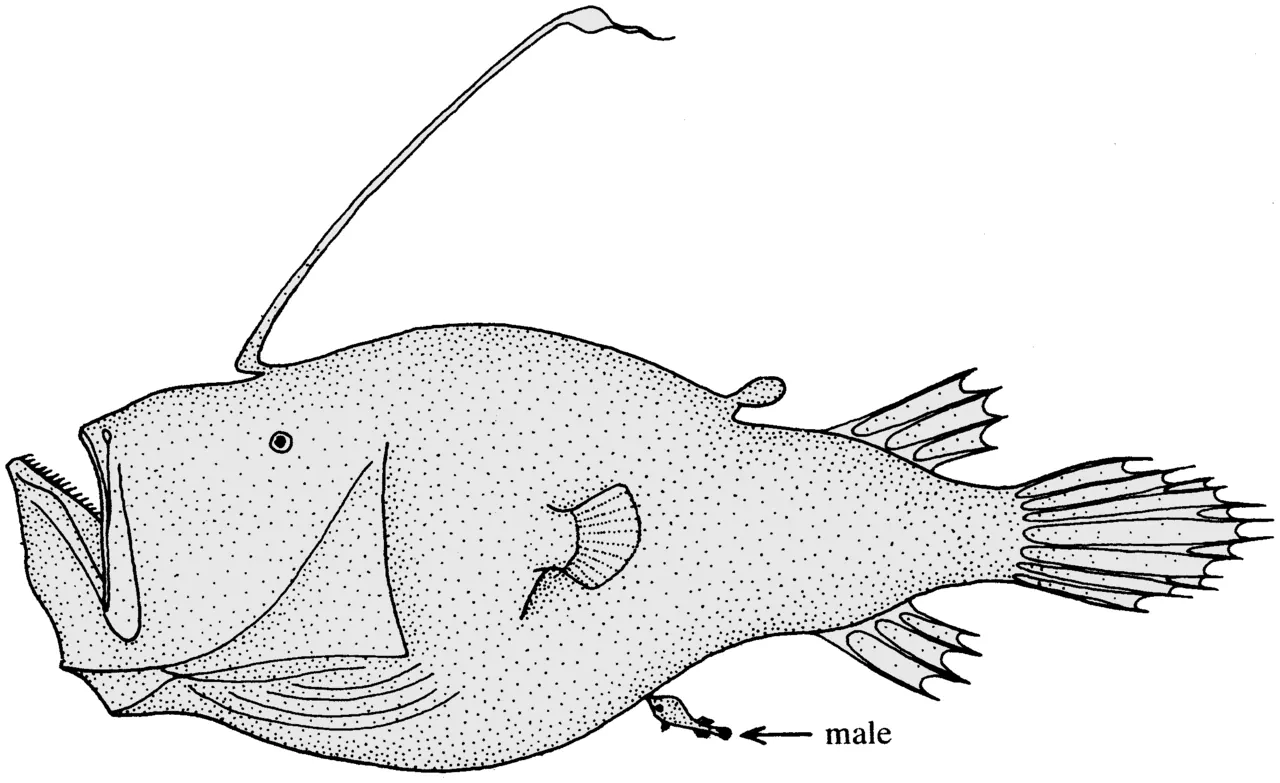
Illustration: Dr Tony Ayling / CC BY-SA 1.0
3 things to know
- The three bumps on its back are modified fin rays, each with a light-producing gland.
- One female caught by a Japanese research ship carried eight fused males.
- Free-living males are only about a centimeter long and must find a female to survive.
- Scientific name
- Cryptopsaras couesii
- Depth
- 500 m – 1,250 m
1,640 – 4,101 ft - Size
- Females up to about 44 cm (17 in); free-living males about 1 to 1.4 cm (0.4 to 0.6 in), attached males larger
- Weight
- Unknown
- Lifespan
- Unknown
- Diet
- Not well known
- Where
- Tropical and subtropical waters of all oceans
- IUCN status
- Least Concern
- Depth zones
- Twilight · Midnight
Three small bumps on the back, just in front of the soft dorsal fin, give the triplewart seadevil its name. Each is a modified fin ray, called a caruncle, holding a light-producing gland. The female is a dark anglerfish with a large head, a tiny eye, skin covered in needle-like spinules and a mouth that opens almost straight up. Her lure is unusual, too: the bone that would normally form the fishing rod is a tiny remnant almost entirely wrapped in the tissue of the glowing bulb, which is where the genus name Cryptopsaras, hidden fisherman, comes from. Females grow to about 44 centimeters (17 inches).
The species lives in tropical and subtropical waters of every ocean, usually 500 to 1,250 meters (1,640 to 4,100 feet) down, though FishBase lists records from near the surface to 3,085 meters (10,120 feet). It turns up in US waters, too: a 1957 paper by Thomas Fast reported the species in Monterey Bay, and in 1958 Hurst Shoemaker described a female from the Gulf of Mexico carrying three parasitic males.
Triplewart males are dwarfs with large eyes. Toshiro Saruwatari of the University of Tokyo, citing a 1951 record, puts the largest known free-living male at 14.3 millimeters (half an inch), though FishBase gives a maximum of 1.05 centimeters (0.4 inch). In this family, attaching to a female is obligatory: a male bites onto her body, fuses with her and lives on as part of her body, and a male that fails to find a female dies. Saruwatari also described a female, 316.5 millimeters (12.5 inches) long, caught in a trawl on a cruise of the research vessel Hakuho Maru. When touched, her three bumps leaked a light bluish bioluminescent fluid. Attached to her were eight males, 35 to 56 millimeters (1.4 to 2.2 inches) long, one on her right side and seven on her left. Until then, Saruwatari wrote, the most ever seen on one female was six. DNA fingerprinting of five of the males showed that none was a sibling of the female, or of each other.
Females lay eggs, which are thought to float in gelatinous rafts, and the larvae drift in the plankton. The IUCN lists the triplewart seadevil as Least Concern, in an assessment from 2013.
Sources
- fishbase.se/summary/Cryptopsaras-couesii.html
- tolweb.org/Ceratiidae
- australian.museum/learn/animals/fishes/triplewart-seadevil-cryptopsaras-couesii-gill-1883
- churashima.okinawa/userfiles/files/page/ocrc/p128-136.pdf
- Study: doi:10.2305/IUCN.UK.2015-4.RLTS.T190067A21910480.en
- Study: doi:10.2307/1440560
- Study: doi:10.2307/1439375