Sloane's Viperfish
Chauliodus sloani
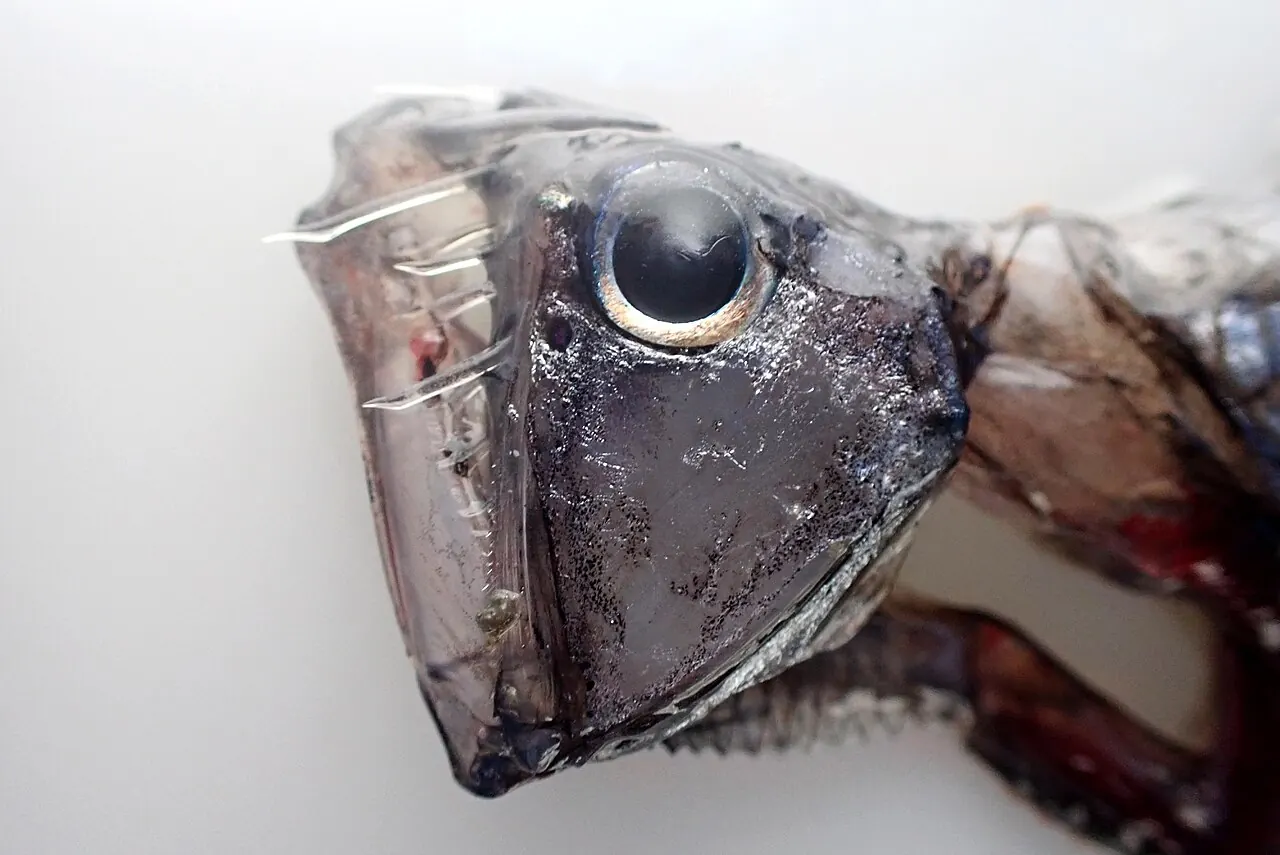
A slender, fanged deep-sea fish with a lure on its back fin that rises at night to hunt surprisingly large prey.
Photo: Isabelle Cheret / Ifremer / CC BY 4.0
3 things to know
- The first ray of its back fin can be up to half as long as its body.
- Rows of small light organs run along its sides.
- In a Mediterranean study, about 1 in 20 of its prey items were more than half its own length.
- Scientific name
- Chauliodus sloani
- Depth
- 200 m – 2,500 m
656 – 8,202 ft - Size
- Up to about 35 cm (14 in) long
- Weight
- Not well known
- Lifespan
- Unknown
- Diet
- Small midwater fishes, especially lanternfishes, and crustaceans
- Where
- Warm and temperate parts of all oceans, with some gaps; also the western Mediterranean
- IUCN status
- Least Concern
- Depth zones
- Twilight · Midnight
Long, fang-like teeth and lights along its sides make Sloane's viperfish one of the most recognizable deep-sea fishes, the Australian Museum says. In life it is an iridescent dark silver-blue with pale fins. Its sides are covered in six-sided pigmented patches, each holding one or more small light organs, or photophores, and the first ray of its back fin can be up to half as long as the body. That ray carries photophores too, which are believed to attract prey. FishBase lists a maximum length of 35 centimeters (14 inches).
It lives in the warm and temperate parts of every ocean, with some gaps, and in the western Mediterranean. Like many deep-sea fishes it commutes each day. The Australian Museum puts it at 500 to 2,500 meters (1,600 to 8,200 feet) by day, rising at night into water shallower than 600 meters (2,000 feet), where food is more plentiful. FishBase records span 200 to 4,700 meters (660 to 15,400 feet).
The Australian Museum lists its diet as mostly crustaceans and small fishes, and FishBase says it feeds mainly on lanternfishes. A 2018 study by P. Battaglia and colleagues examined the stomachs of 206 viperfish caught in the central Mediterranean between 2013 and 2015 and found only fish, from six families, along with a few cases of cannibalism. They titled the paper "Few But Relatively Large Prey." More than half of the prey items were longer than a fifth of the viperfish that ate them, and 5.4 percent were more than half its length.
The skeleton has an odd gap. In a cleared and stained specimen pictured on the Australian Museum's species page, the bony centers of the vertebrae just behind the head are missing, and the notochord shows through in their place.
Little is known about how it breeds. It lays eggs and is believed to spawn in open water, with males and females releasing sperm and eggs into the sea. How long it lives is unknown, and the IUCN lists it as Least Concern.