Pacific Footballfish
Himantolophus sagamius
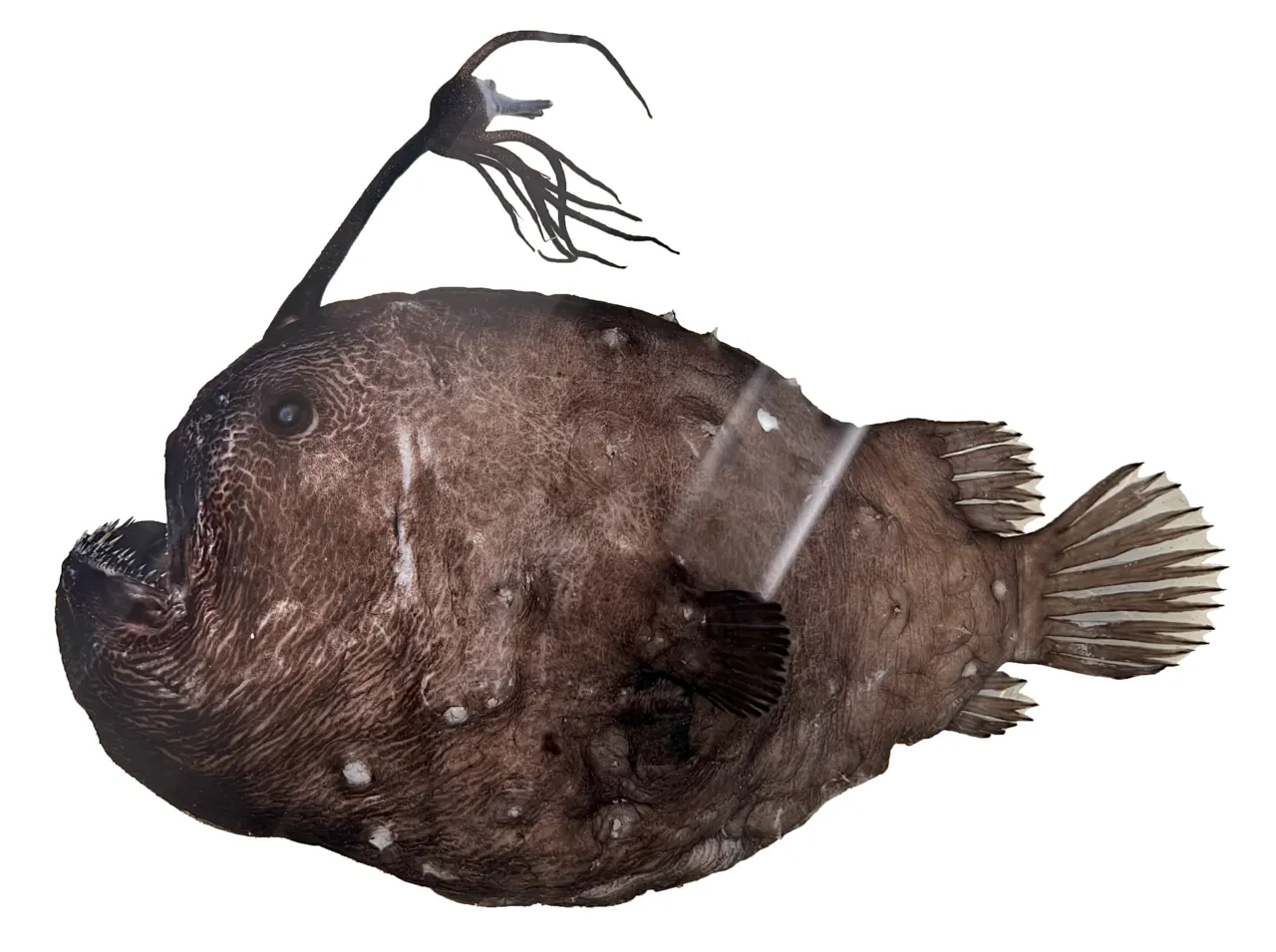
A round, spiny deep-sea anglerfish so rarely seen that each one washing up on a California or Oregon beach makes the news.
Photo: Macrophyseter / CC BY-SA 4.0
3 things to know
- Only about 30 female Pacific footballfish were held in museum collections worldwide as of 2021.
- The lure of one stranded female glowed green under blue light, the first biofluorescence found in a deep-sea anglerfish.
- Footballfish males live free and have never been found attached to a female.
- Scientific name
- Himantolophus sagamius
- Depth
- 613 m – 1,200 m
2,011 – 3,937 ft - Size
- Up to 20 cm (8 in) recorded (FishBase), the size of a female; males in this family about 2.3 to 3.9 cm (0.9 to 1.5 in)
- Weight
- Unknown
- Lifespan
- Unknown
- Diet
- Not well known; footballfishes as a group eat fish, crustaceans and squid
- Where
- North and East Pacific: off northern Japan and the Kuril-Kamchatka region, and from California to Peru; strandings recorded in California and Oregon
- IUCN status
- Least Concern
- Depth zones
- Twilight · Midnight
In May 2021 beachgoers at Crystal Cove State Park in Newport Beach, California, found a female Pacific footballfish on the sand in nearly perfect condition. The Natural History Museum of Los Angeles County, which added it to its fish collection, called it one of only about 30 female specimens of the species held by museums worldwide. More have come ashore since: another female at Crystal Cove in October 2023, and in May 2024 one near Cannon Beach, which the Seaside Aquarium said was, to its knowledge, the first reported on the Oregon coast. Park officials have said it is unknown why they wash ashore.
A female is nearly round and dark, with a protruding, warty chin and skin studded with the bases of spines that make it hard for a predator to swallow. A short, thick stalk on her head ends in a lure, the esca, which carries glowing bacteria and trails long filaments. Her teeth point inward so prey cannot back out. FishBase gives a maximum length of 20 centimeters (8 inches), and the species lives about 613 to 1,200 meters (2,010 to 3,940 feet) down, off northern Japan and the Kuril-Kamchatka region and from California to Peru. Its species name comes from Japan's Gulf of Sagami, where the first specimen described was found.
William Ludt, the museum's ichthyology curator, and Todd Clardy examined the Crystal Cove fish under blue light and saw small spots of green biofluorescence on its esca. Their 2022 paper in the Journal of Fish Biology was the first record of biofluorescence in a deep-sea anglerfish. Those depths are starved of sunlight, so Ludt has suggested the fish's own glowing lure may be what makes the spots fluoresce, perhaps creating a more complex lure for prey or mates.
Males are a different animal in size and habits. In the footballfish family they measure about 2.3 to 3.9 centimeters (0.9 to 1.5 inches), with large nostrils and no lure. Unlike the males of some deep-sea anglerfish, which fuse to a female for life, footballfish males live free: Ted Pietsch notes that none has ever been found attached, even temporarily. The IUCN lists the Pacific footballfish as Least Concern, in an assessment from 2018.
Sources
- fishbase.se/summary/Himantolophus-sagamius.html
- nhm.org/press/natural-history-museum-los-angeles-county-presents-discovery-deep
- nhm.org/anglerfish
- Study: doi:10.1111/jfb.14988
- cbsnews.com/news/footballfish-washes-up-on-oregon-coast-in-rare-sighting
- livescience.com/animals/fish/nightmarish-deep-sea-footballfish-washes-up-on-california-…
- tolweb.org/Himantolophus
- gizmodo.com/freaky-deep-sea-anglerfish-casts-light-in-two-distinct-1848353415
- fishesofaustralia.net.au/home/family/181