Twilight Zone · 200–1,000 m
It Took Until 2012 to Film a Giant Squid Alive in the Deep
A camera lure that mimics a glowing jellyfish finally caught giant squid on video, first off Japan and then in the Gulf of Mexico.
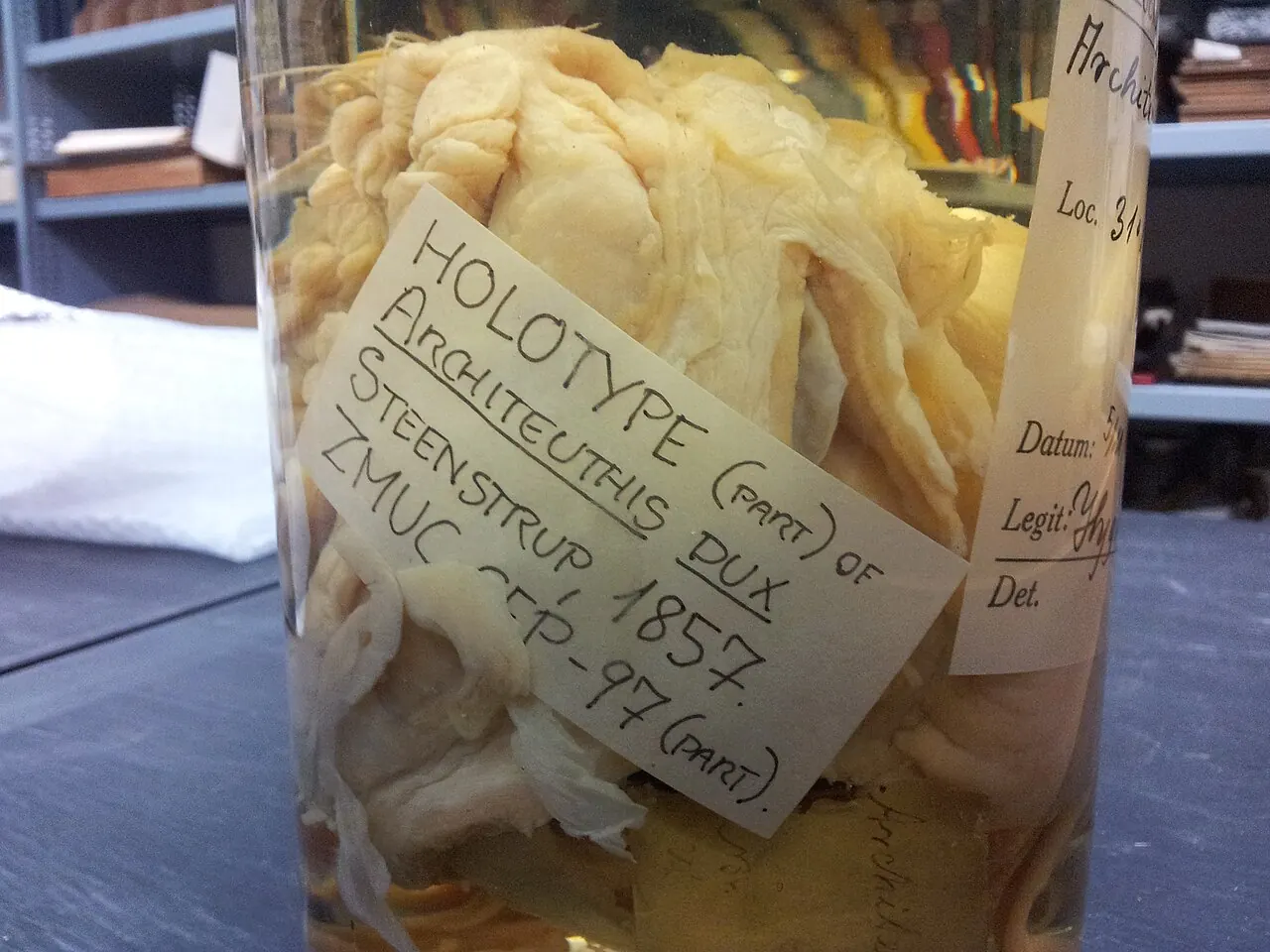
Architeuthis dux
A deep-ocean squid up to about 13 meters long with its tentacles, and a single species that roams the world's deep oceans.
Photo: Inger Eleanor Winkelmann / CC BY-SA 4.0
Architeuthis dux can stretch to about 13 meters (43 feet) for a female and 10 meters (33 feet) for a male, measured from the tail fin to the tips of the two long feeding tentacles, according to Te Papa, New Zealand's national museum. Most of that is tentacle. The mantle, the main body, is only about 2 meters long, and the animal without its tentacles measures about 5 meters. Te Papa says reported lengths of 60 feet and weights of a ton are wrong. The heaviest weight published in SeaLifeBase is 220 kilograms (485 pounds).
Giant squid live in deep oceans worldwide, from tropical to polar waters, probably mostly between about 200 and 1,000 meters (660 to 3,300 feet) down. For a long time researchers argued over whether there was one species or several. In 2013, a team that sequenced mitochondrial DNA from 43 samples collected across the range found no geographic pattern and unusually low genetic diversity. That fits a single global species that travels widely, possibly drifting far as tiny young.
Most of what is known about its food comes from dead animals. Stomachs have held deep-sea fish such as orange roughy and hoki. In 2005, Tsunemi Kubodera and Kyoichi Mori published the first photos of a live giant squid in its habitat, taken at 900 meters off Japan's Ogasawara Islands as it attacked bait. A severed tentacle confirmed it was longer than 8 meters, and the images suggested a more active predator than many had assumed, one that strikes with its long tentacles. Its own main predator is the sperm whale, and giant squid beaks turn up in sperm whale stomachs.
Males are smaller than females, and Te Papa says giant squid reach sexual maturity at about three years old. The male probably injects sperm into the female's arms during mating, and females are thought to spawn once and then die. How long they live is not known. The IUCN Red List rates the species as Least Concern.