Giant Isopod
Bathynomus giganteus
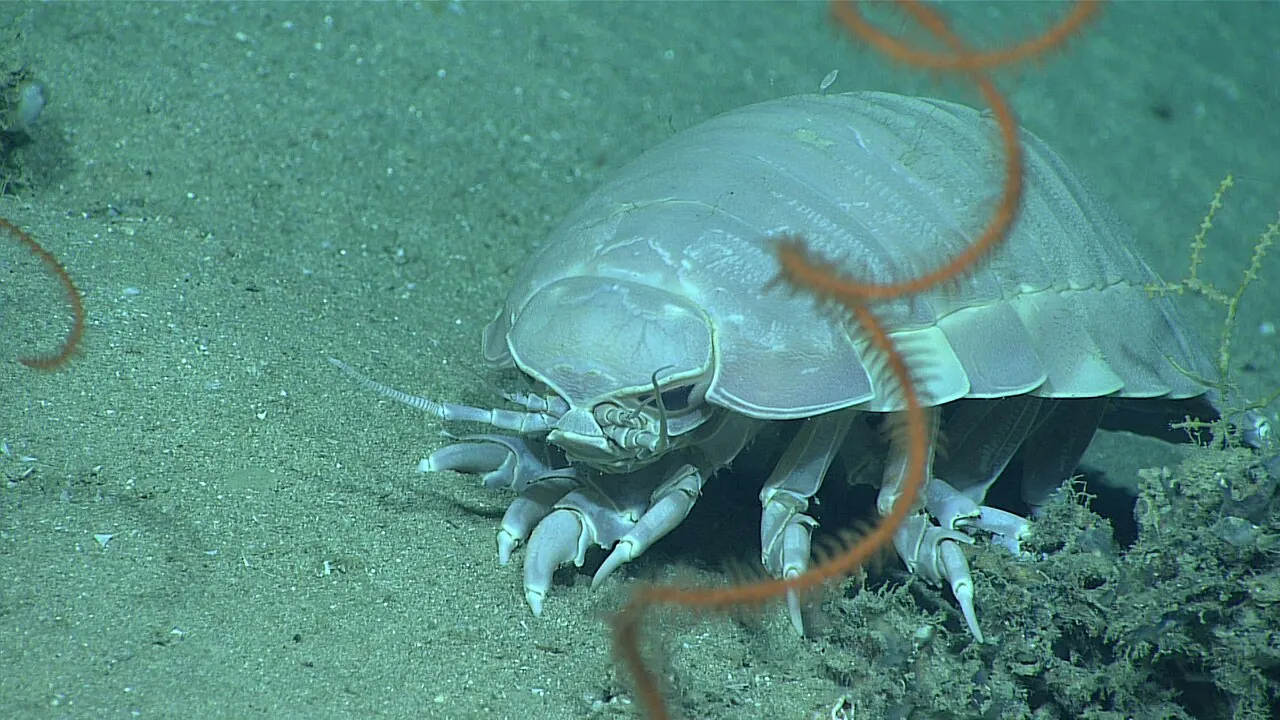
A deep-sea relative of the backyard pill bug that grows to more than 30 cm long and scavenges the seafloor of the western Atlantic.
Photo: NOAA / Public domain
3 things to know
- Each of its eyes can have about 4,000 facets.
- Its young hatch looking like small adults, with no larval stage.
- One aquarium isopod refused food for more than four years.
- Scientific name
- Bathynomus giganteus
- Depth
- 310 m – 2,300 m
1,017 – 7,546 ft - Size
- 26 to 36 cm (10 to 14 in) in one Florida collection; over 46 cm (18 in) reported
- Weight
- Not well known
- Lifespan
- Unknown
- Diet
- Mainly a scavenger of dead animals; gut contents also include fish, shrimp and small invertebrates
- Where
- Western Atlantic, including the Gulf of Mexico and the Caribbean, with records off Brazil
- IUCN status
- Not Evaluated
- Depth zones
- Twilight · Midnight
Picture a pill bug, the kind that rolls up under a garden log, stretched to more than 30 centimeters (a foot) long, and you have a giant isopod. Bathynomus giganteus is one of the largest isopods known. Its armored body has seven pairs of spiny legs and two pairs of antennae, and its compound eyes, each made of up to about 4,000 facets, are unusually large for a deep-sea animal, according to a 1986 account by Regina Wetzer of the Natural History Museum of Los Angeles County. Six caught off Florida in 1976 measured 26 to 36 centimeters (10 to 14 inches), and specimens over 46 centimeters (18 inches) have been reported.
It lives on the seafloor of the western Atlantic, including the Gulf of Mexico and the Caribbean, usually 365 to 730 meters (1,200 to 2,400 feet) down, with records from about 310 to 2,300 meters, according to SeaLifeBase. The first specimen was dredged up west of the Dry Tortugas, off Florida, by the US Coast Survey steamer Blake and named in 1879. Older reports also placed the species in the Indian Ocean, but a 2006 revision by Lowry and Dempsey found those records belonged to other species. In 2022 a nearly identical western Atlantic species, Bathynomus yucatanensis, was described after DNA work first flagged it.
Giant isopods are mainly scavengers, which is why they turn up so often in baited traps set for deep-sea crabs. SeaLifeBase notes mouthparts built to cut and swallow large pieces, a gut that stretches to hold a big meal, and the ability to store large amounts of fat. Gut samples from the genus have also held fish scales, shrimp remains and smaller animals. Females brood their young in a pouch under the body. There is no larval stage, and the young hatch looking like small adults, minus their last pair of legs.
That ability to load up when food arrives fits its best-known habit, going without. A male called No. 1, caught in the Gulf of Mexico and kept at Japan's Toba Aquarium, last ate on January 2, 2009, and had refused food for more than 1,500 days by February 2013, NPR reported. A 2026 study of related species tied such fasts to a huge stomach and a very low resting metabolism. Its lifespan and typical weight are not well documented, and it has not been assessed for the IUCN Red List.
Sources
- research.nhm.org/pdfs/12040/12040.pdf
- sealifebase.se/summary/Bathynomus-giganteus.html
- oceanexplorer.noaa.gov/facts/isopod.html
- pmc.ncbi.nlm.nih.gov/articles/PMC7363738
- pmc.ncbi.nlm.nih.gov/articles/PMC10787354
- npr.org/sections/thetwo-way/2013/02/25/172909365/underwater-hunger-artist-giant-isopod-…
- Study: doi:10.1016/j.cell.2026.05.012
- lssf.cas.cn/en/news/rh/202606/t20260625_5113316.html