Bristlemouths
Cyclothone spp.
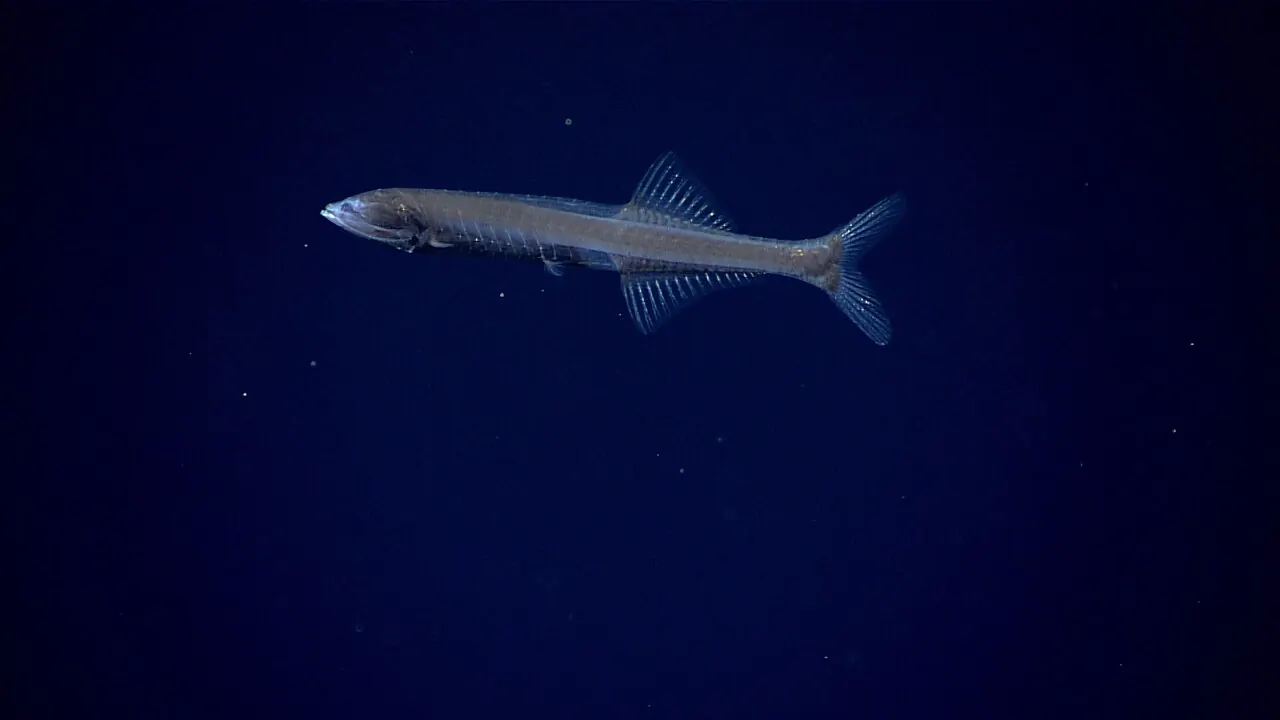
Inch-long fish of the deep twilight zone that Woods Hole scientists say may be the most numerous animals with a backbone on Earth.
Photo: NOAA Office of Ocean Exploration and Research / Public domain
3 things to know
- Woods Hole scientists estimate their numbers in the quadrillions.
- Many species start life as males and turn into females as they mature.
- Unlike many twilight-zone fish, they do not swim toward the surface at night to feed.
- Scientific name
- Cyclothone spp.
- Depth
- 200 m – 2,700 m
656 – 8,859 ft - Size
- Mostly 2–3 cm (about 1 in) long
- Weight
- Unknown
- Lifespan
- Not well known; Cyclothone braueri has about a two-year life cycle
- Diet
- Small zooplankton such as copepods, and other small crustaceans
- Where
- Deep open ocean worldwide
- IUCN status
- Least Concern
- Depth zones
- Twilight · Midnight
Bristlemouths of the genus Cyclothone are small, dark fish, most only 2 to 3 centimeters (about an inch) long, with jaws that open very wide and bristle with needle-like teeth. FishBase lists 13 species. Woods Hole Oceanographic Institution (WHOI) says the group is widely considered the most abundant animal on Earth, and glowing light organs along the belly may help confuse predators attacking from below.
They live in the deep open ocean worldwide, typically around 1,000 meters (3,280 feet) down, according to WHOI. Species differ in depth. Cyclothone braueri usually lives between 200 and 900 meters, while C. microdon, which ranges from about 67 degrees north to 45 degrees south, is usually found from 500 to 2,700 meters.
The abundance claim comes from nets. In the Sargasso Sea off Bermuda, Cyclothone made up 40 to 50 percent of roughly 4,000 fish caught, which works out to about 1 to 12 fish per cubic meter of water. Multiply that across the twilight zone, about 20 percent of the ocean's volume, and WHOI arrives in the quadrillions, while warning that the math assumes every cubic meter is the same.
Unlike many twilight-zone fish, Cyclothone do not swim toward the surface at night. FishBase says C. braueri feeds mostly on copepods and other small zooplankton, and WHOI lists small crustaceans and fish as food. Dragonfish, fangtooths and deep-diving whales eat bristlemouths in turn. Many species start life as males and become females as they mature, and in C. braueri the females grow larger than the males. FishBase describes that species as having a two-year life cycle.
Their swim bladders differ with depth. A 2023 study of six species found working, gas-filled bladders in the shallower ones, which live mainly at 400 to 600 meters, and fat-filled bladders in deeper species, with more fat at greater depths and higher latitudes. Because a fish's swim bladder shapes how it shows up on sonar, that difference matters for surveys that turn echoes into fish counts.
All 13 species are rated Least Concern on the IUCN Red List. WHOI scientists have called it "far too premature" to fish the twilight zone freely while so much is unknown.