Blobfish
Psychrolutes spp. (family Psychrolutidae)
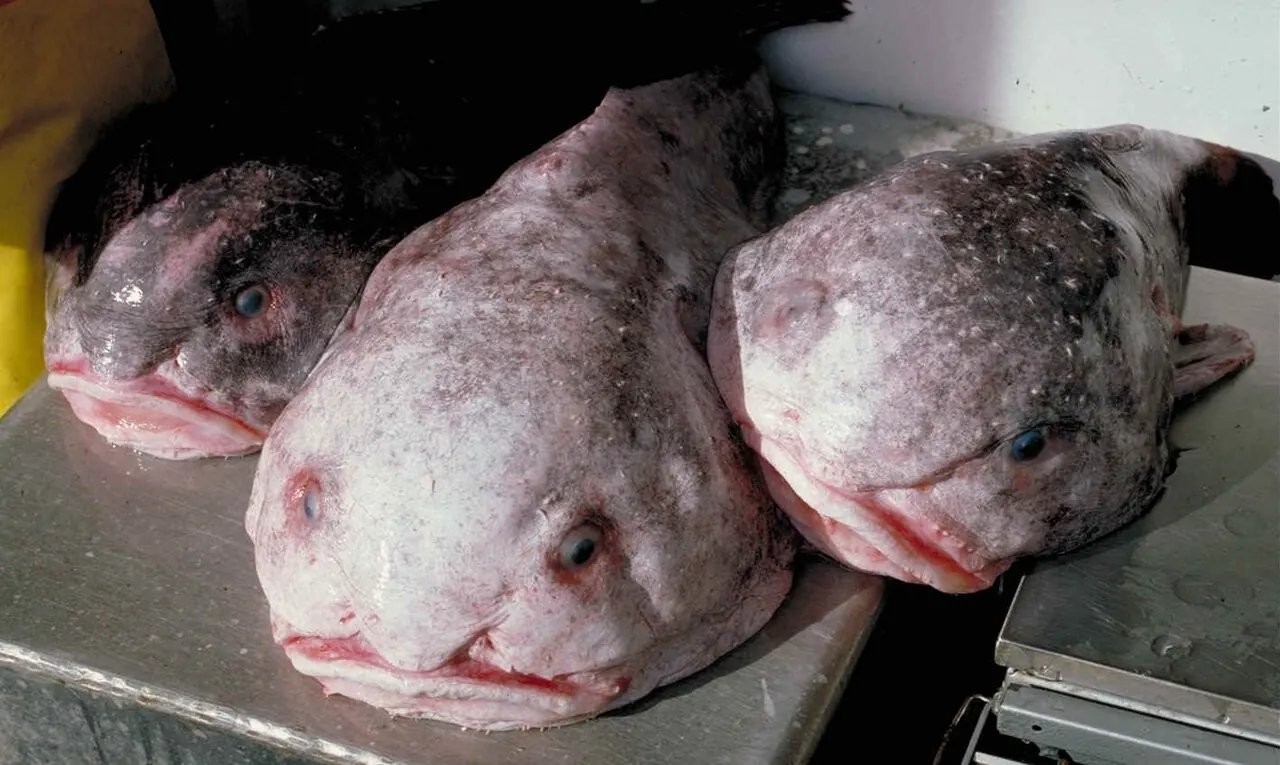
Deep-sea fathead sculpins whose jelly-like bodies hold their shape in water and sag into the famous frown only when hauled into air.
Photo: NOAA Alaska Fisheries Science Center / Public domain
3 things to know
- Most of a blobfish's body is a clear gel almost as dense as seawater.
- The famous "Mr Blobby" photo shows Psychrolutes microporos, trawled in the Tasman Sea in 2003.
- Off Northern California, blob sculpins guard nests that may hold up to 100,000 eggs.
- Scientific name
- Psychrolutes spp. (family Psychrolutidae)
- Depth
- 500 m – 2,800 m
1,640 – 9,187 ft - Size
- Up to about 70 cm (28 in) in the blob sculpin; the smooth-head blobfish, P. marcidus, to about 30 cm (12 in)
- Weight
- Up to 9.5 kg (21 lb) recorded for the blob sculpin; not well known for others
- Lifespan
- Unknown
- Diet
- Bottom animals such as sea pens, crabs, mollusks and sea anemones
- Where
- Deep water of the Atlantic, Indian and Pacific oceans; the species covered here live off southeastern Australia, New Zealand and in the North Pacific from Japan and the Bering Sea to Southern California
- IUCN status
- Not Evaluated (P. marcidus, P. microporos and P. phrictus)
- Depth zones
- Twilight · Midnight
"Blobfish" is a nickname for several deep-sea fishes in the genus Psychrolutes, part of a family the Australian Museum calls the blobfishes or fathead sculpins, after their large, globular heads and floppy skin. FishBase calls P. marcidus the smooth-head blobfish and lists it at up to 30 centimeters (12 inches) on the continental slope off southeastern Australia and Tasmania, 600 to 1,200 meters (2,000 to 3,900 feet) down.
The face that made blobfish famous belongs to a relative. On June 3, 2003, the NORFANZ expedition aboard the research ship Tangaroa trawled three blobfish from 1,013 to 1,340 meters (3,320 to 4,400 feet) on the West Norfolk Ridge in the Tasman Sea. Australian Museum photographer Kerryn Parkinson shot one face-on, the crew nicknamed it Mr Blobby, and fish curators at New Zealand's Te Papa museum identify it as Psychrolutes microporos. Declared the world's ugliest animal in 2013, a blobfish won New Zealand's Fish of the Year public vote in March 2025.
Most of the body is a clear gel almost as dense as seawater. Te Papa curators Andrew Stewart and Thom Linley write that the fish's melting in air comes not from the loss of pressure, though cold and pressure at depth likely keep the gel firmer, but from the loss of the water's support: gravity drags the gel down, the lips sag and a fold of skin flops forward into a nose. A CNN report carried by RNZ credits water pressure instead. Bands of small, sandpaper-like teeth grip whatever fits in the mouth, deep-water sea anemones included.
The North Pacific has its own, the blob sculpin (P. phrictus), found from Japan and the Bering Sea to off San Diego at 500 to 2,800 meters (1,640 to 9,190 feet). FishBase records it at up to 70 centimeters (28 inches) and 9.5 kilograms (21 pounds). In 2003, Jeff Drazen of the Monterey Bay Aquarium Research Institute (MBARI) reported blob sculpins guarding purple egg masses on boulders of the Gorda Escarpment off Northern California, nests he estimated could hold up to 100,000 eggs. MBARI called it the first direct observation of any deep-sea fish brooding its eggs, and Drazen's team warned that trawling and long-line fishing could harm such nurseries.
How long blobfish live is unknown, and the Australian Museum says their eggs and larvae have not been described. FishBase lists none of these three species as assessed by the IUCN.
Sources
- australian.museum/learn/animals/fishes/fathead-psychrolutes-aka-mr-blobby
- australian.museum/learn/animals/fishes/psychrolutidae-blobfishes
- fishbase.se/summary/Psychrolutes-marcidus.html
- fishbase.se/summary/Psychrolutes-microporos.html
- fishbase.se/summary/Psychrolutes-phrictus.html
- blog.tepapa.govt.nz/2024/09/09/the-blob-blog
- mbari.org/news/nurseries-in-the-deep-sea
- Study: doi:10.2307/1543439
- annualreport.mbari.org/2017/story/brooding-blob-sculpin-in-the-canadian-arctic
- rnz.co.nz/news/world/545272/blobfish-overcomes-notoriety-as-world-s-ugliest-animal-to-w…
- marinespecies.org/aphia.php
- commons.wikimedia.org/wiki/File:Psychrolutes_phrictus.jpg