Barreleye
Macropinna microstoma
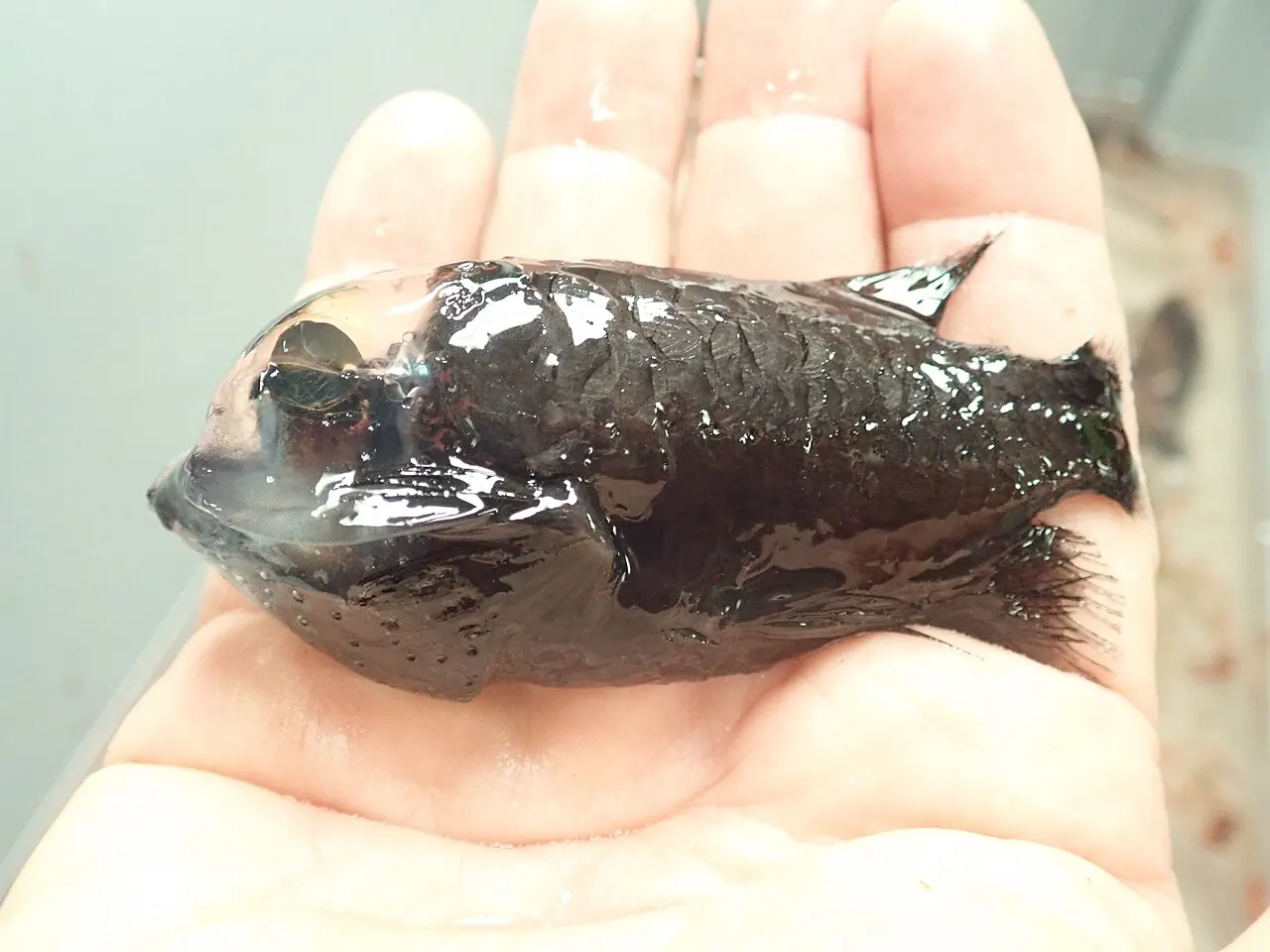
A small North Pacific fish with a see-through dome over its head and green-lensed tube eyes that swivel to follow its food.
Photo: NOAA Office of Ocean Exploration and Research, Exploring Pelagic Biodiversity of the Gulf of Alaska expedition / Public domain
3 things to know
- Its tube-shaped eyes sit inside a clear, fluid-filled shield on top of its head.
- The two spots above its mouth that look like eyes are smell organs called nares.
- MBARI has recorded the species only 11 times in roughly 7,000 robot dives.
- Scientific name
- Macropinna microstoma
- Depth
- 460 m – 800 m
1,509 – 2,625 ft - Size
- Up to about 15 cm (6 in) long
- Weight
- Unknown
- Lifespan
- Unknown
- Diet
- Zooplankton, including small crustaceans and siphonophores
- Where
- North Pacific, from the Bering Sea to Japan and Baja California
- IUCN status
- Not Evaluated
- Depth zones
- Twilight
Macropinna microstoma looks like an ordinary small dark fish until you see the top of its head. A clear dome of tough, flexible skin covers a fluid-filled chamber, and inside sit two large tube-shaped eyes capped with bright green lenses. The two dots above its mouth, which look like eyes, are nares, smell organs that work like nostrils.
The barreleye grows to about 15 centimeters (6 inches). It lives in the North Pacific from the Bering Sea to Japan and Baja California, and MBARI's species guide puts it 460 to 800 meters (1,500 to 2,600 feet) down, in the dim twilight zone. FishBase describes it as solitary and uncommon. The Monterey Bay Aquarium Research Institute (MBARI) has made roughly 7,000 dives with its remotely operated vehicles and has recorded this species only 11 times.
For decades the dome was left out of descriptions, probably because it was destroyed when fish were hauled up in nets. In 2008, MBARI's Bruce Robison and Kim Reisenbichler reported in the journal Copeia that the eyes are not fixed in place. A resting barreleye hangs level with its eyes pointed up, watching for the silhouettes of prey against the faint light above. When it locks onto something, the eyes rotate forward as the fish tilts its body up to feed. FishBase gives the largest turn observed as about 75 degrees. The green lenses may filter out sunlight from above, helping the fish pick out the glow of animals that make their own light.
Some of its food may be stolen. MBARI suggests the barreleye picks off small animals caught in the stinging tentacles of siphonophores, long colonial relatives of jellyfish, with the dome shielding its eyes. Two net-caught fish had fragments of jellies in their stomachs, and MBARI says it also eats small crustaceans and other zooplankton. Large, flat fins let it hang almost motionless, and its very large gut suggests a broad diet.
FishBase lists it as an egg-layer with drifting larvae. Its lifespan is unknown, and it has not been assessed for the IUCN Red List.