Whipnose Angler
Gigantactis vanhoeffeni
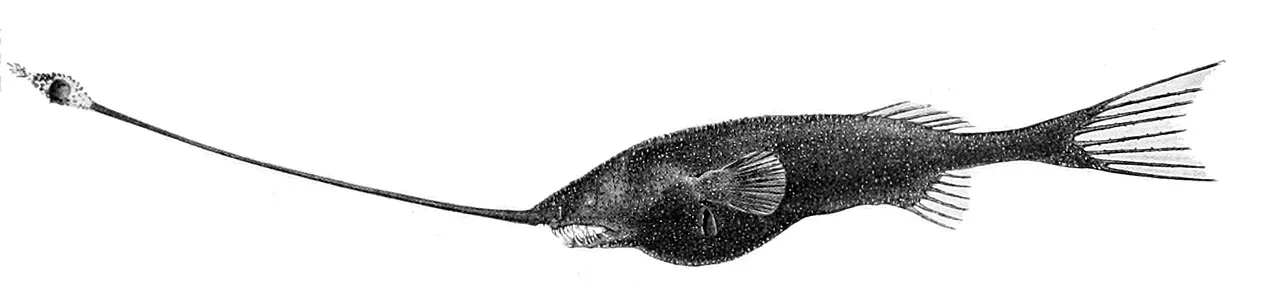
A deep-sea anglerfish that fishes with a lure on a long, whip-thin rod that can be longer than its own body.
Illustration: Carl Chun, Aus den Tiefen des Weltmeeres (1903) / Public domain
3 things to know
- Its rod is short for a whipnose, under 120 percent of the body's standard length.
- Long teeth positioned outside the jaws help it seize large prey.
- No male of this species has ever been identified.
- Scientific name
- Gigantactis vanhoeffeni
- Depth
- 700 m – 1,300 m
2,297 – 4,265 ft - Size
- Females up to about 62 cm (24 in) long; males unknown
- Weight
- Unknown
- Lifespan
- Unknown
- Diet
- Bony fishes and squid
- Where
- Tropical and temperate waters of all oceans
- IUCN status
- Data Deficient
- Depth zones
- Twilight · Midnight
Whipnose anglers are deep-sea anglerfishes with a fishing rod, the illicium, drawn out into a long, thin whip. Theodore Pietsch, writing for the Tree of Life project, counts 22 species in the family, with rods between one and four times the fish's standard length, measured without the tail fin. In Gigantactis vanhoeffeni, known as the cosmopolitan whipnose, the rod is among the shorter ones, under 120 percent of standard length. The lure at its tip is covered in minute spines and carries a dark, elongated extension fringed with short black filaments. Females are dark brown to black, and FishBase gives a maximum total length of 62 centimeters (24 inches).
The species lives in tropical and temperate waters of every ocean, usually 700 to 1,300 meters (2,300 to 4,300 feet) down, and FishBase records it from 300 to 5,300 meters. It is rarely caught. August Brauer described it in 1902 from a fish collected by the German Valdivia expedition east of Zanzibar, and Carl Chun published the drawing shown here in 1903. Stomachs have held bony fishes and squid, and long teeth set outside the jaws let it seize large prey.
Whipnose males are dwarfs that never fuse with females. Fishes of Australia says they grip on only briefly with pincer-like denticles, while Pietsch's Tree of Life page notes that no temporarily attached male has been found. No male of the cosmopolitan whipnose has been identified.
Live whipnoses have rarely been seen. In a 2002 paper in Copeia, Jon Moore described video of whipnose anglers of an unidentified Gigantactis species swimming upside down near the seafloor. Pietsch reads that work as evidence that these fish may drift upside down close to the bottom, letting the lure tempt prey off the seafloor, and his Tree of Life page links footage from Woods Hole's remotely operated vehicle Jason at the Hawaii-2 Observatory of a Gigantactis apparently foraging upside down.
The IUCN lists the cosmopolitan whipnose as Data Deficient, in an assessment from 2014.