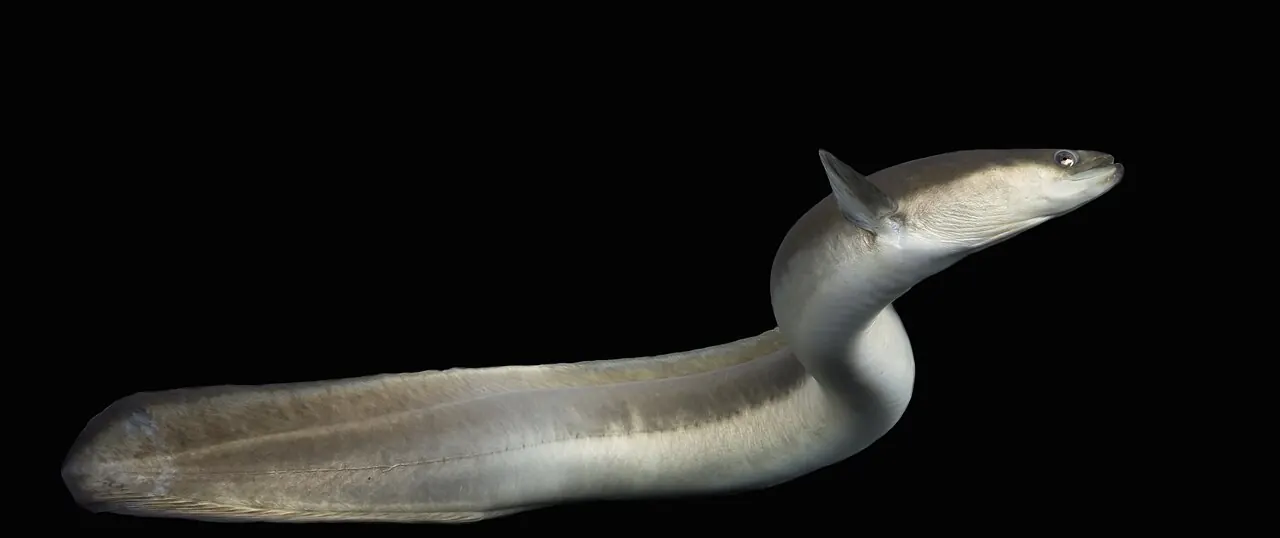
American Eel
Anguilla rostrata
A North American eel that grows up in rivers, lakes and estuaries, then swims to the Sargasso Sea to spawn once and die.
Photo: U.S. Fish and Wildlife Service (Sam Stukel) / Public domain
3 things to know
- American eels are thought to spawn only in the Sargasso Sea, once, and then die.
- A satellite-tagged eel was tracked 2,400 km (1,500 mi) from Nova Scotia to the northern edge of its spawning area.
- Maine's fishery for young glass eels is capped at 9,688 pounds (4,394 kg) a year for 2025 to 2027.
- Scientific name
- Anguilla rostrata
- Depth
- 0 m – 464 m
0 – 1,522 ft - Size
- Commonly about 50 cm (20 in); females up to about 1.5 m (5 ft), males about 0.6 m (2 ft)
- Weight
- Up to about 7.3 kg (16 lb)
- Lifespan
- Up to 43 years reported
- Diet
- Insect larvae, snails, worms, small crustaceans and fish
- Where
- Western Atlantic coasts and rivers from Greenland and Canada to Panama, the West Indies and Trinidad; spawns in the Sargasso Sea
- IUCN status
- Endangered
- Depth zones
- Sunlight · Twilight
An American eel can spend decades in a pond, a river or an estuary, then leave for the open Atlantic and never come back. It is a long fish with a rounded tail fin joined to the dorsal and anal fins, a lower jaw longer than the upper, and small eyes set well forward. FishBase describes adults as brownish to blue-black above and pale below. Females travel farther upstream and grow larger: the Chesapeake Bay Program puts males at about 0.6 meters (2 feet) and females at up to 1.5 meters (5 feet). FishBase lists a top weight of 7.3 kilograms (16 pounds) and a reported maximum age of 43 years.
The species ranges from Greenland down the coasts of Canada and the United States to Panama, and through much of the West Indies. Growing eels live in streams, rivers, muddy lakes and estuaries, hiding by day under banks and logs and eating insect larvae, snails, worms, small crustaceans and fish. They are slow to mature: the Atlantic States Marine Fisheries Commission (ASMFC) gives eight to 24 or more years.
Every one of them starts life at sea. Adults are thought to spawn once, in the Sargasso Sea, and die. Their transparent larvae, shaped like willow leaves, drift back toward the coast and turn into glass eels and elvers in estuaries. For a century the route was inferred from where larvae turned up, since no adult had been seen migrating in the open ocean. Then Mélanie Béguer-Pon and colleagues fitted satellite tags to 38 maturing eels released off Nova Scotia between 2012 and 2014. Eight reached open water, and one was followed for 2,400 kilometers (1,500 miles), to the northern limit of the spawning area. By day it swam at an average depth of 618 meters (2,030 feet), rising to about 141 meters (460 feet) at night, and its deepest dive reached 699 meters (2,290 feet), deeper than the 464 meters (1,520 feet) FishBase lists for the species. The team published the track in Nature Communications in 2015.
The IUCN lists the American eel as Endangered, in an assessment from 2020. In US waters, the ASMFC's 2023 benchmark assessment rated the stock depleted, and the commission caps the catch, including Maine's fishery for glass eels, held to 9,688 pounds (4,394 kilograms) a year for 2025 to 2027. The commission names overfishing, habitat loss and environmental change behind the decline.



