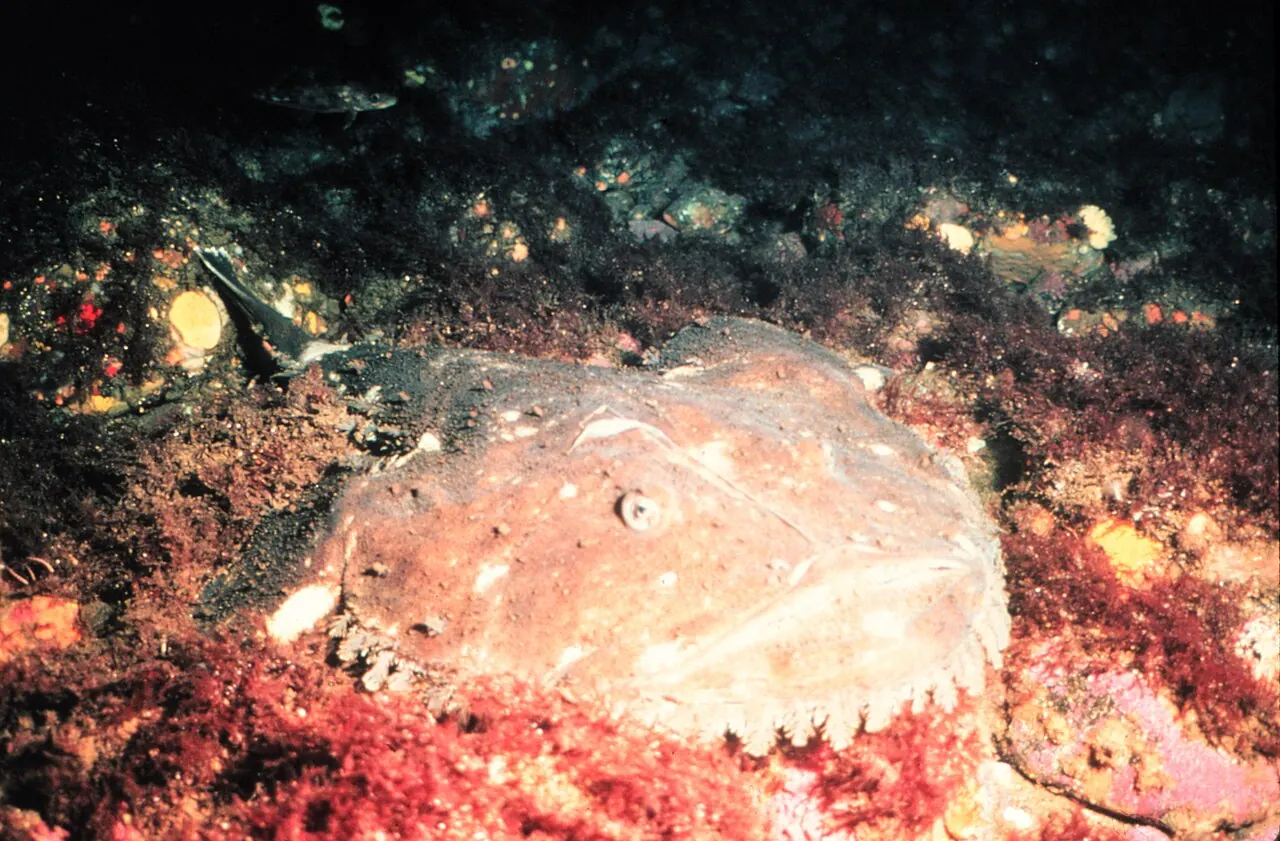
American Goosefish
Lophius americanus
A big-mouthed bottom angler of the US Northeast, sold as monkfish, that lays its eggs in floating veils and sometimes swallows seabirds.
Photo: OAR/National Undersea Research Program (NURP), NOAA / Public domain
3 things to know
- Goosefish lay their eggs in floating mucus veils that can be 6 to 12 m (20 to 39 ft) long.
- Fourteen dovekies, a small seabird, were found in the stomachs of 14 goosefish caught south of Cape Cod in 2007 to 2010.
- Goosefish can walk along the seabed on their sturdy pectoral fins.
- Scientific name
- Lophius americanus
- Depth
- 0 m – 900 m
0 – 2,953 ft - Size
- Up to about 1.4 m (4.6 ft) long, per NOAA's habitat report; few exceed 1 m (3.3 ft)
- Weight
- Up to about 22 kg (49 lb)
- Lifespan
- Not well known; a 2020 study found that the standard vertebra-based ages are unreliable
- Diet
- Mostly fish, including other goosefish, plus crustaceans, squid, seabirds and diving ducks
- Where
- Northwest Atlantic from the Grand Banks and northern Gulf of St. Lawrence to northeastern Florida; common only north of Cape Hatteras
- IUCN status
- Not Evaluated
- Depth zones
- Sunlight · Twilight
Most of a goosefish is head. NOAA Fisheries calls it tadpole-like: a broad head and huge mouth on a narrow, tapering body, mottled dark brown to olive green above and whitish below. A modified spine on top of the head works as a fishing rod with a lure on the end. When prey comes close, the goosefish gulps it in, and backward-pointing teeth trap it. Markets sell it as monkfish. NOAA's habitat report says it grows to about 1.4 meters (4.6 feet) and 22 kilograms (49 pounds), though few pass 1 meter.
It lives on the seabed of the northwest Atlantic, from the Grand Banks and the northern Gulf of St. Lawrence to northeastern Florida, but is common only north of Cape Hatteras. It favors sand, mud and shell, often lying in a hollow or half buried, and moves by swimming slowly or walking on its sturdy pectoral fins. NOAA Fisheries gives its depth range as inshore water down to nearly 900 meters (3,000 feet); one survey in Norfolk Canyon off Virginia found it most often between 200 and 400 meters (660 and 1,310 feet).
An opportunistic hunter, it eats mostly fish, including other goosefish, plus crustaceans, squid, seabirds and diving ducks. In 2013 Matthew Perry of the US Geological Survey, Anne Richards of NOAA and colleagues reported 14 dovekies, small seabirds, from the stomachs of 14 goosefish caught in the winters and springs of 2007 to 2010. The fish came from gillnets set 85 to 151 meters (276 to 491 feet) down, 104 to 150 kilometers (65 to 94 miles) south of Chatham, Massachusetts, and the birds were barely digested. Tagging shows goosefish rising far off the bottom during migrations, which may be when they meet dovekies.
Goosefish spawn from spring to early fall. A female releases her eggs in a floating ribbon of mucus that can be 6 to 12 meters (20 to 39 feet) long and up to 1.5 meters (5 feet) wide, and NOAA says a veil can hold more than a million eggs. It drifts near the surface until the larvae hatch.
How long goosefish live is an open question. Older estimates put typical lifespans at about 9 years for males and 11 for females. In 2020 Cristiana Bank and colleagues marked live goosefish with a chemical and showed that the growth bands on vertebrae, used in standard aging, are not yearly rings.
Sources
- fisheries.noaa.gov/species/monkfish
- fishbase.se/summary/Lophius-americanus.html
- repository.library.noaa.gov/view/noaa/3104/noaa_3104_DS1.pdf
- Study: doi:10.1656/045.020.0112
- eaglehill.us/NENAonline/articles/NENA-20-1/20-Perry.shtml
- eurekalert.org/news-releases/775466
- phys.org/news/2013-04-goosefish-capture-small-puffins-deep.html
- Study: doi:10.7755/FB.118.1.2
- api.gbif.org/v1/species/2415069/iucnRedListCategory
- commons.wikimedia.org/wiki/File:Lophius_americanus.jpg



