Velvet Belly Lanternshark
Etmopterus spinax
A small deep-sea shark of the eastern Atlantic whose black belly glows, and whose spines carry their own lights.
Photo: Joacim Näslund / CC BY 4.0
3 things to know
- Its belly is covered with thousands of tiny light organs, each less than 0.2 mm across.
- Light organs beside its two dorsal spines could be seen by predators several meters away.
- In a 2008 age study, the oldest female was 11 years old.
- Scientific name
- Etmopterus spinax
- Depth
- 200 m – 500 m
656 – 1,640 ft - Size
- Commonly about 45 cm (18 in) long; up to 60 cm (24 in)
- Weight
- Up to about 850 g (1.9 lb)
- Lifespan
- At least 11 years (oldest female aged); males to at least 8
- Diet
- Small fishes, squid and crustaceans
- Where
- Eastern Atlantic from Iceland and Norway to Gabon, and the Mediterranean Sea
- IUCN status
- Vulnerable
- Depth zones
- Twilight
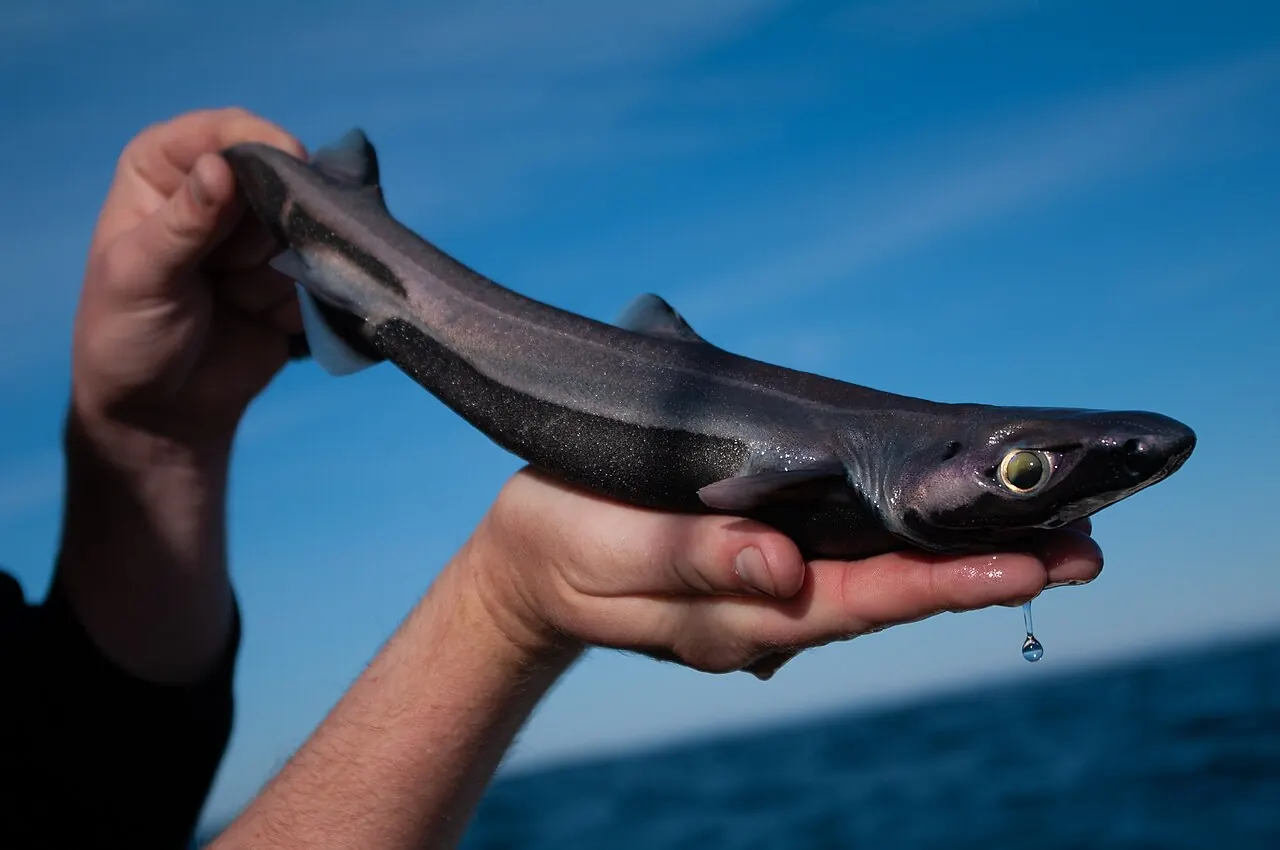
This little shark is named for its underside, which is black and sharply set off from the brown of the rest of its body, like a patch of velvet. It is a robust shark with a flattened snout and a stout, grooved spine at the front of each dorsal fin. Adults are commonly about 45 centimeters (18 inches) long and reach 60 centimeters (2 feet).
The velvet belly lives over the outer continental shelves and upper slopes of the eastern Atlantic, from Iceland and Norway to Gabon, and in the Mediterranean. It is usually found between 200 and 500 meters (660 and 1,640 feet) down, and has been recorded from 70 to 2,490 meters. It eats small fishes, squid and crustaceans.
Like other lanternsharks, it makes its own light. Its belly is covered with thousands of tiny light organs, each less than 0.2 millimeters across, which shine downward and help hide the shark's silhouette from animals looking up from below. Hormones such as melatonin switch the glow on. In 2013 Julien Claes of the Université catholique de Louvain in Belgium and colleagues described a second set of lights on sharks caught in Raunefjord, Norway: rows of light organs beside the two dorsal spines. Their light also shines through the partly translucent spines. Modeling showed that most of the shark's likely predators, but not its main prey, could see the display from several meters away, and the team suggested it works as a warning about the spines.
Females carry their young inside them until birth, with 6 to 20 pups in a litter. In a 2008 study in the northeast Atlantic, Coelho and Erzini aged velvet bellies by counting growth bands in the second dorsal spine and found males up to 8 years old and females up to 11. The species grows slowly and matures late, and the authors suggested it may breed only every 2 to 3 years, though their data were not conclusive.
Large numbers are caught as bycatch in deep-water fisheries, and some are used for fishmeal or dried and salted for food. The IUCN's 2020 assessment lists the velvet belly as Vulnerable. Its range may also be moving: a 2026 analysis of Norwegian bottom-trawl surveys from 1995 to 2020 found a significant northward shift in its abundance, which the authors linked to warming water.