Telescopefish
Gigantura spp.
A small deep-sea fish with binocular-like eyes and stretchy jaws, whose larvae were mistaken for a different fish for over 80 years.
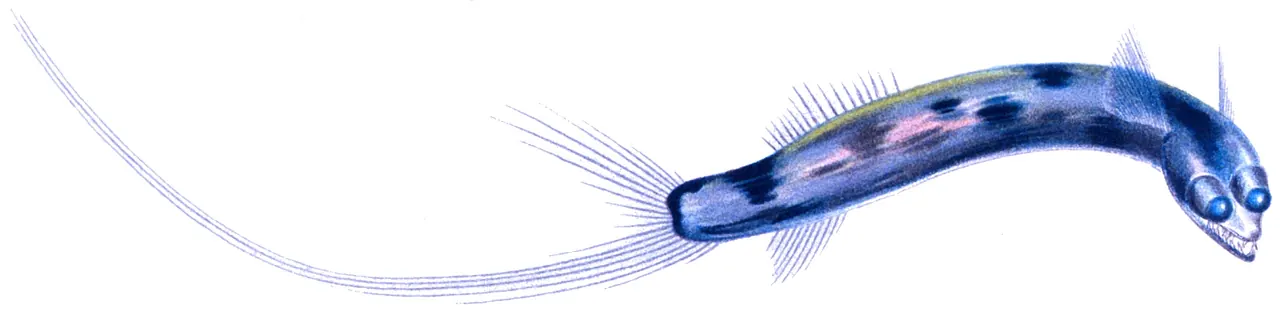
Illustration: August Brauer, in Carl Chun, Aus den Tiefen des Weltmeeres (1903) / Public domain
3 things to know
- Its tubular eyes point forward like a pair of binoculars.
- One telescopefish was found with prey twice its own size folded inside its stomach.
- Its larvae look so different that for over 80 years they were treated as a separate species.
- Scientific name
- Gigantura spp.
- Depth
- 500 m – 2,500 m
1,640 – 8,202 ft - Size
- Up to about 26 cm (10 in) long
- Weight
- Unknown
- Lifespan
- Unknown
- Diet
- Other midwater animals, including prey larger than itself
- Where
- Tropical and subtropical oceans worldwide
- IUCN status
- Least Concern
- Depth zones
- Twilight · Midnight
There are two telescopefishes, Gigantura chuni and Gigantura indica, and they differ by only a few fin rays. Both are small, silvery and scaleless, with long bodies, a ribbon-like streamer trailing from the tail and large tubular eyes that point forward like binoculars. According to the Smithsonian's Ocean Portal, neither grows longer than about 26 centimeters (10 inches).
Telescopefishes live in tropical and subtropical seas around the world, about 500 to 2,500 meters (1,600 to 8,200 feet) down, where almost no sunlight reaches. Tubular eyes like theirs are thought to gather what little light there is. The Smithsonian suggests the fish may watch for the glow of bioluminescent prey, or for animals silhouetted against the faint light from above, and probably use both. Their jaws can stretch so wide that a telescopefish can swallow prey bigger than itself, and one was found with prey twice its size folded inside its stomach. The stomach is black and opaque, which may keep the light of glowing prey from showing through and drawing predators.
Adults are synchronous hermaphrodites, with both male and female organs, and release eggs and sperm into open water. The young then go through one of the most dramatic transformations among fish. As larvae, in what is called the Rosaura stage, they are small, rounded and stout, and they look so unlike the adults that for over 80 years scientists treated them as a separate species. Growing up involves changes to the bones and the shape of the body, and how that transformation happens is still unknown.
Few people have seen a telescopefish alive. The Smithsonian counts only two encounters, one with each species, and both times two fish hung side by side with their heads pointed toward the surface. Researchers are now looking into whether telescopefish tend to live in pairs. The IUCN lists both species as Least Concern, in assessments from 2013.