Spookfish
Opisthoproctus soleatus
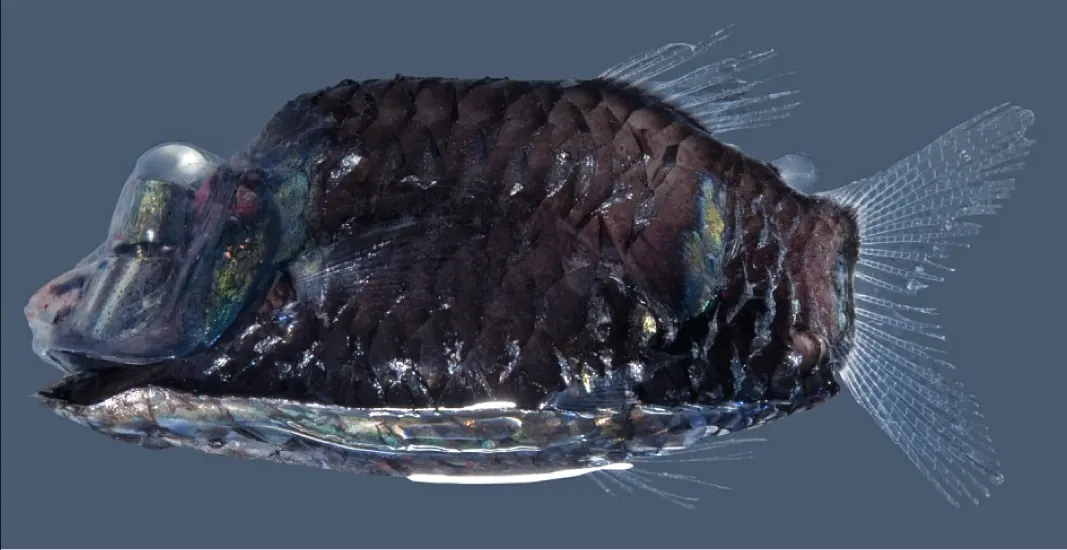
A small tube-eyed deep-sea fish with a flat, mirror-like belly that spreads light made by bacteria living in its gut.
Photo: S. Johnsen (Duke University), from Poulsen et al. 2016, PLOS ONE / CC BY 4.0
3 things to know
- Its flat belly, called the sole, reflects and screens light made inside its body.
- The light comes from bacteria living in a bulb at the end of its gut.
- Since 2016 it has been the only species left in the genus Opisthoproctus.
- Scientific name
- Opisthoproctus soleatus
- Depth
- 500 m – 700 m
1,640 – 2,297 ft - Size
- Up to about 10.5 cm (4 in) long (standard length)
- Weight
- Unknown
- Lifespan
- Unknown
- Diet
- Not well known
- Where
- Tropical and temperate seas around the world
- IUCN status
- Least Concern
- Depth zones
- Twilight
Opisthoproctus soleatus looks as if it has been pressed flat from below. Its belly is a broad, level platform as wide as the fish and as long as its whole trunk, covered in large, thin scales. Ichthyologists call it the sole. Its eyes are tubes, a feature shared by every fish in its family, and FishBase describes the top of its snout as transparent. The fish is small, with a recorded maximum of about 10.5 centimeters (4 inches) in standard length.
FishBase calls its whole family, the Opisthoproctidae, the barreleyes or spookfishes, so the names are shared: FishBase lists this species as the barrel-eye and the IUCN as the barreleye. It is not the North Pacific barreleye Macropinna microstoma, the fish with the see-through head, which a 2016 study led by Jan Yde Poulsen names as the closest relative of the sole-bearing fishes. The spookfish lives in tropical and temperate seas around the world, between about 300 and 800 meters (980 and 2,600 feet) down and mostly at 500 to 700 meters. FishBase says it probably does not migrate toward the surface at night.
The sole is part of a lighting system. Light is made in a dark bulb at the end of the gut, near the anus, by luminous bacteria that Poulsen's team identify as Photobacterium phosphoreum. It passes through a lens into a reflecting chamber and out through the sole, where scales that darken toward their edges act as a screen. E. Bertelsen described it as a new type of light organ in the journal Nature in 1958. The glow probably hides the fish's dark outline against faint sunlight from above, and Poulsen's team suggest it may also carry signals.
The sole also hid species from scientists. Related fish carry pigment patterns on their soles that had been dismissed as differences between individuals, because formalin and alcohol fade them in museum jars. Working from fresh specimens, photographs and DNA, Poulsen's team showed that the patterns mark separate species. They described two new mirrorbellies, moved the long-snouted relatives into a revived genus, Monacoa, and left O. soleatus as the only species in Opisthoproctus.
What the spookfish eats and how long it lives are not well known. The IUCN lists it as Least Concern, from a 2012 assessment, with United States waters within its range.