Orange Roughy
Hoplostethus atlanticus
A brick-red deep-sea fish that can live well past 100 years. Heavy fishing in the 1980s and 1990s made it a symbol of overfishing.
Photo: CSIRO / CC BY 3.0
3 things to know
- Lead-radium dating of ear stones in 2009 showed that the oldest group of fish tested was at least 93 years old.
- Its old name was slimehead; it was renamed orange roughy in the 1970s to help it sell.
- It gathers in dense spawning schools over undersea hills and slopes, where fishing fleets target it.
- Scientific name
- Hoplostethus atlanticus
- Depth
- 400 m – 900 m
1,312 – 2,953 ft - Size
- Commonly about 40 cm (16 in); FishBase lists up to 75 cm (30 in)
- Weight
- Up to 7 kg (15 lb)
- Lifespan
- Well over 100 years; the oldest estimated was 149
- Diet
- Prawns, fish and squid; juveniles eat mainly crustaceans
- Where
- Patchy, in deep cold water of the Atlantic, Indian and Pacific oceans: Iceland to Morocco, southern Africa, the south-central Indian Ocean, Australia, New Zealand and Chile
- IUCN status
- Not Evaluated
- Depth zones
- Twilight
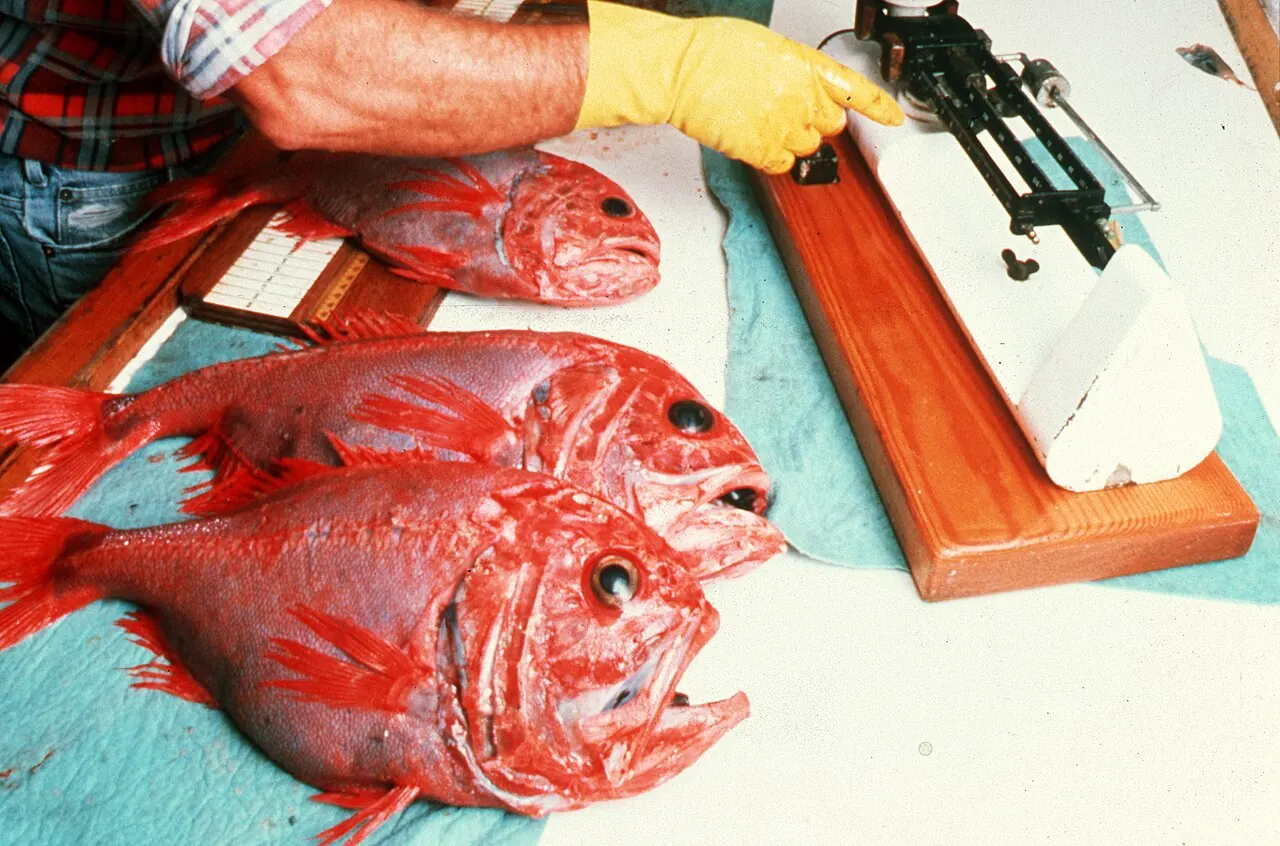
An orange roughy is bright brick red, with a bluish-black mouth and gill cavity, a deep body and a heavy head. It lives in cold water of 3 to 9°C (37 to 48°F) over steep continental slopes, ocean ridges and seamounts. FishBase records it from 180 to 1,809 meters (590 to 5,935 feet), usually 400 to 900 meters (1,310 to 2,950 feet), in scattered places across the Atlantic, Indian and Pacific oceans. It eats prawns, fish and squid.
It is one of the longest-lived fish known. Published lifespan estimates once ranged from about 20 years to well over 100. Ages are estimated by counting growth zones in thin slices of the ear stones, called otoliths, and the Marine Stewardship Council (MSC) says the oldest fish found was estimated at 149 years. To check those counts, Allen Andrews, Dianne Tracey and Matthew Dunn tested them in 2009 with lead-radium dating, which reads the slow radioactive decay of radium into lead inside the otolith core. The oldest group of fish they dated was at least 93 years old.
Once a year, orange roughy crowd into dense spawning schools over undersea hills, releasing eggs and sperm at the same time. Little is known about the larvae and young.
Fishing fleets target those dense schools. The fish used to be called slimehead, a name The Washington Post reported scientists gave it for its mucus canals, and the MSC says a US National Marine Fisheries Service marketing program in the mid-1970s came up with orange roughy instead. New Zealand's deep-water fisheries took off in the late 1970s with what stock modeler Patrick Cordue describes as somewhat of a gold rush mentality, and by the early 1990s scientists realized the fish were far less productive than assumed. According to FishBase, severe overfishing led the Australian government to list the species as threatened in 2006.
New Zealand cut catches, at times to zero, and in 2016 three of its orange roughy fisheries were certified by the MSC, the first orange roughy fisheries anywhere assessed against its standard, with catch limits around 4 percent of stock size compared with 15 to 20 percent in the early years. In 2023 the fishery suspended two of those three certificates because it no longer had a complete stock assessment, and agreed to cut the catch by 40 percent. The IUCN has not assessed the species.
Sources
- fishbase.se/summary/Hoplostethus-atlanticus.html
- Study: doi:10.1139/f09-059
- msc.org/en-au/what-we-are-doing/msc-theory-of-change/sustainable-fishing/sustainable-fi…
- msc.org/en-us/media-center/news-media/news/new-zealand-orange-roughy-fishery-certified-…
- msc.org/en-au/media-centre-anz/news-views/2023/12/06/nz-orange-roughy-fishery-self-susp…
- nbcnews.com/id/wbna32230324
- api.gbif.org/v1/species/2357093/iucnRedListCategory
- commons.wikimedia.org/wiki/File:CSIRO_ScienceImage_2948_Orange_Roughy.jpg