Lophelia Reef Coral
Desmophyllum pertusum (formerly Lophelia pertusa)
The deep sea's main reef builder, a white coral that needs no sunlight and forms the vast mound fields of the Blake Plateau off the US Southeast.
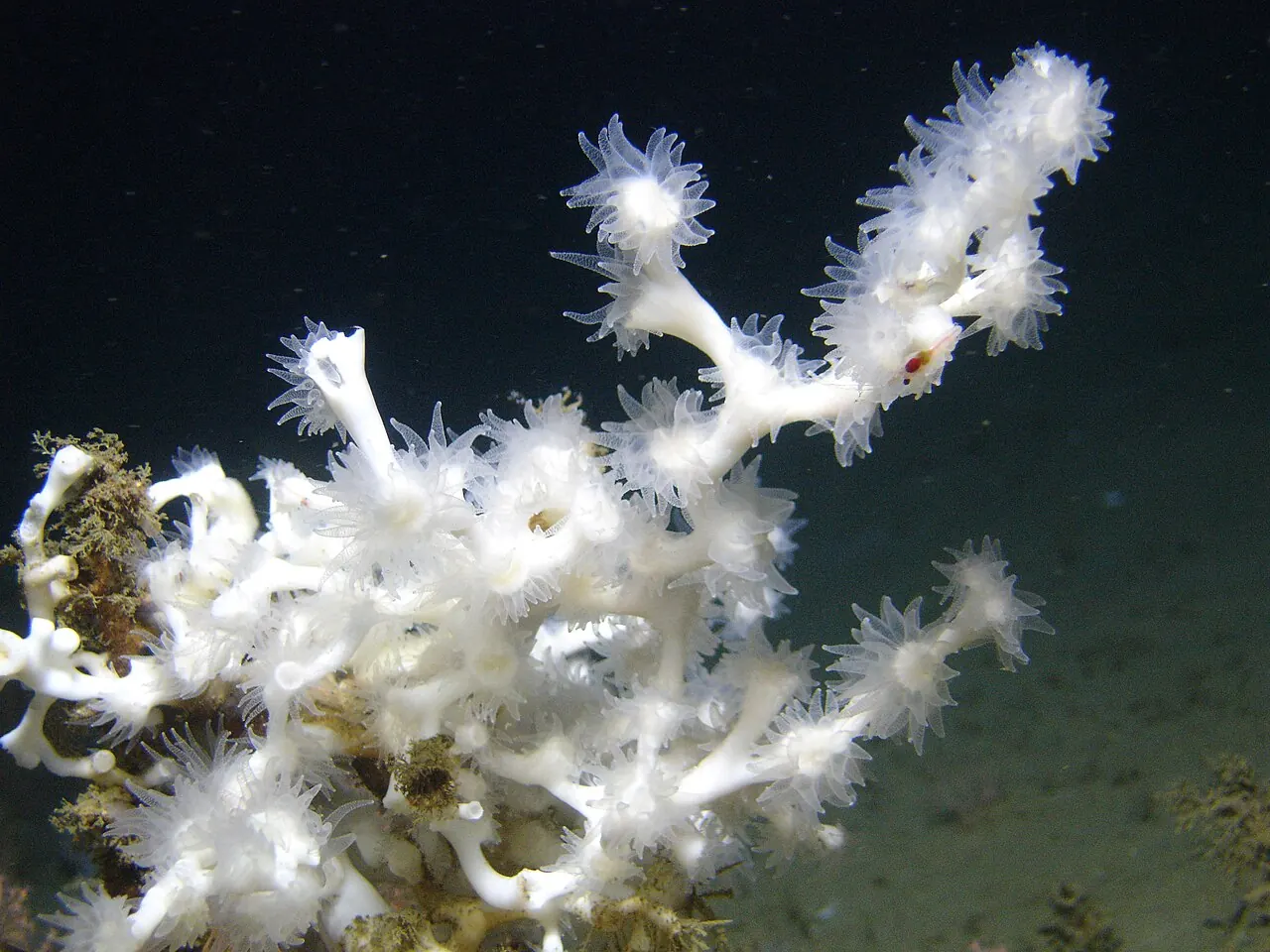
Photo: NOAA Ocean Explorer / CC BY-SA 2.0
3 things to know
- Its reefs grow in darkness, most commonly 200 to 1,000 m (656 to 3,280 ft) down.
- Mapping published in 2024 found 83,908 coral mound peaks on the Blake Plateau off the US Southeast.
- Its larvae swam for weeks in lab tests and survived eight weeks.
- Scientific name
- Desmophyllum pertusum (formerly Lophelia pertusa)
- Depth
- 200 m – 1,000 m
656 – 3,281 ft - Size
- Branching colonies that merge into reefs; one colony from Norway's Røst Reef was 80 cm (31 in) long
- Weight
- Unknown
- Lifespan
- Unknown for single colonies; reef growth on the Scandinavian shelf began about 11,650 years ago
- Diet
- Small particles and plankton filtered from the passing water
- Where
- Atlantic Ocean and Mediterranean Sea, from Norway, Iceland and Greenland to Brazil, Argentina and West Africa, including US waters
- IUCN status
- Vulnerable
- Depth zones
- Twilight
White branches tipped with see-through polyps, growing where no sunlight reaches: Desmophyllum pertusum is the most common reef-building coral of the cold, deep sea. Many people still call it Lophelia pertusa, the name the World Register of Marine Species now lists as superseded. It has no algae in its tissues, so, as NOAA Ocean Exploration notes, its white color is healthy and it cannot bleach. The polyps catch small particles drifting past. It grows most commonly 200 to 1,000 meters (656 to 3,280 feet) down, in water averaging about 4°C (39°F), and has been recorded from 50 meters in Norwegian fjords to 3,600 meters on the Mid-Atlantic Ridge.
NOAA calls the Blake Plateau, about 100 miles offshore between Miami and Charleston, the largest deep-sea coral reef habitat discovered to date: 6.4 million acres of coral mounds, made up mostly of this species. In a 2024 paper led by Derek Sowers of the Ocean Exploration Trust, researchers combined 31 sonar mapping surveys of the plateau and counted 83,908 coral mound peaks; the biggest section is nicknamed Million Mounds. On the Scandinavian shelf, mostly free of ice by about 15,000 years ago, coral growth began only around 11,650 years ago, a 2012 dating study found.
Growth is slow. Dating the youngest part of an 80-centimeter colony from Norway's Røst Reef with lead-210, Sabatier and colleagues estimated about 8 millimeters (a third of an inch) a year, a figure they called uncertain. Reproduction is seasonal: Waller and Tyler found that it produces a single batch of around 3,000 eggs. In 2014 Larsson and colleagues described its larvae for the first time. They swam upward at half a millimeter a second, began probing the bottom after three to five weeks and survived eight weeks in the lab, long enough to drift far. The coral has even settled on North Sea oil and gas platforms, at 22 of 28 Norwegian installations reviewed in a 2026 study.
Bottom trawling has done visible damage. Fosså and colleagues estimated in 2002 that 30 to 50 percent of the reef areas off Norway had been damaged or affected by fishing. The IUCN assessed the species as Vulnerable worldwide in 2023 and, in a separate 2014 regional assessment, as Endangered in the Mediterranean.
Sources
- marinespecies.org/aphia.php
- oceanexplorer.noaa.gov/news/oer-updates/2024/million-mounds-news.html
- sealifebase.se/summary/Lophelia-pertusa.html
- Study: doi:10.1371/journal.pone.0102222
- Study: doi:10.1007/s00338-005-0501-7
- Study: doi:10.5194/bg-9-1253-2012
- Study: doi:10.1016/j.quascirev.2011.12.005
- Study: doi:10.1023/a:1016504430684
- Study: doi:10.1007/s12526-026-01647-z
- iucnredlist.org/species/195215/166021306
- iucnredlist.org/species/195215/51215350